Closing a Project Without Losing the Learning: A Practical Guide to Handover and Knowledge Capture
Most teams sprint to close-out focused on compliance. Here's how to capture the knowledge that actually matters before the team walks out the door.
There is a particular kind of institutional amnesia that hits organizations right when it shouldn't: at the end of a project. The team has spent months, sometimes years, solving problems no one anticipated, building relationships that won't appear in any report, and learning what actually works in this context with these communities. Then the final report deadline arrives, the compliance checklist comes out, and everyone scatters. That hard-won knowledge? Gone.
I see this pattern constantly in humanitarian and development work. Project closure, as one research article on humanitarian contexts puts it, is "a core feature of humanitarian action" [Hunt et al., 2020], and yet it remains one of the least systematically managed moments in the project lifecycle. The irony is that the closing phase is precisely the moment when structured knowledge capture pays the highest return. You have the whole team together, implementation is fresh in memory, and there is still time to do something with what you learned.
Here is how I'd approach it.
Why Close-Out Learning Gets Skipped
The mechanics of project closure are well understood. According to productive.io's project management guide, proper closure means "securing acceptance, reconciling finances, archiving documentation, and completing knowledge transfer" [1]. The University of Massachusetts Boston's project management office adds that closing activities must include "identification and capture of lessons learned and best practices, and archival of these organizational process assets for subsequent reference, organizational learning and reuse" [2].
That's the theory. In practice, the lessons learned session gets bumped because the final report is due, or it happens but produces a list of vague platitudes that nobody reads. The problem is not that teams don't know they should capture learning. The problem is they don't have a lightweight enough process to make it worth doing under time pressure.
⚠️ Warning: Scheduling a lessons learned meeting at the very end, after the final report is submitted, almost guarantees poor attendance and shallow reflection. Team members have already moved on mentally and sometimes physically.
Start Capturing Before You Close
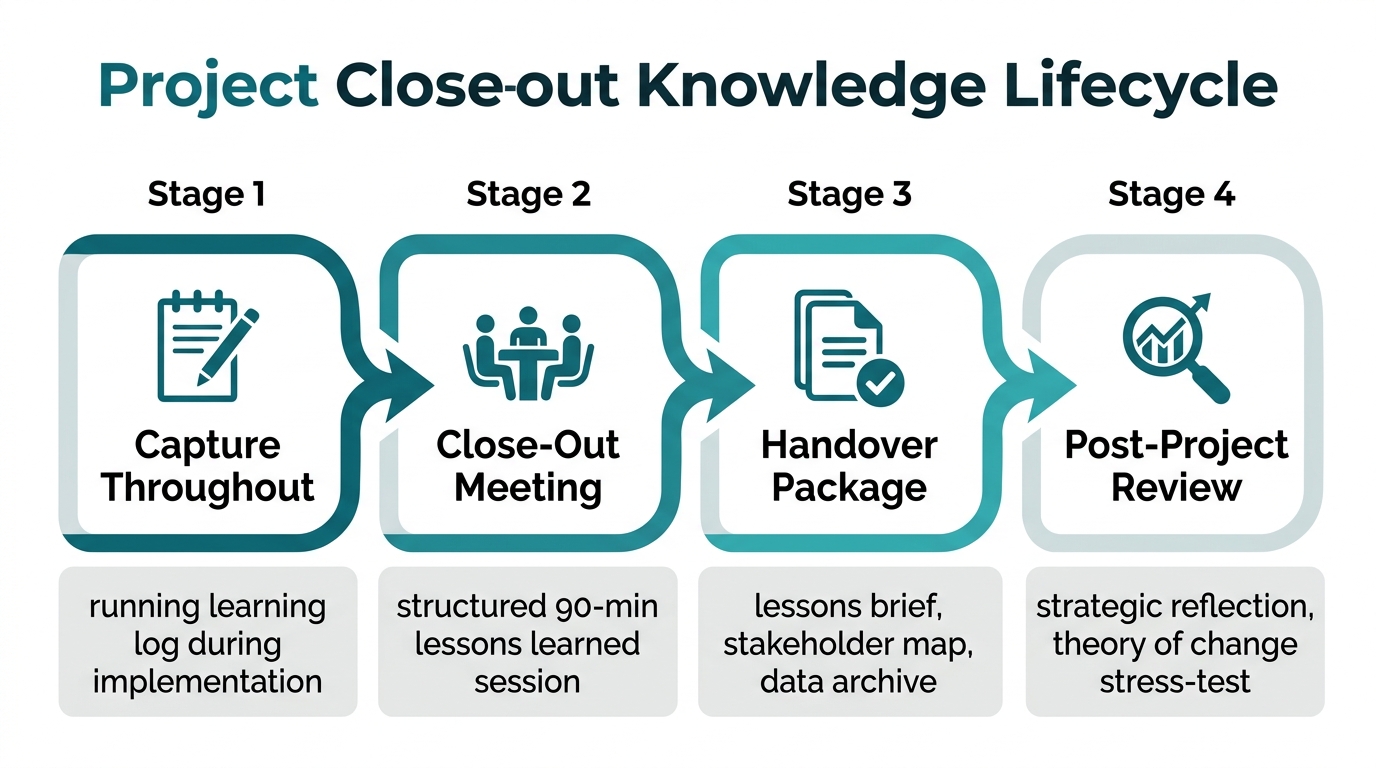
The best close-out documentation is built incrementally, not assembled in a panic during the final week. A project closure guide hosted on Scribd emphasizes capturing lessons throughout the project, not just at the end [3]. I'd recommend keeping a running "learning log" from the midpoint of implementation onward: a shared document where anyone on the team can drop a quick note when something surprising happens, a partnership delivers unexpected results, or an approach fails and you pivot.
By the time close-out arrives, you are curating and structuring notes that already exist, rather than asking exhausted people to reconstruct six months of experience from memory.
💡 Tip: A single shared Google Doc or Teams channel with the prompt "What surprised you this week?" works fine. You don't need specialized software. The discipline matters more than the tool.
The Close-Out Meeting That Actually Works
The UMass Boston guidance recommends that the project manager schedule and facilitate a Project Closure Meeting with the project sponsor, project owner, and the entire project team [2]. That's right. But the agenda design is what determines whether you get useful output or a box-ticking exercise.
Here is the structure I'd suggest:
- Before the meeting: Circulate three questions 48 hours in advance. Ask each participant to come with written answers. This ensures reflective thinking happens before the room pressure kicks in.
- In the meeting (90 minutes max): Open with a structured "what went well / what we'd do differently / what we wish we'd known at the start" round. Collate themes, not individual opinions.
- Prioritize ruthlessly: Not every lesson is equally useful. The iseoblue project management guide recommends that teams "prioritise the lessons and decide how to implement lessons in future projects" [4]. A lesson is only valuable if someone can act on it. Filter for the ones that would change behavior in a future project.
The three questions I'd circulate in advance:
- What is one thing we learned about implementation in this context that isn't written anywhere?
- What assumption did we start with that turned out to be wrong?
- If a new team started this project tomorrow, what is the single most important thing to tell them?
📝 Note: For humanitarian programs, this question set is especially useful because contextual knowledge (community dynamics, local authority relationships, informal gatekeepers) is exactly the kind of thing that never makes it into donor reports but determines whether the next team succeeds or fails.
The Knowledge Transfer Package
Lessons learned sessions are necessary but not sufficient. Whoever receives this work, whether that is a follow-on project team, a government counterpart, or an organizational archive, needs a structured handover package. Based on established close-out practice [1][2], here is what that package should include:
| Component | What It Contains | Who Needs It |
|---|---|---|
| Final project report | Deliverables, outcomes, budget reconciliation | Donor, senior management |
| Lessons learned document | Prioritized operational insights, what to replicate or avoid | Next project team, M&E unit |
| Stakeholder map with notes | Key contacts, relationship quality, informal dynamics | Handover counterpart |
| Risk and issue log | What risks materialized, how they were mitigated | Program design team |
| Data and document archive | All monitoring data, field records, key correspondence | M&E and institutional memory |
| Signed closure checklist | Formal acceptance from sponsor/client | Finance, compliance |
The LinkedIn guidance on project closure communication is clear that "focusing on documentation, deliverables, and lessons learned ensures a smooth handoff and future success" [5]. The table above is the minimum viable version of that.
The Post-Project Review: A Separate, Slower Conversation
There is a difference between the close-out meeting (done with the team before dispersal, focused on operational learning) and a post-project review (done weeks later, once implementation dust has settled, focused on strategic and organizational learning).
The iseoblue guide frames the post-project review as the moment to "validate project outcomes, gather feedback from stakeholders, and ensure alignment on the project's impact and final outcomes" [4]. This is where you step back from "what went wrong with the procurement process" and ask "did this project actually achieve what we thought it would achieve?"
In MEL terms, this is where your theory of change gets stress-tested by reality. I find it useful to do this conversation explicitly with the original logframe in hand. Which assumptions held? Which pathways played out differently than expected? That analysis directly feeds the design of the next project.
Make the Learning Usable
The graveyard of humanitarian and development work is full of lessons learned documents that were filed, never read, and never acted on. The iseoblue guide asks the right question here: "Is it just for you, as a project manager, or is it for the improvement of the organisation?" [4]
To make learning actually usable:
- Keep the lessons document to two pages maximum. If it's longer than that, nobody reads it.
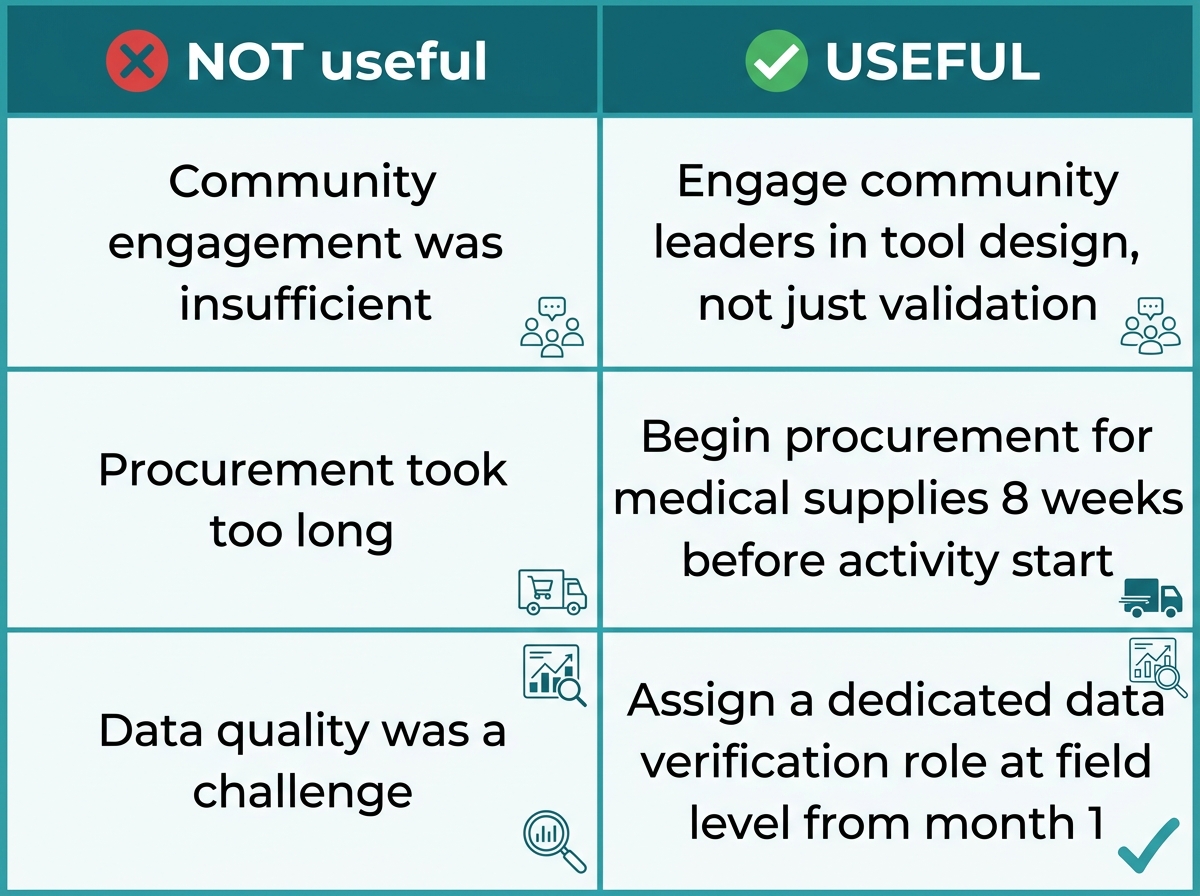
- Write lessons as actionable recommendations, not retrospective complaints. "Engage community leaders in tool design, not just validation" is useful. "Community engagement was insufficient" is not.
- Tag lessons by theme (partnerships, data collection, staffing, security) so future teams can search for relevant insights.
- Present findings to someone who will commission future projects. Learning that never reaches decision-makers changes nothing.
If you're working on a close-out process and want help turning your lessons learned notes into a structured two-page brief, a handover package template, or a post-project review agenda, that's exactly the kind of thing I can help you build at vera.ignex.io.
Close Well, Not Just Cleanly
Compliance close-out and knowledge close-out are not the same thing, and treating them as identical is how organizations keep relearning the same lessons on every project cycle. The final report satisfies the donor. The structured knowledge transfer satisfies the organization, the next team, and ultimately the communities who need programs that actually improve over time.
The investment is modest: a well-designed 90-minute meeting, a two-page lessons document, and a basic handover package. The return is that the next team doesn't start from zero. In contexts where team turnover is high and institutional memory is fragile, that is not a small thing.
Close-out is the last thing on a project and the first investment in the next one. Treat it accordingly.
Sources
- What Is Project Closure: Guide, Steps, Best Practices, Tools — productive.io
- Project Closing Phase — UMass Boston Project Management Office
- Project Closure and Lessons Learned Guide — Scribd
- Closing a Project: Handovers, Lessons Learned and Benefits — iseoblue
- Project Closure Communication — LinkedIn
- Closing well: national and international humanitarian workers — Hunt et al., 2020, Conflict and Health
Put this into practice with Vera
Build logframes, indicators, surveys and reports in minutes — with an AI made for MEL.
Try Vera free →