FGD vs. KII: How to Choose the Right Qualitative Method (and Stop Wasting Field Time)
A practical MEL guide to picking the right qualitative tool, designing it well, and making your field time count
One of the questions I get asked most often when helping teams design evaluation or assessment tools is some version of: "Should we do FGDs or KIIs for this?" And my honest answer is almost always the same: it depends on what you are actually trying to learn, and from whom.
That sounds obvious. But in practice, I see organizations default to one method out of habit, or mix them up in their data collection plans without a clear rationale. The result is either data you can not really use, or field time burned collecting the same insight twice. So let me walk through how I think about this choice.
What Each Method Is Actually For
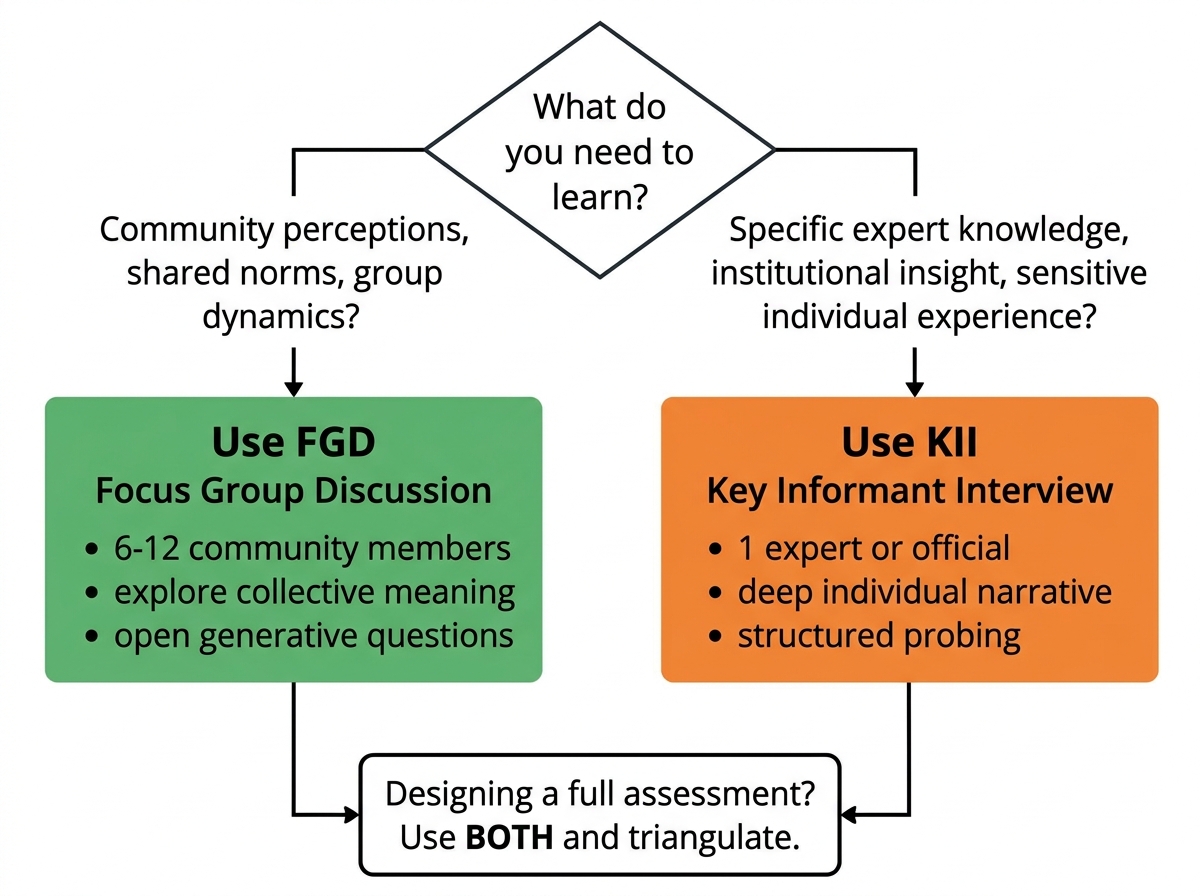
At the most fundamental level, these two methods serve different purposes, even though both are qualitative and both involve talking to people.
Focus Group Discussions (FGDs) bring together a small group, typically 6 to 12 participants, to explore shared experiences, community norms, perceptions, or group dynamics [1]. The value of an FGD is not just what any individual says: it is the interaction between participants. When one person's comment sparks a reaction, a debate, or a correction from someone else in the room, you are learning something about how a community collectively understands a topic. That is irreplaceable data you simply cannot get from individual interviews.
Key Informant Interviews (KIIs), by contrast, involve one-on-one (or occasionally one-on-two) conversations with people who hold specific knowledge, expertise, or positional insight relevant to your research question [1]. A health facility manager, a village chief, a program officer who has been implementing for three years: these are people whose individual perspective is the point. You are not looking for a group dynamic. You are mining expertise, lived authority, or institutional memory.
💡 Tip: A quick diagnostic: ask yourself whether the interaction between respondents would add value to your data. If yes, FGD. If the interaction would actually suppress candid responses (power dynamics, social desirability bias), KII.
The Core Decision Framework
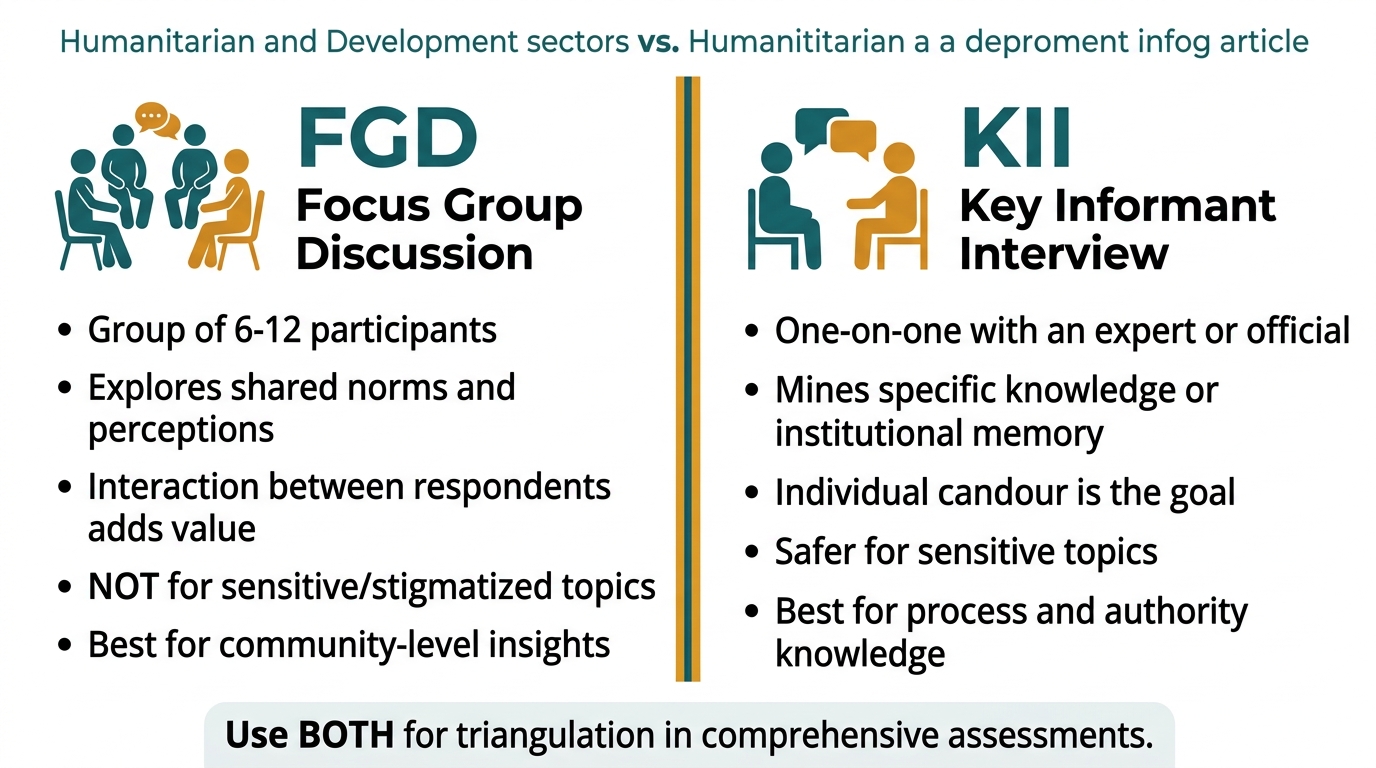
Here is how I frame the choice across the dimensions that matter most in humanitarian and development MEL work:
| Dimension | FGD | KII |
|---|---|---|
| Best for | Shared perceptions, norms, community attitudes | Expert/institutional knowledge, sensitive individual experiences |
| Group size | 6-12 participants | 1 respondent (occasionally 2) |
| Data type | Collective meaning-making, group consensus or disagreement | Deep individual insight, process knowledge |
| Power dynamics | Risk: vocal participants dominate; hierarchy silences others | Risk: interviewer bias; respondent tells you what you want to hear |
| Time per session | 90-120 minutes typically | 45-90 minutes typically |
| Typical respondents | Community members, beneficiaries, peer groups | Program managers, officials, technical specialists, community leaders |
| When NOT to use | Sensitive/stigmatized topics where group setting is unsafe | When you need community consensus or group-level norms |
[1][2]
⚠️ Warning: Never use an FGD to explore topics like gender-based violence, HIV status, or household income in mixed community groups. The group setting creates real harm risk and suppresses honest responses. KII with trained interviewers is far safer for sensitive topics.
Designing Each Method Well
Choosing the right method is only half the battle. Poorly designed guides waste the advantage you gained by choosing correctly.
Designing Your FGD Guide
A strong FGD guide is not a survey in disguise. It should have a small number of open, generative questions (typically 5 to 8 focal questions) that give the group room to take the discussion somewhere you did not anticipate [3]. Start broad and get more specific. Build in probes, but hold them lightly: your job as a facilitator is to follow the energy of the group, not march through a script.
Every FGD session should open with a clear, standardized script that covers: who you are, why you are here, what participants can expect, how the information will be used, and a genuine informed consent process [3]. Confidentiality assurances matter especially in community settings where people know each other.
Venue selection is not a logistical afterthought. The TCI Urban Health qualitative guidance is explicit on this: the space should be accessible to respondents, ensure privacy, be free from distractions, and be large enough for the group to sit comfortably [3]. A cramped, noisy, or public space will undermine everything you worked to design.
📝 Note: Assign a dedicated note-taker separate from the facilitator. The facilitator cannot manage group dynamics and capture nuance at the same time. If you record (with consent), still take notes: recordings fail, and notes capture non-verbal cues recordings miss.
Designing Your KII Guide
A KII guide is more structured than an FGD guide, but still open-ended. You are directing the conversation toward specific knowledge domains, but you want the respondent to narrate, not just answer yes/no. Use probing questions heavily: "Can you walk me through what happened?", "What did that look like in practice?", "Who else was involved?"
Build rapport early. KII respondents, especially senior officials or technical experts, will give you much richer data if they trust the interviewer and understand why their perspective specifically matters [2]. Explain what makes them a key informant: it signals respect and helps them orient their answers usefully.
💡 Tip: End every KII with a referral question: "Is there anyone else you think I should speak with about this?" Key informants often know whose door you should knock on next, and that kind of purposive sampling chain is a legitimate and powerful qualitative strategy.
Using Both Together (and Doing It Intentionally)
In most comprehensive assessments, needs analyses, or program evaluations, you will use both methods. The question is not just which one but how they complement each other in your sampling strategy.
A well-designed qualitative data collection plan might use KIIs with program staff, health officials, and community leaders to understand institutional context and process, then use FGDs with beneficiary groups to explore community-level perceptions and experiences [4]. The two datasets triangulate each other: where they converge, you have robust findings; where they diverge, you have something interesting worth investigating further.
📝 Note: Different stakeholder groups in a study may need different methods. A research design guide from ResearchGate illustrates this clearly: the same study may target facility managers for KIIs while targeting community women's groups for FGDs, with the participant categories mapped explicitly against each method [4].
The Field-Time Argument
Here is what I find is often missing from methodological discussions: the opportunity cost of getting this wrong is real. Running FGDs when you needed KIIs means you have group-level data that cannot answer your specific institutional question. Running KIIs when you needed FGDs means you have 12 individual transcripts that all say roughly the same thing, when one well-facilitated FGD would have given you the same insight (plus the dynamic between perspectives) in a fraction of the time.
Before finalizing your data collection plan, I always recommend asking three questions:
- Who specifically holds the knowledge or experience I need?
- Does the group interaction between respondents add analytical value, or does it introduce noise or bias?
- What will I actually do with this data: what analysis, what audience, what decision does it feed?
If you answer those honestly, the method choice usually becomes obvious.
If you are designing a qualitative data collection plan and want help building out FGD guides, KII protocols, or a full sampling matrix that maps methods to stakeholder groups, that is exactly the kind of work I do at vera.ignex.io. You can also browse real example outputs at vera.ignex.io/examples to see what a ready-to-use instrument actually looks like before you commit.
Getting the method right before you go to the field is one of the highest-leverage decisions in any qualitative study. I hope this helps you make it with more confidence.
Follow Vera for more on MEL & project management: LinkedIn · Instagram · Facebook · X
Sources
Put this into practice with Vera
Build logframes, indicators, surveys and reports in minutes — with an AI made for MEL.
Try Vera free →