From Paper to Phone: How Mobile Data Collection Transformed M&E (2015-2024)
A decade of adoption, hard lessons, and what it means for monitoring and evaluation teams today
Think back to what field data collection looked like in 2015. A stack of paper forms, a data entry clerk squinting at handwriting, a two-week lag before anyone in the capital office had a clue what was happening in the field. That was the norm, not the exception, for most humanitarian and development organizations.
A decade later, the picture looks completely different. And while the shift happened gradually, the cumulative effect has been transformative for how M&E actually works on the ground.
Why Mobile Collection Took Hold So Quickly
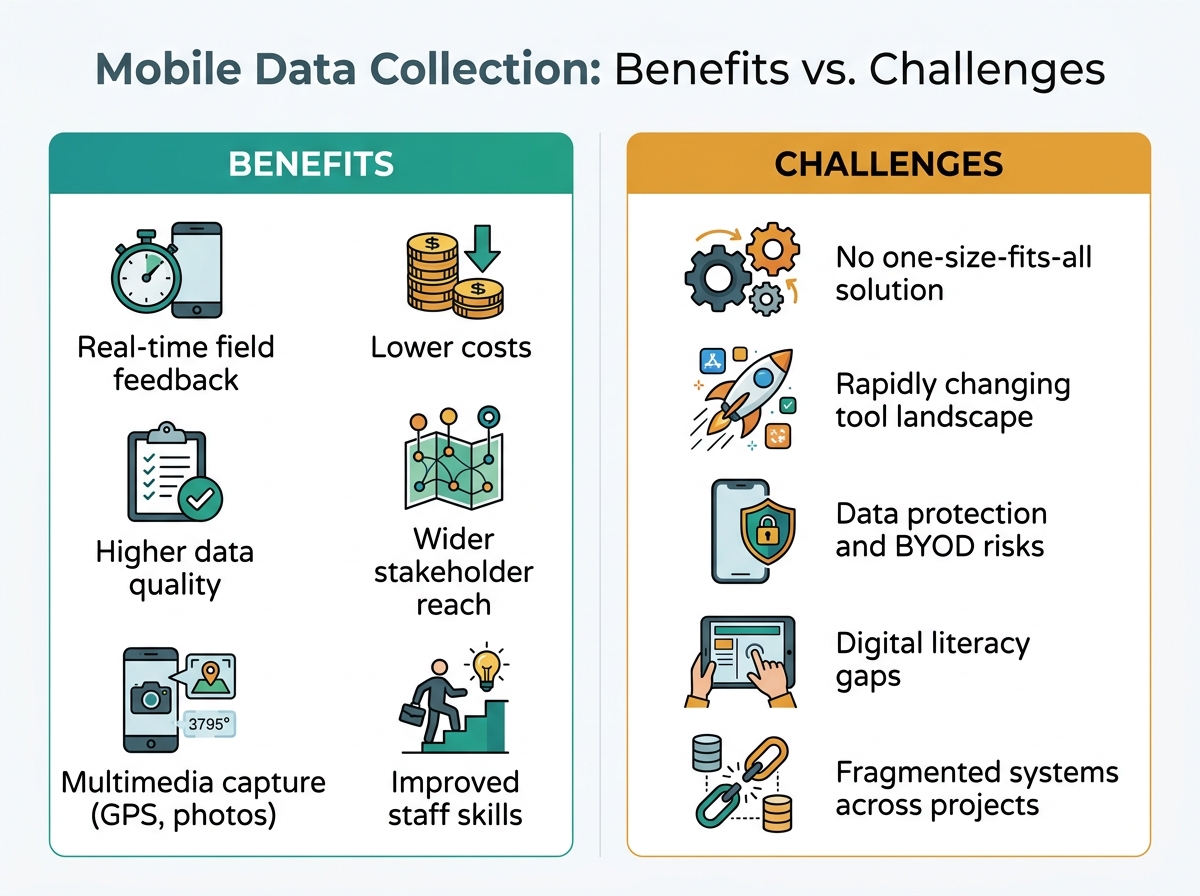
The pull factors were obvious from the start. As the Aptivate briefing on mobile data collection in M&E lays out, the benefits are hard to argue with: higher-quality and more complete data, the ability to reach a wider range and number of stakeholders, multimedia capture (photos, GPS coordinates, audio), and nearly real-time feedback from the field [Aptivate]. For anyone who had ever managed a paper-based monitoring system, "nearly real-time" was not a minor improvement. It was a revelation.
At the same time, smartphones and tablets were becoming accessible enough to deploy at scale. Nelson Bamwine's widely shared piece on LinkedIn captures the mood of the mid-2010s well: the new age of smartphones and ICT had unlocked mobile-based data collection as a real operational option, not just a pilot toy [Bamwine]. Platforms like KoboToolbox and ODK made XLSForm design something a non-developer could actually do. The barrier dropped fast.
💡 Tip: If your team is still debating whether to move to mobile collection, the question has largely been answered by the sector. The more useful question now is which tool fits your context and how to implement it ethically and sustainably.
By the late 2010s, adoption had moved well beyond early adopters. The ICTworks piece summarizing lessons from five years of mobile data collection rollout notes that "in the last decade, mobile data collection has been used more and more by humanitarian and development organizations for situation analyses, project monitoring, follow-up of activities and vulnerable populations" and that some NGOs were already planning for all of their quantitative data collections to be carried out on mobile devices [ICTworks]. That is a significant statement. We went from cautious pilots to organizational-wide commitments within about five years.
What the Adoption Curve Actually Looked Like
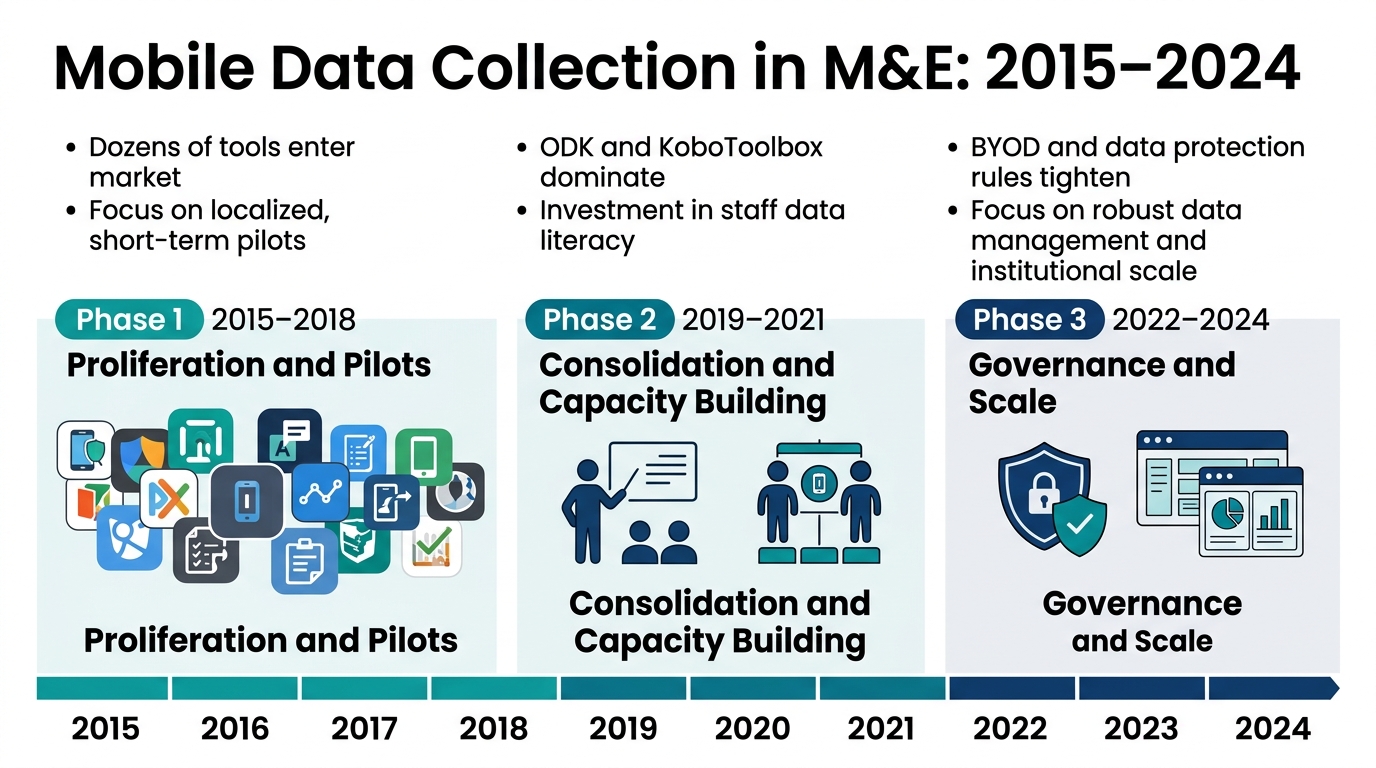
It is tempting to describe adoption as a smooth upward line, but that misses the texture of what happened. The early period (roughly 2015 to 2018) was characterized by enthusiasm and proliferation. Dozens of tools flooded the market, and teams were experimenting freely. The Aptivate briefing flags this clearly: "the mobile device sector is highly competitive and rapidly changing, and new mobile applications constantly coming onto the market, and the plethora of ICT tools available is daunting" [Aptivate].
That plethora caused real problems. Organizations adopted tools project-by-project, ending up with fragmented systems that could not talk to each other. Training was inconsistent. Data quality varied. The lesson learned from this period, documented in detail in the ICTworks scaling guide, is that there is no singular solution that fits 100% of a project's needs [ICTworks]. Organizations that tried to find the perfect universal tool wasted years. The smarter ones picked a platform, invested in building internal capacity around it, and adapted.
From roughly 2019 onwards, the question shifted. The ICTworks piece puts it plainly: "very few people in the sector doubt the relevance of mobile data collection for many different kinds of uses. The main challenges concern more the question of how to implement these tools in the most effective and ethical way" [ICTworks]. Adoption was no longer the debate. Implementation quality was.
The Research Side: A Parallel (and Slower) Story
It is worth separating field monitoring adoption from research-grade data collection, because the trajectories are different. A 2021 scoping review published in JMIR Public Health found that despite the huge number of health apps on the global market and the obvious potential, app-based questionnaires for collecting patient-related data had "not played an important role in epidemiological studies" and that only a few studies had integrated smartphone apps into longitudinal data-collection approaches [PMC/JMIR].
This gap between operational M&E adoption and academic/research adoption is instructive. Operational teams moved fast because the efficiency gains were immediate and visible. Research teams moved slower because the validity and reliability standards are more stringent, and because longitudinal studies require tool stability over years, which is hard to guarantee in a rapidly changing app market.
The Aptivate briefing does note that mobile data collection "can help to meet five standards of validity, integrity, precision, reliability and timeliness" [Aptivate] when implemented well. The keyword is "when implemented well." That is the part that takes deliberate effort.
The Compliance and Governance Dimension
By the early 2020s, a new complexity entered the picture. As more organizational data moved to personal devices and messaging apps, the governance questions became harder to ignore. Risk Management Magazine's 2024 analysis of mobile data collection challenges highlights that organizations are now responsible for all company data on personal devices, including under BYOD policies, and that "increasing regulatory requirements, the rapid adoption of mobile messaging by employees, and the growing list of chat applications and related data types means companies are responsible for collecting and storing unprecedented amounts of data from personal devices" [RMM].
For M&E teams, this translates into questions that were barely on the radar in 2015: Where is collected data stored? Who has access to it? What happens when a field enumerator's personal phone is lost or stolen? How do we handle the data of vulnerable populations under evolving data protection frameworks?
⚠️ Warning: Data protection is not just an IT problem. If your M&E team is collecting data on beneficiaries via mobile devices, you need clear protocols around consent, storage, and deletion. This is now a standard part of ethical data collection practice.
Where We Are Now, and What It Means for Your Team
By 2024, mobile data collection is not a trend in M&E. It is the baseline. The questions that matter now are operational and ethical: How do you build staff capacity that outlasts any individual project? How do you choose a tool that can scale across your organization without a prohibitive investment in time and resources [ICTworks]? How do you protect the data of the people you serve?
The efficiency gains are real and documented. Reduced time and costs, improved staff skills, more open and accessible data, early insights from the field rather than lagged reports [Aptivate]. These are not hypothetical benefits. Teams that have made the investment are seeing them.
But the shift also demands more of M&E professionals, not less. Knowing how to design a good XLSForm, manage data flows responsibly, interpret real-time dashboards, and train field staff who may have varying levels of digital literacy: these are now core competencies, not nice-to-haves.
📝 Note: Mobile data collection amplifies both good and bad M&E design. A poorly designed paper form becomes a poorly designed digital form. The technology does not fix weak indicator logic or vague data-collection questions. Get the fundamentals right first.
If you are working through any of this, whether designing a new mobile monitoring system, converting existing paper tools to XLSForm, or just trying to figure out which platform fits your context, that is exactly the kind of work I help teams with. Come find me at vera.ignex.io and we can work through it together.
The decade from 2015 to 2024 proved that mobile data collection works. The next decade will be about doing it well.
Sources
- The Challenges of Mobile Data Collection – Risk Management Magazine
- Mobile Data Collection for M&E – Briefing Paper – Aptivate
- Mobile Phone Based Data Collection for M&E and Evidence Based Decision Making – LinkedIn / Nelson Bamwine
- 10 Lessons Learned in Scaling Mobile Data Collection Processes – ICTworks
- Possibilities, Problems, and Perspectives of Data Collection by Mobile Apps in Longitudinal Epidemiological Studies: Scoping Review – PMC/JMIR
- Evaluating a Mobile Data-Collection System for Production Information in SMEs – ResearchGate
Put this into practice with Vera
Build logframes, indicators, surveys and reports in minutes — with an AI made for MEL.
Try Vera free →