How to Design a Proposal That Actually Gets Funded
A practical guide to writing grant proposals that persuade, convince, and win
If there is one thing I hear constantly from program managers, M&E officers, and project leads, it is this: "We had a great idea, but we didn't get funded." And almost every time I dig into the proposal, the problem is not the idea. The problem is how the idea was packaged, positioned, and presented to the funder.
Writing a proposal that gets funded is not just about having a worthy project. It is about telling a clear, credible story that aligns with what the funder actually cares about, and backing that story with evidence, a solid plan, and realistic numbers. Let me walk you through how to approach this.
Start With the Funder, Not the Project
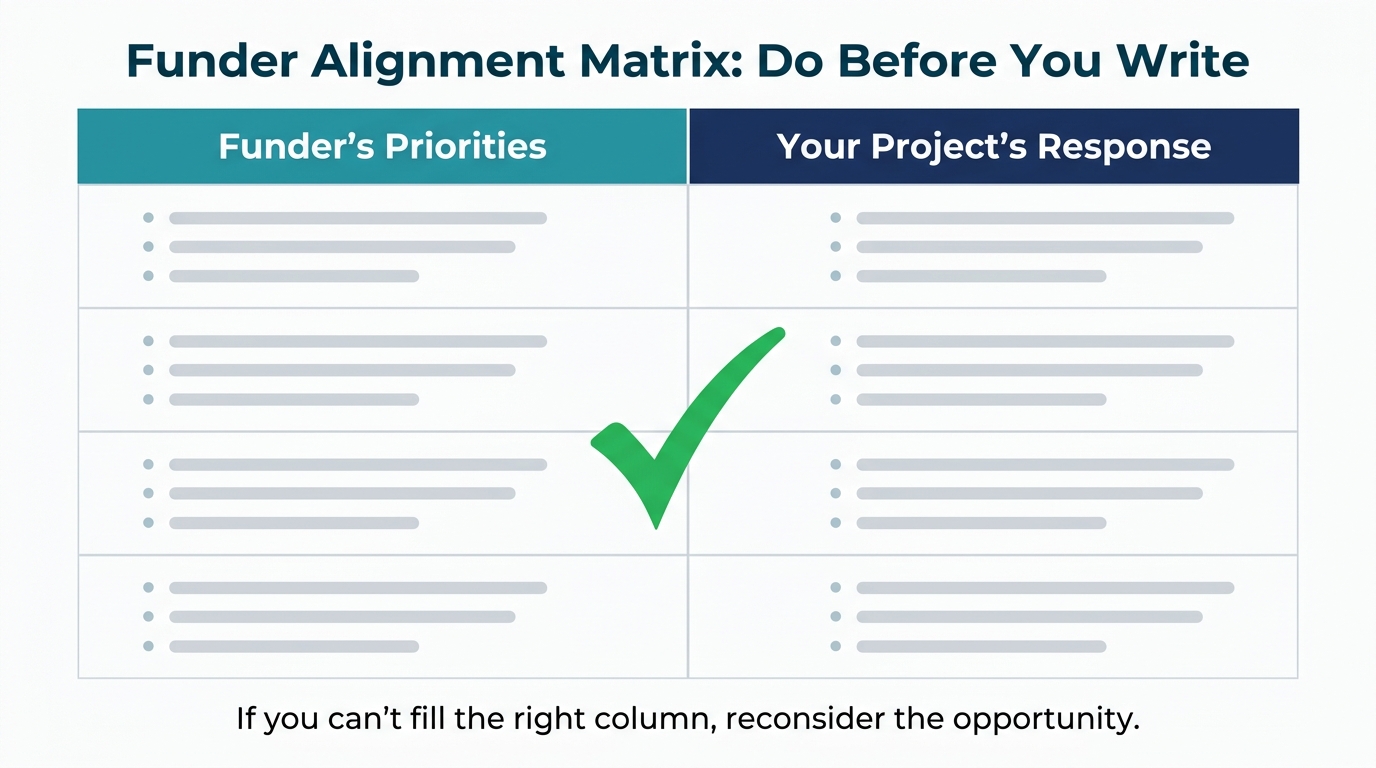
This is the single most common mistake I see: organizations begin proposal writing from the inside out, leading with their own priorities and then trying to fit the funder's requirements around them afterward.
Flip that process. Before you write a single sentence, ask yourself: does this project align with what this funder wants to support? As The Grant Plant reminds us, "no matter how great your project is, if it doesn't match what the funder wants to support, it's going to be a tough sell" [1]. Funders want to see the "why" and "how" behind your approach, not just a checklist of tasks.
Read the Request for Proposal (RFP) carefully, more than once. Take notes on the funder's stated priorities, their language, and their theory of change. Then build your narrative using their vocabulary and framing, while staying true to your mission.
💡 Tip: Create a simple alignment matrix before drafting anything. List the funder's stated priorities in one column and your project's corresponding elements in another. If you can not fill in the second column for most rows, reconsider whether this is the right funding opportunity.
Know Your Project Inside and Out
A grant proposal is, at its core, a request to trust you with money. That trust has to be earned through clarity. According to PandaDoc's grant writing guide, a successful proposal must convince funders of "the value and impact of the proposed project" and demonstrate that your organization is capable of carrying it out [2].
That means you need to have done the thinking before you start writing. Know your target population, your geographic scope, your implementation timeline, and the specific change you are trying to produce. Know your market: who else is doing similar work, and what gap does your project fill that others do not?
This pre-writing clarity is what separates proposals that feel sharp and purposeful from those that feel vague and aspirational. As the UW-Madison Writing Center puts it, a strong grant proposal demonstrates that "you have an important and fully considered plan to advance a valuable cause" and that "you are responsible and capable of realizing that plan" [3].
The Anatomy of a Strong Proposal
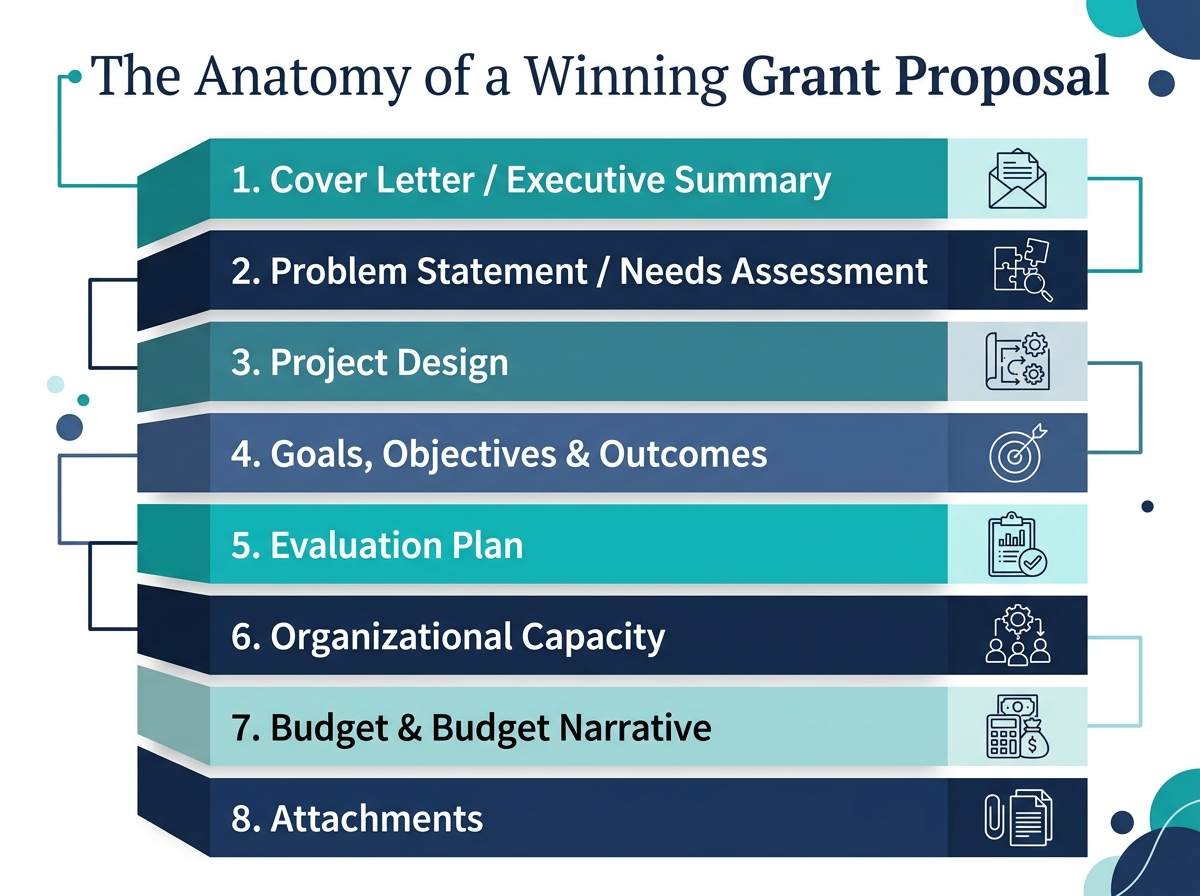
While every funder has its own formatting requirements (always follow the RFP sequence), there is a standard anatomy to a competitive grant proposal [4]:
| Section | What It Does |
|---|---|
| Cover Letter / Executive Summary | Hooks the reviewer; states the ask clearly |
| Problem Statement / Needs Assessment | Establishes urgency with data and context |
| Project Design / Program Description | Explains what you will do, how, and why |
| Goals, Objectives, and Outcomes | Defines measurable success |
| Evaluation Plan | Shows how you will track and learn |
| Organizational Capacity | Proves you can deliver |
| Budget and Budget Narrative | Makes the financial case |
| Attachments | Supports credibility (letters, CVs, data) |
📝 Note: Always follow the funder's specific RFP sequence. The anatomy above is a reference, not a rigid template.
The Problem Statement: Make Urgency Undeniable
The problem statement is where you earn the reviewer's attention. Use data (local, national, or global as appropriate) to establish the scale and nature of the problem. Quote credible sources. Connect the problem directly to the population you serve.
Avoid vague language like "many people suffer from..." Be specific: who, how many, where, and why does it matter now?
The Project Design: Your Blueprint
Think of the project design section as your blueprint, as The Grant Plant describes it [1]. Get clear on your activities, your target beneficiaries, your timeline, and the logic connecting your inputs to your intended outcomes.
This is also where your Theory of Change lives. Even if you do not call it that explicitly, you need to articulate: "If we do X with these resources, then Y will happen, because Z." Funders are investing in a causal logic, not just a list of activities.
⚠️ Warning: A common pitfall is writing a project design that is activity-heavy but outcome-light. Do not just describe what you will do; explain why it will work and what evidence supports that approach.
Goals, Objectives, and the Evaluation Plan
Your goals should be ambitious but credible. Your objectives should be SMART (Specific, Measurable, Achievable, Relevant, Time-bound). And your evaluation plan should explain precisely how you will know whether you achieved them.
This is where MEL design and proposal writing intersect directly. Funders, especially institutional donors like USAID or UN agencies, want to see a credible monitoring and evaluation framework. Weak indicators or vague data collection plans are red flags. Strong ones signal organizational maturity.
If this is an area where you want support building out your indicators or evaluation framework, this is exactly the kind of work I can help with at vera.ignex.io.
The Budget: A Financial Business Case
Here is something that surprises many first-time grant writers: the budget is not just a spreadsheet. It is a narrative argument. As Thompson Grants emphasizes, "a competitive proposal is more than a compelling narrative; it's a financial business case" [4].
Every line item should be justified in a budget narrative. Costs should be reasonable, allowable under the funder's rules, and proportional to the scope of work. Personnel costs should be tied to specific roles and percentages of effort. Indirect costs should be correctly calculated and explained.
Common budget mistakes to avoid:
- Underbudgeting to appear cost-efficient (it often raises red flags instead)
- Leaving out obvious costs like staff time for reporting
- Failing to account for cost-sharing requirements if the funder expects a match
💡 Tip: Read the funder's cost principles before building your budget. Many institutional funders, like USAID, have detailed rules about what is and is not allowable.
Organizational Capacity: Prove You Can Deliver
Funders are not just investing in an idea. They are investing in an organization. Your proposal needs to demonstrate that your team has the track record, systems, and leadership to implement successfully.
Include relevant past performance, key personnel credentials, and your financial management systems. Letters of support from partners or community leaders add credibility. As the Duckworth Senate guidance notes, a compelling proposal includes a clear picture of "the nature of the project, its goals, needs, and anticipated" outcomes alongside the organizational capacity to achieve them [5].
Final Checks Before You Submit
Before hitting submit, run through this checklist:
- Does every section respond directly to the funder's stated priorities?
- Is the problem statement grounded in current, credible data?
- Does your Theory of Change hold up logically from inputs to outcomes?
- Are your indicators SMART and trackable?
- Is your budget fully justified and compliant with funder rules?
- Have you spell-checked and proofread for formatting compliance?
- Are all required attachments included and properly labeled?
⚠️ Warning: Submitting a proposal with missing attachments or incorrect formatting is one of the fastest ways to get disqualified, even if the content is strong. Never skip the final compliance review.
The Bigger Picture
Proposal writing is a skill, and like any skill, it improves with practice, feedback, and good tools. The most successful organizations I have seen treat each proposal not just as a funding application but as a discipline: they invest time in funder research, project design, and MEL planning long before the deadline arrives.
If you are working on a proposal and want help designing your logframe, building your indicator matrix, or drafting your evaluation plan, bring it to me. That is exactly the kind of work I do every day at vera.ignex.io.
A great idea deserves a proposal that does it justice. Let's make sure yours gets there.
Sources
- Mastering Project Design for Grant Proposals – The Grant Plant, Inc.
- How to Write a Grant Proposal – PandaDoc
- Planning and Writing a Grant Proposal: The Basics – UW-Madison Writing Center
- 3 Sample Grant Proposal Templates to Help You Win Funding – Thompson Grants
- How to Develop and Write a Grant Proposal – Duckworth Senate
Put this into practice with Vera
Build logframes, indicators, surveys and reports in minutes — with an AI made for MEL.
Try Vera free →