Indicator Targets Are Not Guesses: How to Set Realistic, Evidence-Based Targets That Hold Up to Scrutiny
A practical guide to grounding your indicator targets in baselines, evidence, and logic, not optimism
One of the most awkward silences in a program design workshop happens right after someone asks: "And how did you arrive at that target?"
The honest answer, more often than I'd like, is: "We estimated." Or: "Our donor expected 80%, so we wrote 80%." Or simply: "It felt achievable."
That silence matters. It signals something important: a target that cannot be explained cannot be defended, and a target that cannot be defended will eventually undermine trust in your entire results framework. Whether you are facing a mid-term evaluation, a donor review, or just an internal reflection meeting, the question will come up. And "we guessed" is not an answer.
Here is how I think about target-setting, and how I help teams do it in a way that holds up.
Why Targets Get Treated Like Guesses in the First Place
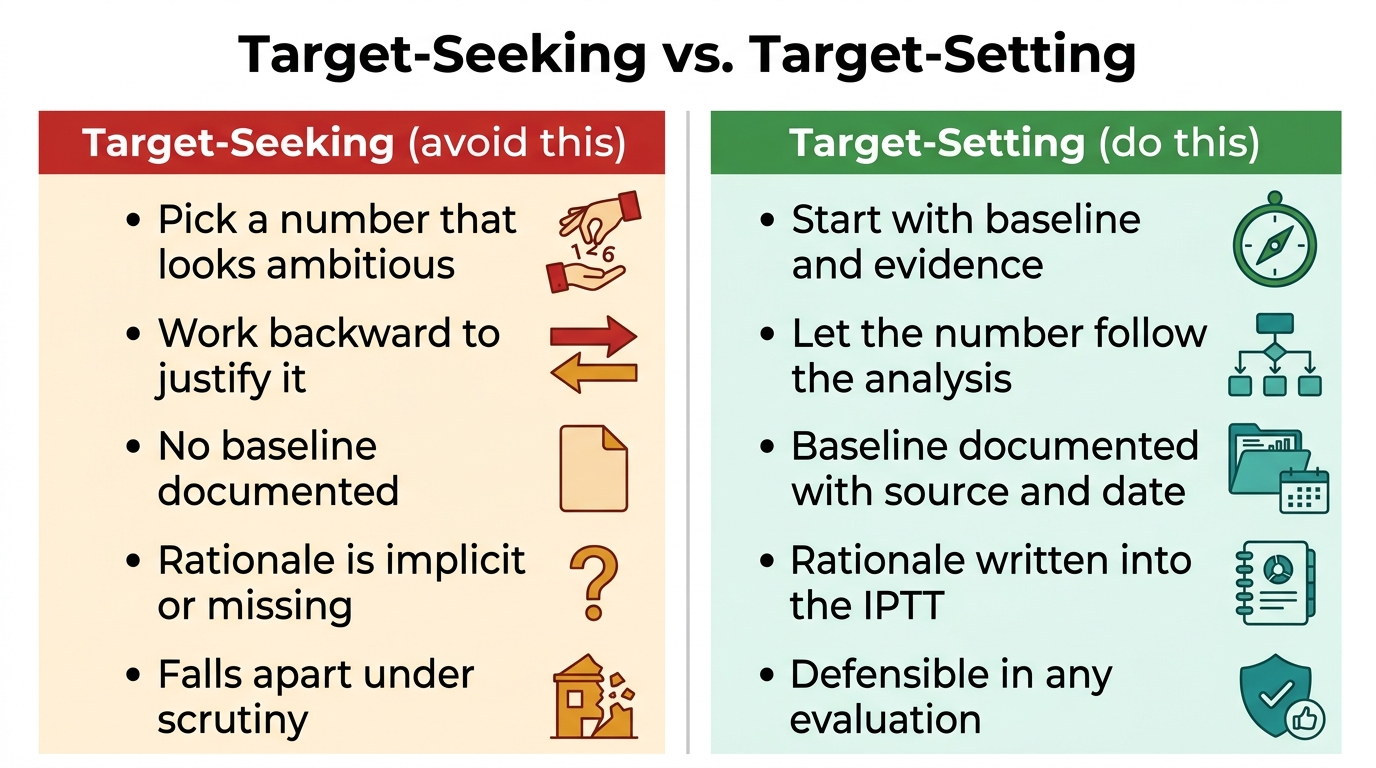
The problem starts with a confusion that Sarah Dickins captured well in her analysis of target-seeking versus target-planning [1]: many teams pick a number first (often to satisfy a donor or look ambitious) and then work backward to justify it. That is target-seeking. Real target-setting works the other way around, you start with evidence, context, and a theory of how change happens, then let the number follow.
A related trap is confusing indicators with targets. As Marc Robinson notes [4], indicators and targets play distinct roles in performance management and conflating them leads to sloppy thinking. An indicator is the measure (e.g., "% of children who are literate"). A target is the specific value you commit to achieving by a specific point in time (e.g., "65% of children literate by project month 24"). Mixing these up makes it impossible to have a real conversation about ambition versus feasibility.
⚠️ Warning: Setting a target before you have a credible baseline is one of the most common mistakes I see. Without a baseline, you have no idea whether your target represents modest progress, extraordinary change, or something that was already happening before your project started.
The Foundation: Know Where You Are Starting From
The ASA Research Target Setting Guide [3] frames it simply: effective target-setting requires knowing where you are now, what you are trying to achieve, and what realistic improvement looks like given that starting point. That sounds obvious. In practice, teams skip step one constantly.
A strong baseline does three things:
- Gives you a denominator for change (you cannot say "we improved literacy" without a pre-project literacy rate).
- Reveals the headroom available (a community already at 85% literacy has very different target space than one at 30%).
- Anchors your targets to something verifiable rather than aspirational.
Sarah Dickins [1] gives a clear example: if a community already has 50% child literacy before your project begins, a target of "more than 50%" is the bare minimum of meaningful ambition. Without the baseline, you might set 50% as your target and technically "achieve" it by doing nothing at all.
💡 Tip: If you do not yet have a formal baseline, start with secondary data: national survey data, previous project reports, government statistics, or even a rapid situational analysis. A rough but grounded estimate is far better than no reference point at all.
Building the Evidence Layer
A baseline tells you where you are. Evidence tells you what movement is realistic.
This is where too many teams stop short. They look at the baseline, pick a round number that sounds like progress, and move on. But the SMART methodology [3] asks for something more deliberate: a real investigation of what is achievable, drawing on comparable projects, local context, and the specific inputs your project will deploy.
Ask yourself:
- What do similar projects in similar contexts show about typical rates of change for this indicator over this timeframe?
- What constraints (access, cultural norms, resource gaps, staff capacity) might slow progress below what comparable projects achieved?
- What enabling factors (community buy-in, pre-existing infrastructure, political will) might accelerate it?
- What does your Theory of Change actually predict will happen, and at what pace?
This is also where stakeholder analysis earns its place in target-setting. Dickins [1] emphasizes that targets should be grounded in stakeholder or situation analysis, not just top-down assumptions. Beneficiary communities, local implementing partners, and government counterparts often know things about feasibility that headquarters does not.
📝 Note: "Challenging but realistic" is the standard phrase in the literature [3], and it is worth taking seriously in both directions. A target that is too easy is just as problematic as one that is impossible: it tells you nothing useful about whether your program worked.
A Simple Framework for Setting Defensible Targets
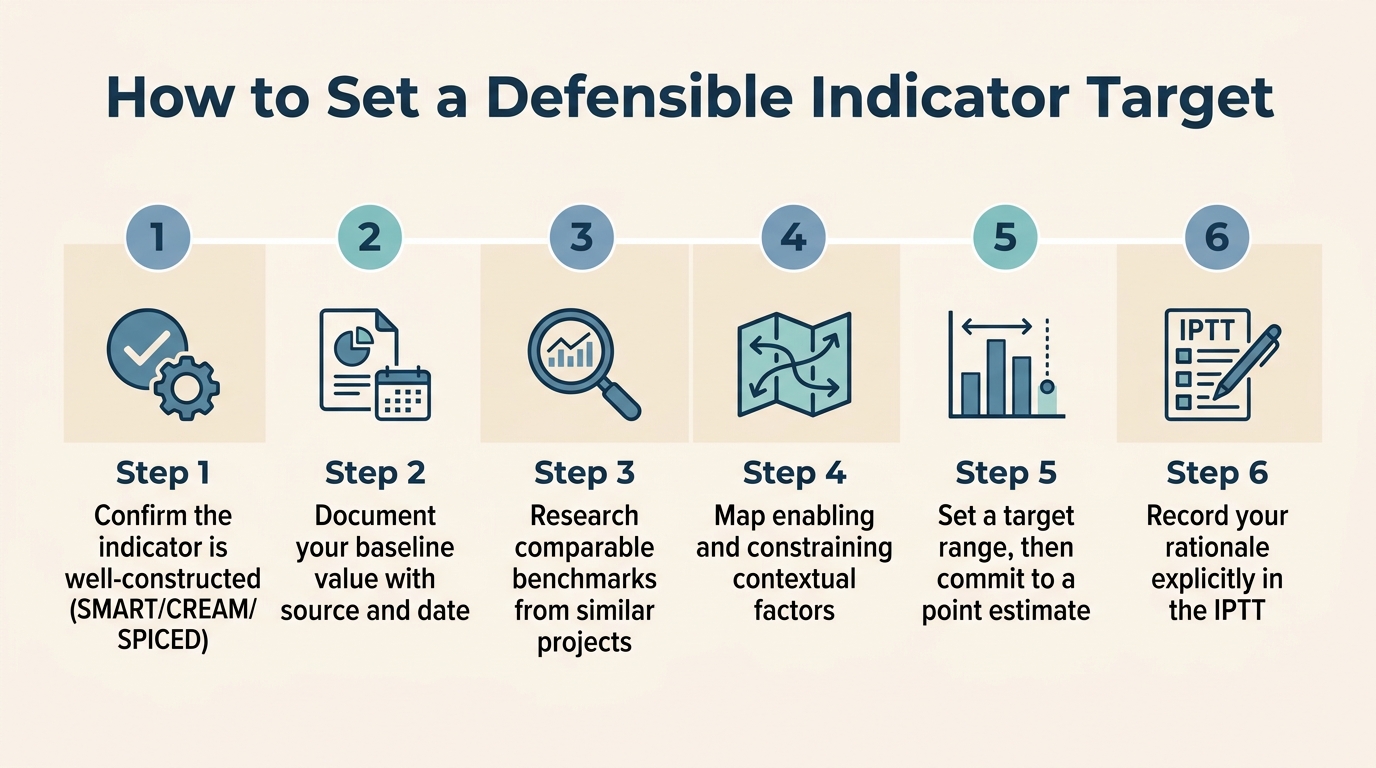
When I work through target-setting with teams, I use a structured sequence that draws on SMART methodology [3] and the baseline-anchored approach recommended by Dickins [1]:
- Confirm the indicator is well-constructed. A vague indicator produces an arbitrary target. Apply SMART, CREAM, or SPICED criteria [1] before you even think about numbers.
- Document the baseline value. State the source, date, and method. If it is estimated, say so.
- Research comparable benchmarks. What did similar projects achieve? What does sectoral evidence suggest?
- Map the enabling and constraining factors specific to your context.
- Set a target range first, then commit to a point estimate. This forces honesty about uncertainty.
- Record your rationale explicitly. Write down why this number, not just what the number is.
That last step is the one most teams skip, and it is the one that will save you in a donor meeting or evaluation. A one-sentence rationale ("based on the project baseline of 42% and evidence from comparable nutrition programs in the region showing average improvements of 12-15 percentage points over 24 months, we set a target of 55%") is infinitely more defensible than a number with no paper trail.
💡 Tip: Build your target rationale directly into your indicator reference sheet or IPTT. Do not keep it in a separate document that will get lost. The rationale and the target belong together.
What Scrutiny Actually Looks Like
When a target gets challenged in an evaluation, the questions usually come in this order:
- What was the baseline, and how was it measured?
- What evidence informed the size of the expected change?
- Was the target set before or after the project started?
- Were there any revisions to the target mid-project, and why?
A team that can answer all four questions with documentation is in a strong position, even if they fell short of the target. A team that cannot answer the first question is in trouble even if they exceeded it, because there is no way to demonstrate that the achievement was real.
The LinkedIn QA framework [5] makes a related point about quality assurance metrics: targets and thresholds should be set based on relevant data and should reflect what is both achievable and meaningful. The same logic applies across all program indicators. A target that you hit every single reporting period without fail is probably not ambitious enough. A target you never come close to probably was not evidence-based to begin with.
Putting It All Together
Target-setting is not a moment at the end of your design process where you fill in a column in a spreadsheet. It is a deliberate analytical exercise that draws on your baseline, your evidence base, your Theory of Change, and your honest understanding of context. It should take time. It should involve discussion. And it should leave a paper trail.
If you are building or revising an indicator matrix and want help thinking through target rationales, structuring your IPTT, or grounding your framework in real evidence, that is exactly the kind of work I do. Come work with me at vera.ignex.io.
The silence after "how did you arrive at that target?" does not have to be awkward. With the right process, your answer can be the most confident sentence in the room.
Follow Vera for more on MEL & project management: LinkedIn · Instagram · Facebook · X
Sources
- Target-setting or target-seeking? Planning and tracking impact | Sarah Dickins | Medium
- Your Guide to the SBTi Target Setting Process | CEMAsys
- S.M.A.R.T. Target Setting Guide | ASA Research
- Don't Confuse Indicators and Targets | Marc Robinson Blog
- How do you set realistic and achievable targets and thresholds for Quality Assurance metrics and indicators? | LinkedIn
Put this into practice with Vera
Build logframes, indicators, surveys and reports in minutes — with an AI made for MEL.
Try Vera free →