The Art of the After-Action Review: Turning Field Chaos into Organizational Learning
A practical, field-grounded guide to running AARs that generate honest insights teams will actually act on
I have sat through a lot of After-Action Reviews. Some of them changed how a team operated for years afterward. Others were politely useless: a room full of people agreeing that "communication could have been better," writing it down, and never revisiting it again.
The difference between those two outcomes is almost never about resources, time, or even team willingness. It is about how the AAR was designed, facilitated, and followed up. Here is what I have learned about doing it well.
What an AAR Actually Is (and Is Not)
The After-Action Review was originally developed by the United States Army in the 1970s as a structured method for soldiers to learn from both mistakes and achievements Wharton Executive Education, 2012. That lineage matters: the military designed it for high-stakes, fast-moving environments where learning from failure was literally a matter of survival.
In humanitarian and development contexts, the purpose is the same, even if the stakes look different. An AAR is a qualitative review conducted after the end of an activity, project phase, or emergency response to identify best practices, gaps, and lessons learned Public Health Ontario, 2022. It is not an evaluation (which requires external rigor and independence). It is not a debrief (which tends to be informal and undocumented). And it is definitely not a blame session, even when things went badly wrong.
📝 Note: An AAR focuses on the system and process, not individual performance. The question is always "what happened and why?" not "who failed?"
The Four Core Questions
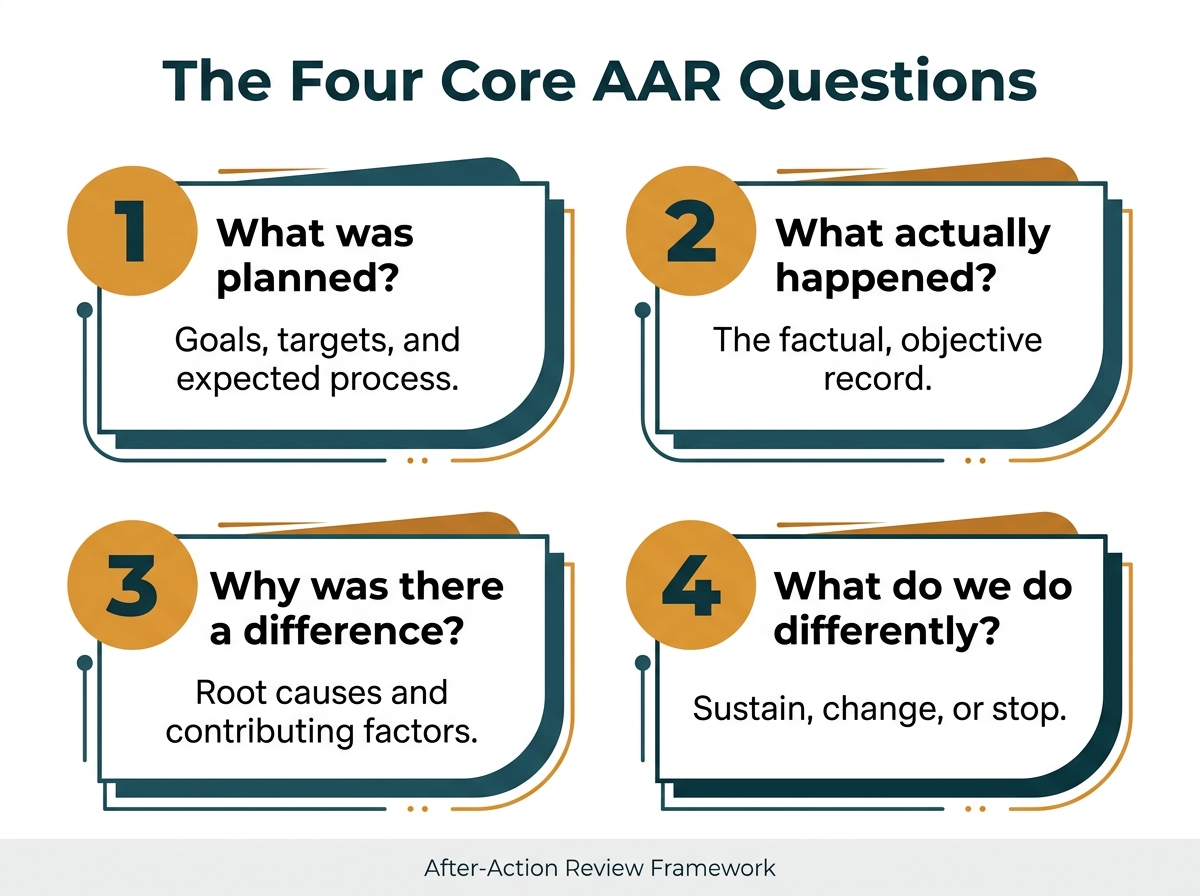
Every good AAR, regardless of context, returns to four foundational questions. The Humanitarian Innovation Fund's guide frames them clearly HIF/Elrha:
- What was planned? What were you hoping to achieve? What did the plan say would happen?
- What actually happened? As objectively and specifically as possible, what occurred?
- Why was there a difference? What factors, decisions, or conditions explain the gap between plan and reality?
- What do we do differently? What should be sustained, changed, or stopped going forward?
These sound simple. Running them honestly in a room full of people who lived through a stressful response is not. The gap between question three and four is where most AARs fall apart, because teams jump to "we need better communication" without ever diagnosing why communication broke down in the first place.
💡 Tip: Spend at least 40% of your facilitation time on question three. That is where the real learning lives.
Setting the Climate Before You Start
Wharton's research on the AAR method is blunt about this: leaders must first create a climate of transparency, selflessness, and candor where team members can challenge current ways of thinking and performing Wharton Executive Education, 2012. Everyone, including senior staff, must be willing to name where their own decisions contributed to what went wrong, and to acknowledge the people who helped things go right.
In practice, this means a few concrete things before anyone enters the room:
- Brief participants in advance. The Humanitarian Innovation Fund guide is clear that before the AAR starts, all team members must understand the purpose of the exercise and how the information generated will be used HIF/Elrha. Surprise is the enemy of candor.
- Keep hierarchy out of the facilitation role. The line manager should not be the facilitator. Someone neutral, or at least not the most senior person present, keeps discussion more honest.
- Separate the AAR from performance management. If people think this conversation will affect their contract renewal, they will tell you what sounds good, not what is true.
⚠️ Warning: If leadership only listens to good news during the AAR, the team will learn quickly to deliver only good news. Model the behavior you want.
Structure That Actually Works in the Field
For most field teams, a two-to-three hour structured session works better than a full-day retreat. Here is a practical sequence:
- Opening (15 minutes): Facilitator explains ground rules, purpose, and how outputs will be used. Restate that this is a learning process, not an audit.
- Timeline reconstruction (30 minutes): Build a shared factual timeline of what happened. Use a whiteboard or flip chart. Keep it descriptive, not evaluative. This step is critical because team members often have genuinely different versions of events.
- Gap analysis (45-60 minutes): Work through the four core questions together. Use small groups if the team is large, then reconvene to share.
- Root cause discussion (30-40 minutes): For each major gap, push past the surface explanation. Ask "why" at least twice before accepting an answer.
- Recommendations and owners (20-30 minutes): Every recommendation should have a named owner and a realistic timeline. Vague recommendations die quietly.
- Close (10 minutes): Confirm next steps, documentation owner, and when findings will be shared back with the team.
💡 Tip: A structured AAR template distributed before the session dramatically improves participation. People come with specific examples ready, not just general impressions.
From Field Notes to Organizational Learning
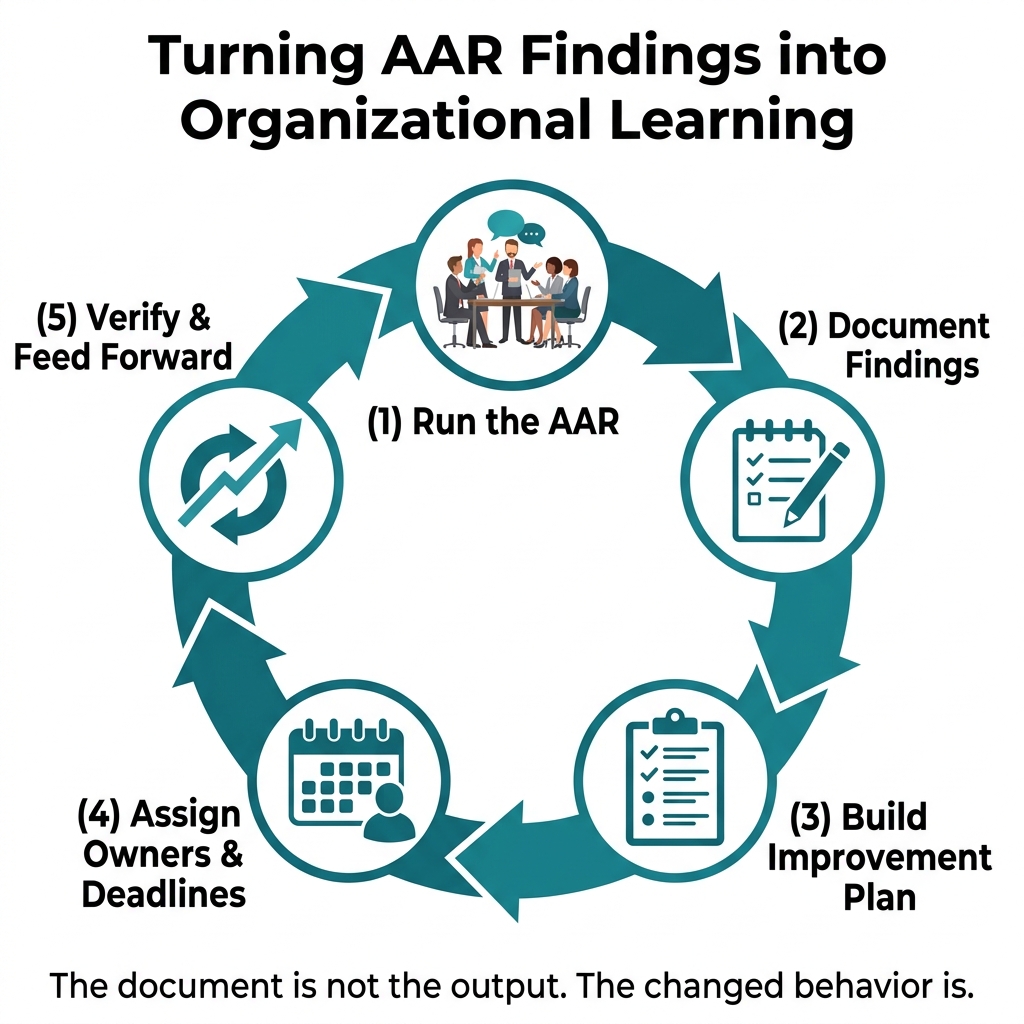
This is where most organizations stop short. The AAR generates a document, the document gets filed, and six months later a new team makes the same mistakes.
Research on public health emergency preparedness AARs found that recurring challenges were consistently reported across different agencies and incident types, suggesting that lessons identified in AARs were not being systematically applied PMC, 2012. That pattern is painfully familiar in humanitarian contexts too.
The FAO's AAR manual for animal health emergencies makes a useful distinction: an AAR produces findings, but organizational learning requires that those findings be integrated into standard operating procedures, training, and future planning cycles FAO. The document is not the output. The changed behavior is the output.
Concretely, this means:
- Develop an Improvement Plan alongside the AAR report. Each finding should map to a corrective action, an owner, a resource requirement (if any), and a verification method FEMA/YouTube guide.
- Schedule a follow-up check-in at 30, 60, or 90 days to review progress on recommendations.
- Feed findings into the next planning cycle explicitly. If your AAR says field data collection tools were confusing, that note needs to reach whoever designs tools for the next phase, not just sit in a lessons-learned folder.
| AAR Finding | Corrective Action | Owner | Deadline | Verification |
|---|---|---|---|---|
| Reporting templates inconsistent across sites | Standardize to one unified form | MEL Coordinator | 30 days | Form in use at next reporting cycle |
| Beneficiary feedback not collected in real time | Add PDM step to distribution SOP | Field Manager | 45 days | Updated SOP signed off |
| Partner coordination calls ad hoc | Establish weekly standing call with agenda | Program Manager | Immediate | Calendar invite sent |
Running AARs During a Response, Not Just After
One of the most underused adaptations of the AAR is the in-action review: a shorter, lighter version run during an ongoing response, not just at the end. Public Health Ontario's rapid review of best practices notes that in-action reviews allow teams to course-correct in real time, not just document what went wrong after the fact Public Health Ontario, 2022.
In a multi-month emergency response, a 30-minute weekly or bi-weekly in-action review, focused only on the past cycle, can catch coordination failures before they compound. The bar for formality is lower, but the four core questions still apply.
Making It a Habit, Not an Event
The teams I have seen turn AARs into genuine learning engines are the ones that treat them as a routine, not a special occasion. They run short reviews after major field activities, not just at project close. They have a shared template everyone knows. They track recommendations and hold each other accountable. And critically, senior leadership participates with the same openness they expect from junior staff.
That culture does not appear by accident. It is built, deliberately, one honest conversation at a time.
If you want to move from "we do AARs" to "we actually learn from them," I am happy to help you build the tools that make it easier: facilitation guides, structured templates, or improvement tracking trackers your team will actually use. That is exactly the kind of work I do at vera.ignex.io.
Sources
- Conducting After Action Reviews for animal health emergencies (FAO)
- Humanitarian Innovation Fund - After Action Review (AAR) Guide (Elrha)
- Best Practices for Conducting In- and After-Action Reviews as part of Public Health Emergency Management (Public Health Ontario, 2022)
- Use of After Action Reports (AARs) to Promote Organizational and Systems Learning in Emergency Preparedness (PMC)
- After Action Review - AAR Process - Nano Tools for Leaders (Wharton Executive Education)
- Developing an After-Action Report and Improvement Plan (YouTube/FEMA)
Put this into practice with Vera
Build logframes, indicators, surveys and reports in minutes — with an AI made for MEL.
Try Vera free →