The Assumptions Column Nobody Fills In: How to Use Logframe Assumptions to Actually Manage Risk
Stop treating assumptions as a formality. Here is how to make them the most powerful risk management tool in your logframe.
Here is a confession I make every time I help a team review a logframe: I read the assumptions column first.
Not the goal. Not the indicators. The assumptions. Because that is where the real story lives. That is where you find out whether a team has thought seriously about what could go wrong, or whether they filled in the column with two lines of optimistic filler text at 11pm the night before the proposal deadline.
I am not alone in this instinct. MEL practitioners who review logframes regularly have noted the same pattern: the assumptions column is where the logic breaks down, where teams document the things they hope will happen rather than the things they have genuinely assessed [LinkedIn, ELD Impact]. And when those hoped-for things do not happen, projects struggle, evaluations find weak evidence, and donors get frustrated donor narratives that are strong on story but thin on proof.
Let me walk through what assumptions actually are, why they matter structurally, and how to turn them from a compliance column into a genuine risk management tool.
What Assumptions Actually Are (and What They Are Not)
The INTRAC Logical Framework guidance defines assumptions as external factors beyond the project's control that are nonetheless crucial to its success [INTRAC, 2024]. The key word is "external." Assumptions are not things your team will do. They are conditions in the environment that have to hold for your vertical logic to function.
Here is what that means structurally: a logframe's vertical logic is essentially a chain of "if-then" statements [EvalCommunity]. If you deliver the activities, you get the outputs. If the outputs are in place, you achieve the purpose. If the purpose is achieved, you contribute to the goal. Assumptions are the hidden connective tissue in every one of those "if-then" steps. They are what makes the "then" plausible given the "if."
Without assumptions being named and tracked, you do not have a logical framework. You have a wish list dressed up in a matrix.
📝 Note: Assumptions sit at every level of the logframe except the goal row. At the activity level, they explain what must be true for activities to produce outputs. At the output level, they explain what must hold for outputs to generate purpose-level change. At the purpose level, they explain the conditions under which purpose contributes to the wider goal [INTRAC, 2024].
The Glass Half Full Problem
One of the most useful framings I have seen for understanding assumptions comes from Ian Seath's writing on the subject: assumptions are risks stated positively [Seath, 2014]. A risk says "the road will be impassable during rainy season." The equivalent assumption says "roads remain accessible for distribution throughout the project period."
Same reality. Different framing. The assumption framing is not wrong, it is just a convention, and one that can create a dangerous psychological bias. When you write "government counterpart remains supportive," it sounds reassuring. When you write "risk of government counterpart withdrawal is HIGH," it sounds like something you need to act on. The underlying condition is identical.
💡 Tip: For every assumption you write, draft the risk equivalent in parentheses next to it. If the risk version sounds alarming, that assumption deserves a monitoring signal, a contingency response, and a named person responsible for watching it.
This is exactly why so many assumptions columns get filled with low-stakes conditions that are nearly certain to hold, while the genuinely threatening external factors get quietly omitted. Naming a critical assumption feels like admitting the project might fail. But leaving it unnamed does not make the risk disappear. It just means you will not see it coming.
A Practical Test: The "Killing Assumption"
When I am working with a team on their logframe, I use what I call the killing-assumption test. For each level of the logframe, I ask: "What single external condition, if it failed, would make the rest of this row irrelevant?"
That is a killing assumption. It should be in your logframe. If it is not, your vertical logic has a gap.
Common examples I encounter:
- At activity to output level: community mobilization works as planned, beneficiaries have time and willingness to participate, local vendors can supply materials at projected costs.
- At output to purpose level: implementing partners have capacity to use the outputs, no competing program undermines uptake, policy environment remains permissive.
- At purpose to goal level: macroeconomic conditions do not erode household-level gains, government services are maintained, no large-scale displacement occurs.
⚠️ Warning: If every assumption in your logframe is low-probability-of-failure, something is wrong. Either you are working in an unusually stable context (possible, but rare), or you have been unconsciously filtering out the conditions that make you nervous (common, and dangerous).
From Static Column to Live Monitoring Tool
Here is where most teams stop: they write the assumptions, submit the proposal, and never look at the column again. The logframe gets filed. Implementation begins. The assumptions become historical artifacts.
This is the structural failure that evaluation research consistently identifies. EvalCommunity describes it as "the Indicator Gap": the logframe matrix built during proposal writing is never connected to the data collected during implementation [EvalCommunity]. The same gap exists for assumptions. They are written, not monitored.
What does monitoring an assumption actually look like? It means treating each critical assumption as a monitored condition with:
- A signal: What observable change would tell you the assumption is at risk? ("Road access" might be monitored through rainfall data, community feedback, or driver reports.)
- A trigger point: At what point does a weakening signal require a response?
- A contingency: What will the team do if the assumption fails? Who decides?
- A responsible person: Not a committee. One named person whose job it is to watch that signal.
This is not a complicated system. It can live in a simple monitoring matrix alongside your IPTT. The point is that assumptions become actionable rather than archival.
💡 Tip: Review your assumptions column at every quarterly review, not just at the end-of-project evaluation. Ask: "Which of these assumptions is showing early warning signs?" That question, asked regularly, is worth more than a full-day risk workshop held once at project start.
What Good Assumptions Look Like
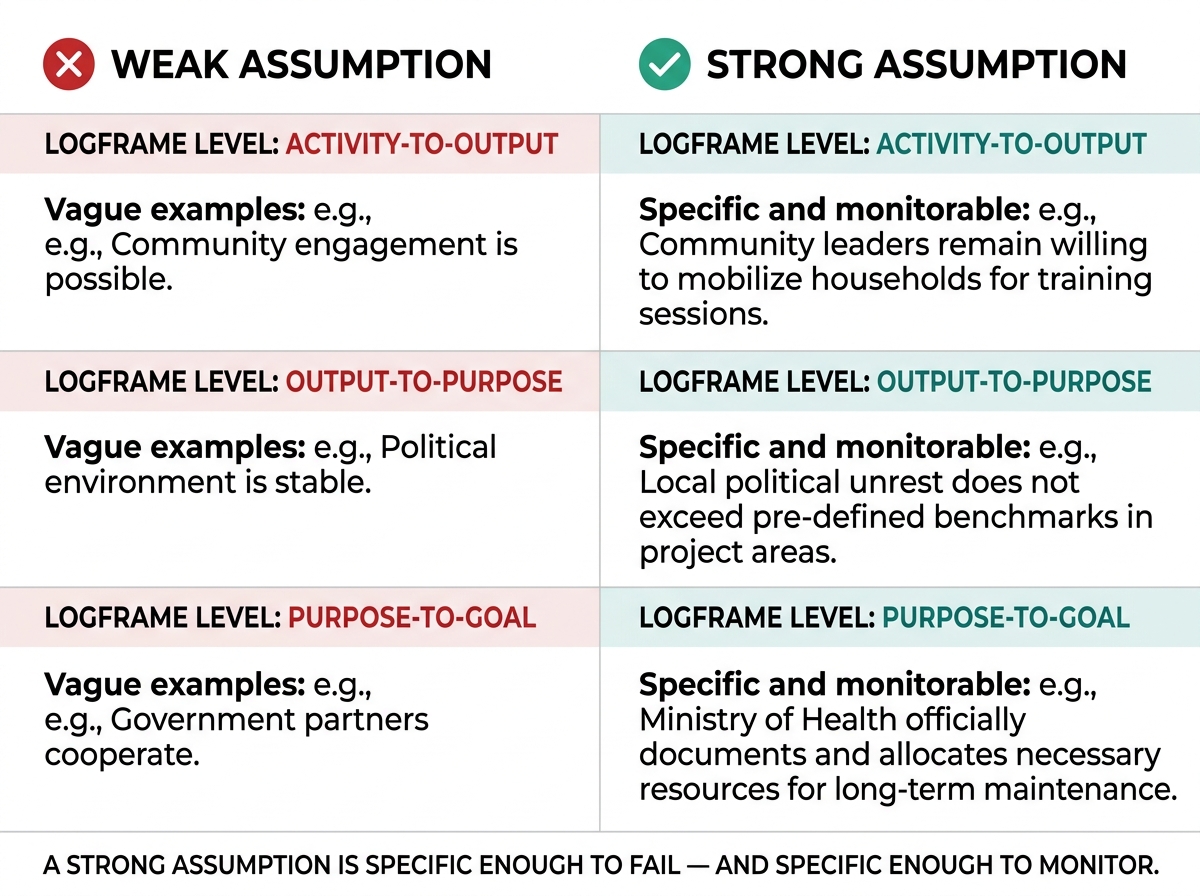
For reference, here is a quick comparison of weak assumptions versus strong ones:
| Level | Weak (vague, unmonitorable) | Strong (specific, monitorable) |
|---|---|---|
| Activity to Output | "Community engagement is possible" | "Community leaders remain willing to mobilize households for training sessions" |
| Output to Purpose | "The health system functions" | "District health offices maintain capacity to absorb and use trained CHWs" |
| Purpose to Goal | "Political conditions are stable" | "No policy reversal restricts NGO service delivery in target areas" |
Strong assumptions are specific enough to fail. If you cannot imagine a realistic scenario in which the assumption does not hold, it is probably not worth writing down. If you can imagine it all too easily, it absolutely needs to be written down and watched.
Why This Matters Beyond Compliance
The logframe is required in some form by virtually every major donor: USAID, UN agencies, the World Bank, the EU [SoPact; INTRAC, 2024]. But the assumptions column is rarely scrutinized at appraisal, rarely asked about in progress reports, and almost never the subject of a dedicated review meeting. It is the compliance column that gets the least compliance attention.
That is backwards. The assumptions column is the only place in the entire matrix where you are explicitly naming what is outside your control. Everything else in the logframe is about what you will do and what you will measure. The assumptions column is about the world your project lives in. In humanitarian and development contexts, that world is volatile, and that column deserves more serious attention than it usually gets.
If you want help turning your current logframe assumptions into a monitored risk register, or building a logframe from scratch with live, trackable assumptions built in from the start, that is exactly the kind of work I do at vera.ignex.io. Drop your logframe in and let's work through it together.
The assumptions column is not a formality. It is the most honest part of your logframe. Treat it that way.
Follow Vera for more on MEL & project management: LinkedIn · Instagram · Facebook · X
Sources
- Logframe: The Logical Framework Matrix Explained — SoPact
- Logframe Assumptions: The Weak Link in Project Funding — LinkedIn / ELD Impact
- Project Assumptions or Risks: Is Your Glass Half Full? — Ian Seath
- The Logical Framework — INTRAC (PDF)
- Risk: Why Isn't It Part of a Logical Framework? — ELD Training
- The Logical Framework (Logframe) Demystified — EvalCommunity
Put this into practice with Vera
Build logframes, indicators, surveys and reports in minutes — with an AI made for MEL.
Try Vera free →