The Donor Report Nobody Reads: How to Write Narrative Progress Reports That Actually Get Noticed
Practical techniques for turning dry activity logs into compelling, credible donor narratives that build trust and invite continued funding.
I'll be honest with you: most donor reports are not read. They are filed.
A program officer opens the PDF, checks that it exists, skims the first paragraph, and saves it to a folder with forty-three other documents. That's not cynicism, it's the pattern that comes up again and again when practitioners talk candidly about reporting r/nonprofit practitioners confirm this: "most of the donors only scan through the document". And yet we spend days, sometimes weeks, producing them.
The good news: a well-written progress report is genuinely different from a compliance document disguised as one. It answers the questions a program officer is already asking before they even open the file. As Instrumentl's grant reporting guide puts it, the real job of a progress report is to answer: "Is the program delivering what was promised?" Everything else is decoration.
Here is how I'd approach writing one that actually lands.
Start With the Questions Your Funder Is Already Asking
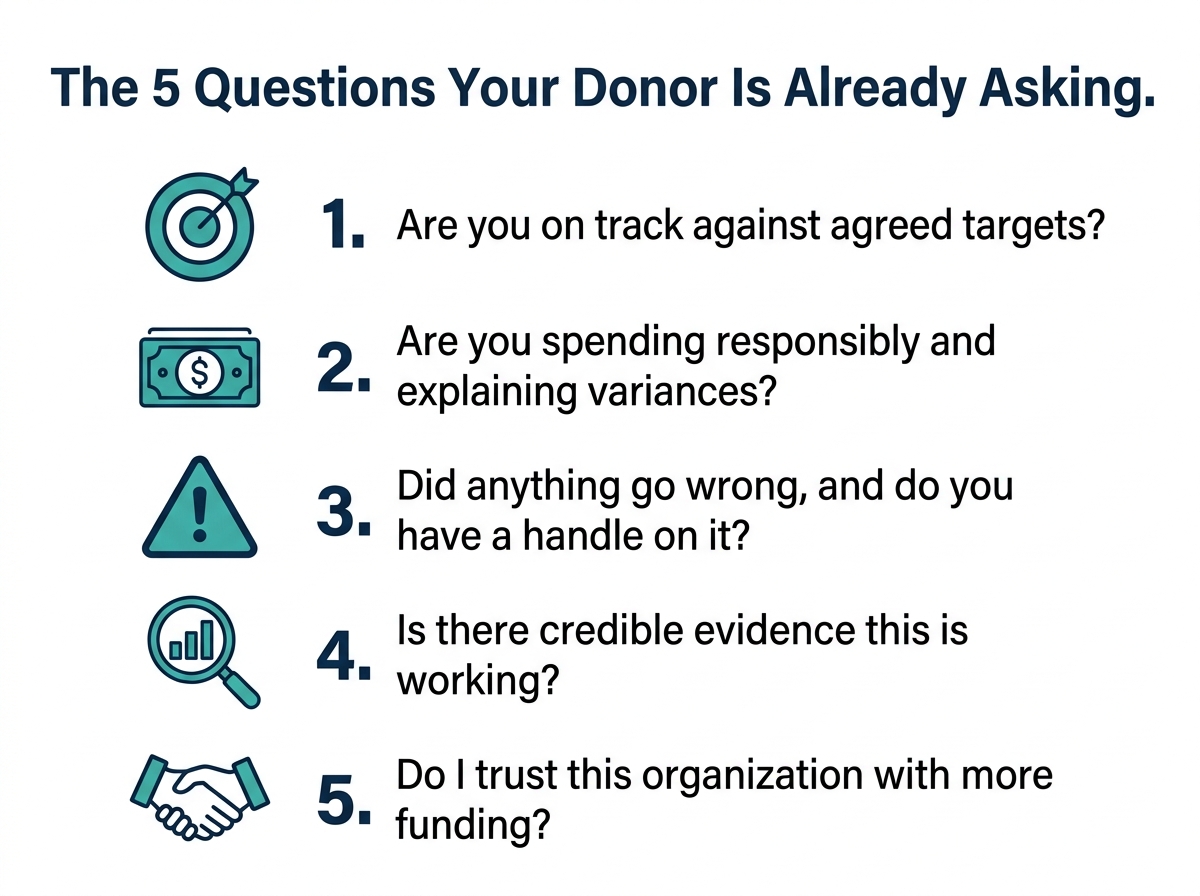
Before you write a single sentence, flip the frame. You are not writing a summary of what your team did. You are answering a set of implicit questions sitting in the back of your program officer's mind:
- Are you on track against the targets we agreed to?
- Are you spending responsibly and explaining variances?
- Did anything go wrong, and do you have a handle on it?
- Is there evidence that this is working, beyond your own say-so?
- Do I trust this organization to steward more funding?
Every section of your narrative should answer at least one of these. If a paragraph doesn't answer any of them, cut it.
💡 Tip: Before drafting, write the five questions above on a sticky note and keep it next to your screen. Every paragraph should earn its place by addressing at least one of them.
The Activity-Log Trap (and How to Escape It)
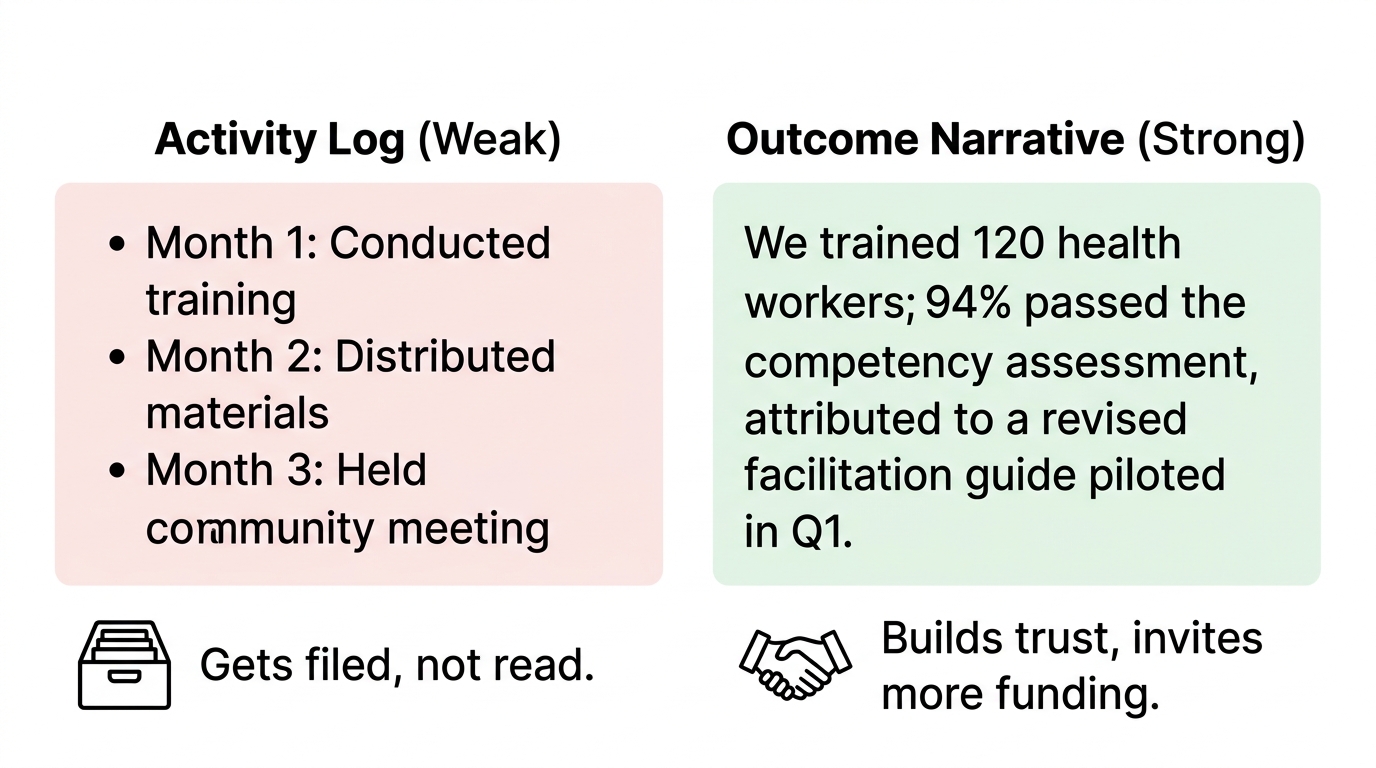
The single most common failure in donor narratives is the activity log: a chronological list of things that happened. "In Month 1, we conducted a training. In Month 2, we distributed materials. In Month 3, we held a community meeting."
This is not a narrative. It is a calendar.
The difference between an activity log and a compelling narrative is causality and evidence. Instead of "we trained 120 health workers," write "we trained 120 health workers, 94% of whom passed the competency assessment, a result our field supervisors attribute to the revised facilitation guide we piloted in Q1." One tells a funder what you did. The other tells them what you accomplished and why they should believe it.
The IASC's 8+3 reporting template makes a structural suggestion worth stealing: when narrative reporting is required, organize progress descriptions by specific objectives or outcomes, not by activity or timeline. This forces your writing to stay anchored to results rather than inputs.
📝 Note: The 8+3 template was designed to make humanitarian reporting simpler and less bureaucratic across multiple donors simultaneously. Even if your donor doesn't use it, its outcome-first logic is sound and transferable to almost any narrative format.
Structure That Actually Works
Here is the section order I'd recommend for most narrative progress reports:
- Executive summary (half a page maximum): The answer to "is this working?" in plain language. Include your headline achievement numbers.
- Progress against objectives: Organized by outcome or strategic objective, not by activity. Each section should include: what you planned, what you achieved, evidence of change, and any variance explained.
- Challenges and adaptations: This is where credibility lives. Donors trust organizations that surface problems honestly and show they responded. Silence about challenges reads as either obliviousness or concealment.
- Financial narrative: Don't just attach a budget table and hope for the best. Comment briefly on any significant variance. Many donors now explicitly require commentary on efficiency and value for money, the GHDI's donor reporting research found this is a mandatory requirement across several major institutional donors.
- Learning and forward look: What did you learn this period that will change how you work in the next one? This signals organizational maturity and investment in quality.
⚠️ Warning: Resist the urge to save the "good news" for the end and bury the problems in the middle. Funders notice this structure, and it erodes trust. Lead with honesty; it reads as strength, not weakness.
Making Your Evidence Credible (Not Just Impressive)
Numbers without context are noise. A single story without numbers is anecdote. The strongest donor narratives combine both, and they are specific about methodology.
When you cite a result, say briefly how you know it. "Based on our post-distribution monitoring survey (n=340, conducted by an independent enumerator team in November)" is not excessive detail. It signals that your data has integrity. The GHDI research confirms that major institutional donors increasingly require organizations to specify their assessment methodology and whether data came from direct or indirect sources.
Qualitative evidence works best when it is specific and attributed. Rather than "beneficiaries expressed appreciation for the services," try: "During a focus group in Kolda district, a 34-year-old mother of three said she had walked two hours to reach the previous clinic; the new community health post means she can now reach care in under 30 minutes." That is not anecdote padding, it is a human illustration of an indicator you are already tracking.
| Weak phrasing | Stronger alternative |
|---|---|
| "We reached many beneficiaries" | "We reached 4,820 individuals (61% women) against a target of 4,500" |
| "Training was well-received" | "94% of trainees passed the end-of-training competency test" |
| "Challenges were encountered" | "Heavy rains delayed field activities by 3 weeks in October; we recovered by extending the reporting period with donor agreement" |
| "Communities were engaged" | "12 community dialogues were held, attended by 380 community members including 14 local leaders" |
Formatting: Short Paragraphs, White Space, and the Right Length
Practitioners in the nonprofit community consistently note that donors scan before they read. Design your report for that reality. Use headers. Use short paragraphs of two to four sentences. Use a table to present indicator performance. Use a photo with a caption that tells a story in two sentences. These are not cosmetic choices: they determine whether your report gets read at all.
On length: many donors specify page limits, and you should respect them. The GHDI research found that one major donor caps final reports at 20 pages. When no limit is given, aim for the minimum length that honestly covers your results. A tighter report signals confidence. A padded one signals insecurity.
💡 Tip: Write your first draft without worrying about length. Then cut everything that doesn't answer one of the five funder questions from the section above. You will usually cut 20-30% without losing anything meaningful.
Harmonization: When You Report to Multiple Donors
If your project has several funders, the reporting burden can become crippling. The Global Public Policy Institute's work on harmonizing donor reporting documents how the humanitarian sector has tried to address this through shared templates, with mixed success. The principle, though, is worth applying even at the project level: write one strong core narrative organized around outcomes, then adapt the framing, emphasis, and formatting for each donor's template rather than writing entirely separate reports.
This is not cutting corners. It is sensible. The facts of your program don't change from donor to donor. What changes is which indicators each funder tracks, which outcomes they care most about, and which formatting rules they require.
A Final Thought on Trust
The best donor report is not the most polished one. It is the most honest one. A funder who reads a report that says "we fell short of our target in Q2, here is why, and here is what we changed" learns something important about your organization: that you are honest, that you understand your own program, and that you will manage their next grant the same way.
That is the report that gets cited in the next proposal review meeting. That is the report that builds a funding relationship instead of just closing out a contract period.
If you want help turning your current reporting template into a well-structured, outcome-focused narrative, or if you need an indicator performance table that makes your progress numbers scannable and credible, that's exactly the kind of work I can do with you at vera.ignex.io.
Sources
- Harmonizing Donor Reporting - Global Public Policy Institute (GPPi)
- Donor reports best practices : r/nonprofit
- Donor Reporting Requirements Research - GHDI Initiative
- 16 Effective Donor Reports That Strengthen Relationships - Neon One
- The 8+3 Template - Inter-Agency Standing Committee (IASC)
- How to Write a Grant Progress Report: Template & Step-by-Step Guide - Instrumentl
Put this into practice with Vera
Build logframes, indicators, surveys and reports in minutes — with an AI made for MEL.
Try Vera free →