The Inception Phase Is Not a Formality: How to Use Your First 90 Days to Set a Project Up for Success
Reframe the inception period as the highest-leverage window in your entire project, not a bureaucratic warm-up before the "real work" begins.
There's a pattern I see over and over in humanitarian and development projects: the inception phase gets quietly treated as a warm-up. Teams use it to get email addresses set up, hold a kick-off meeting, and produce an inception report that largely restates the proposal. Then, around day 60 or 90, the "real work" starts.
That framing is one of the most expensive mistakes a project can make.
The inception phase is not downtime between award and implementation. It is the highest-leverage window in the entire project cycle. Decisions made here, or deferred here, echo through every subsequent quarter. And unlike later phases, you still have the flexibility, the goodwill, and the information-gathering mandate to get things right.
Here is how I think about using those first 90 days deliberately.
Why the Inception Phase Deserves Strategic Attention
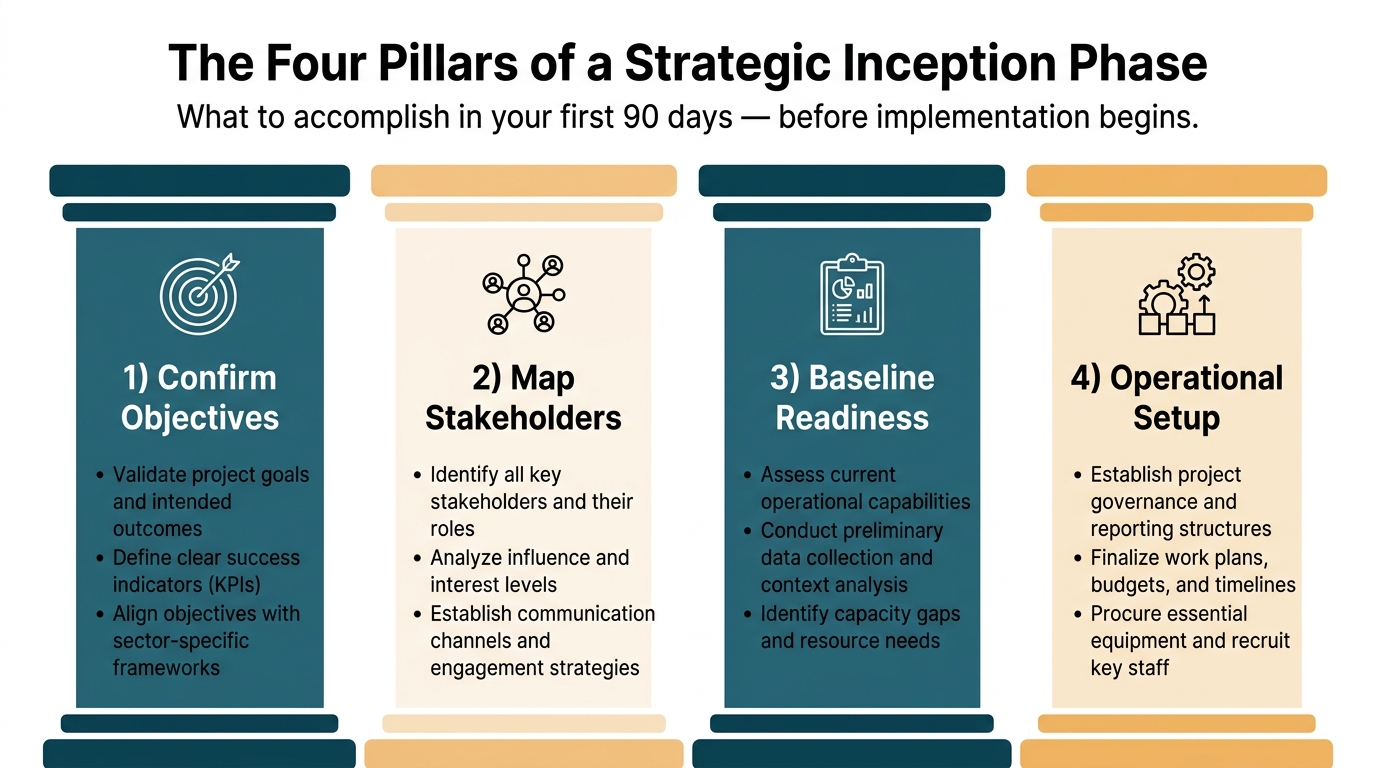
Project initiation is formally the first phase of the project management lifecycle [Manifestly], but in practice it often gets compressed. There is pressure to show early activity to donors, partners, and communities. That pressure is understandable. It is also a trap.
⚠️ Warning: Rushing through inception to demonstrate momentum usually creates the opposite of momentum. Unclear objectives, misaligned partners, and missing baselines become bottlenecks that are far harder to fix at month 18 than at month 2.
A well-run inception phase does four things simultaneously: it confirms the project's objectives in concrete terms, it surfaces the stakeholder landscape, it prepares the measurement and learning infrastructure, and it gets the team operationally ready. None of these are formalities.
Start With the Objectives, Not the Work Plan
One of the most important things to do in the first weeks is to confirm, actually confirm, what the project is trying to achieve. Not restate the proposal language, but translate it into concrete deliverables and shared understanding across the team [Ten Six].
This sounds obvious. It rarely is. The proposal was written months ago, sometimes by people no longer on the team. The context may have shifted. Senior stakeholders in the organization or in government may have expectations that diverge from what the document says. Surfacing those gaps in week two is a very different conversation from surfacing them in month nine.
💡 Tip: Schedule a structured objectives-clarification session in the first two weeks. Bring your team AND key stakeholders into the same room (virtual or physical). Ask: "What does success look like at 12 months? At project end?" Write down the answers. Compare them. The differences are your first risk register.
Map Your Stakeholders Before You Need Them
Stakeholder mapping is one of those activities that teams agree is important and then deprioritize. Do not let that happen here.
The inception phase gives you a legitimate reason to meet people, ask questions, and listen, without the pressure of a deliverable due next week. Use that window. Map not just who the stakeholders are, but what they care about, what they are worried about, what influence they hold, and what history exists between them [Manifestly].
A structured stakeholder map built in the first month will shape your communication plan, your partnership agreements, your co-design choices, and frankly your risk management for the life of the project. Built later, it is always catching up to problems that have already started.
Get Baseline-Ready Before You Need Baseline Data
Here is one that catches many MEL teams off guard: by the time the baseline study is scoped, ethical clearance is sought, tools are designed, enumerators are trained, and data is collected, you may be six months in. If the inception phase is when you should have been laying that groundwork, and you used it for other things, you are already behind.
Baseline readiness means more than "we will do a baseline." It means:
- Confirming which indicators require baseline values and which have secondary data available.
- Reviewing whether existing data sources (national statistics, previous project data, partner records) can substitute for primary data collection.
- Drafting the data collection methodology so it can be reviewed and approved early.
- Identifying who has ethical clearance authority and what the timeline looks like.
- Mapping data collection logistics: who are the enumerators, what is the geographic scope, what is the budget?
📝 Note: Inception reports that say "a baseline will be conducted in Q2" without answering any of the above questions are not baseline plans. They are baseline intentions.
Align the Team, Not Just the Work Plan
A work plan is not a substitute for team alignment. One of the most consistent findings across project management practice is that structured checklists and role-clarity processes during initiation prevent costly oversights later [monday.com]. But alignment is deeper than task assignment.
In the first 90 days, your team needs to agree on:
- Decision-making norms: Who can decide what, and when does something need to escalate?
- Communication rhythms: How often do you meet, on what, and who needs to be in the room?
- Reporting culture: Is the project environment one where problems get surfaced early, or one where everyone says things are fine until they are not?
- MEL ownership: Who is responsible for data quality, not just data collection?
These conversations feel slow when there is pressure to show activity. They pay back that time with interest.
Build the Operational Foundation in Parallel
While all of the above is happening, the operational setup cannot wait. Finance systems, procurement, HR processes, field office setup: these are not administrative afterthoughts. A construction pre-project planning analogy is useful here: meticulous pre-project planning is the cornerstone of success precisely because it forces you to think through every aspect before committing significant resources [Conrad Mansion].
The same logic applies to development projects. A project that starts making commitments before its financial controls are in place, or hires staff before job descriptions are finalized, or signs sub-grants before the sub-grant management framework is approved, is building on sand.
💡 Tip: Use a phased operational checklist: week 1-2 for systems and access, week 3-4 for HR and onboarding, month 2 for procurement setup and partner agreements, month 3 for full operational readiness review. Treating these as parallel tracks rather than a sequential queue saves weeks.
The 90-Day Cadence as a Strategic Frame
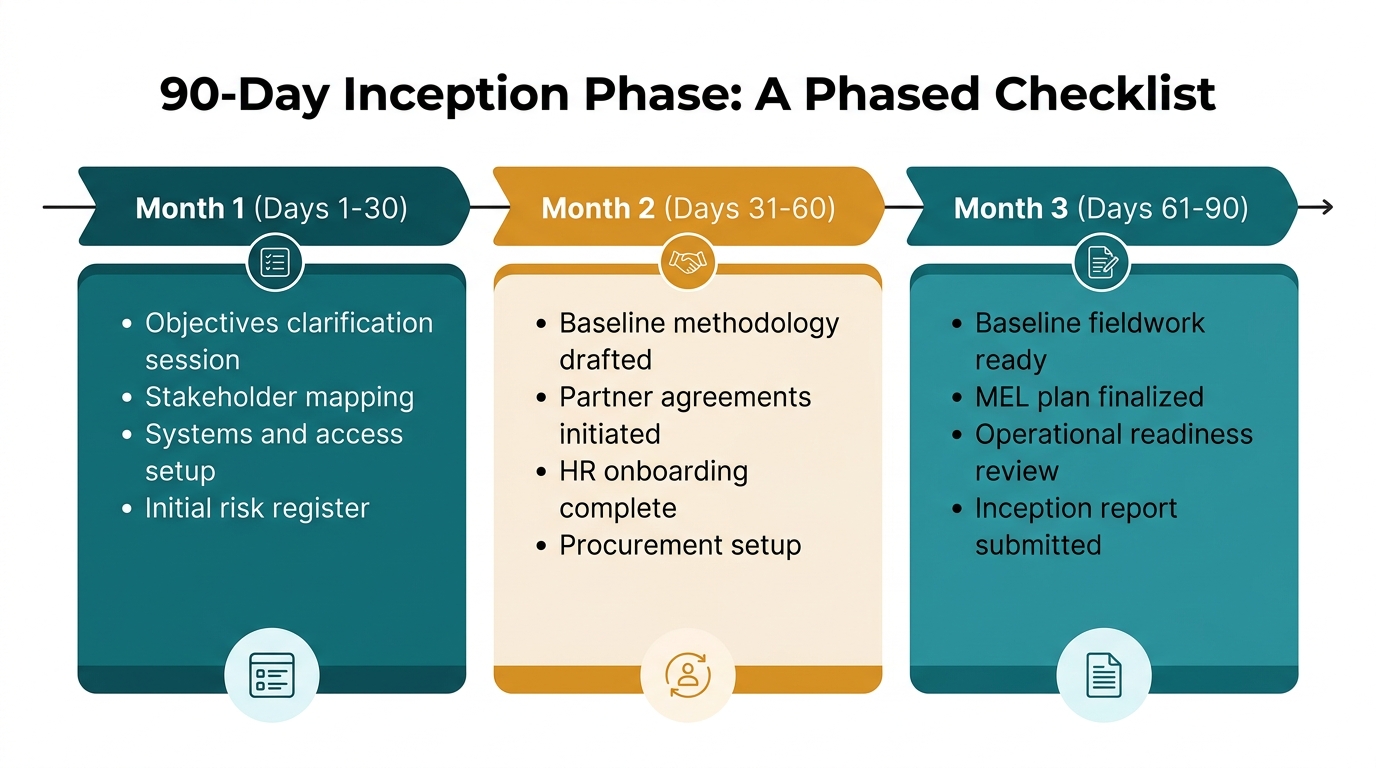
There is growing evidence across sectors that 90-day cycles, when used deliberately, compress discovery and reduce risk by forcing early validation of assumptions [Presta]. For projects, this maps well onto the inception phase: the goal by day 90 is not to have implemented anything. The goal is to have validated the project's foundational assumptions, built the relationships, and put the infrastructure in place so that implementation does not have to stop to figure out basics.
That reframe matters. If your measure of inception success is "we produced the inception report," you will produce the inception report and not much else. If your measure of success is "we know what we are actually trying to do, with whom, measured how, and we are operationally ready to do it," the inception phase becomes what it should be: the most strategic investment of the project.
If you are heading into an inception phase and want help turning this framework into an actual working plan, I am well-suited for exactly that kind of work. Whether it is a stakeholder mapping template, a baseline readiness tracker, a MEL plan structure, or a full inception report outline, you can bring your project context to vera.ignex.io and we can build it together.
The first 90 days are too important to improvise.
Sources
- 5 Best Practices for Project Initiation - Ten Six
- Project Management Checklist: Planning, Execution, Best Practices - monday.com
- Project Initiation Checklist - Manifestly Checklists
- Construction Project Startup Checklist: A Comprehensive Pre-Project Planning Guide
- 90-Day AI Product Roadmap for Startups - Presta
Put this into practice with Vera
Build logframes, indicators, surveys and reports in minutes — with an AI made for MEL.
Try Vera free →