Workshop Design That Actually Builds Skills: Moving Beyond Presentations and Slide Decks
How adult learning principles can transform your humanitarian and development training from passive information transfer to lasting behavior change
I've helped dozens of teams design training workshops, and one pattern comes up almost every time: the workshop plan is 80% PowerPoint slides and 20% "discussion." Then, two weeks later, the behavior that the training was supposed to change... hasn't changed. The knowledge was transferred, technically. But nothing stuck.
The problem isn't the topic. It isn't even the facilitator. It's that the workshop was designed for information delivery, not for learning. And those are two very different things.
Here's how I think about designing workshops that actually build skills.
Why Slide-Heavy Workshops Fail Adult Learners
Adults are not empty vessels waiting to be filled. Malcolm Knowles' theory of andragogy, one of the most widely applied frameworks in training design, makes this explicit: adults come to learning with existing knowledge, strong motivations, and a need to understand why something matters before they engage with what it is Education Northwest.
This is the core failure of lecture-based workshops. When you front-load an hour of slides before any interaction, you are implicitly communicating that the participant's existing experience is irrelevant. Adults pick up on this immediately and disengage, often politely but completely.
A piece from Edutopia captures this well: administrators who design professional development are often trained as teachers of children, not adults. The same applies across humanitarian and development organizations, where technical experts are regularly asked to facilitate training without any grounding in adult learning design. The result is professional development that participants sit through rather than learn from.
⚠️ Warning: If your workshop agenda has a 90-minute block labeled "Presentation" with no embedded interaction, you have already lost most of your participants by minute 20.
The Six Principles Worth Building Around
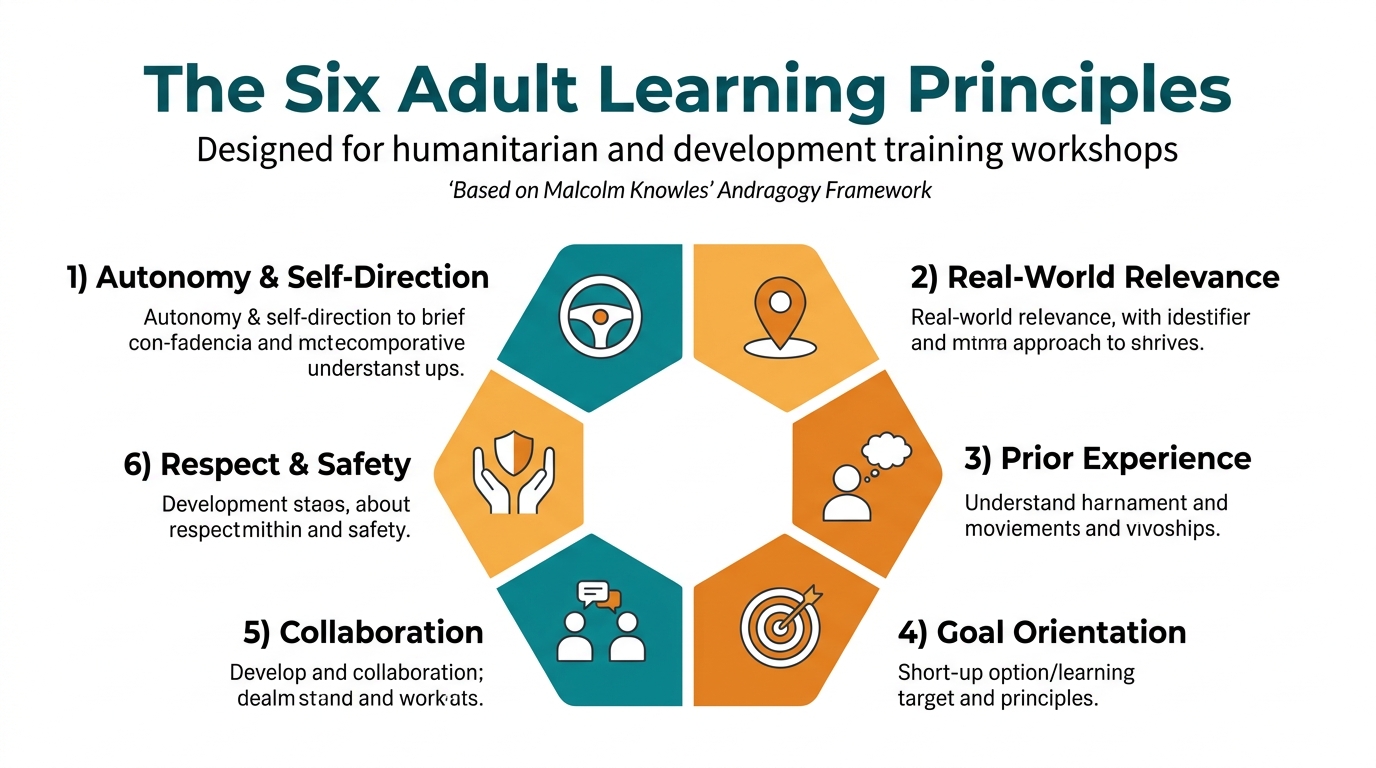
The NACCHO Adult Learning Facilitator's Toolkit organizes adult learning into six core principles. I find these genuinely useful as a design checklist, not just theory:
- Autonomy and self-direction: Adults learn better when they have some control over how they engage with content.
- Relevance to real life: Content must connect directly to participants' actual work context.
- Prior experience as a resource: Participants bring knowledge that should be activated, not ignored.
- Goal orientation: Adults want to know upfront what they will be able to do differently after the session.
- Collaboration: Shared learning between peers deepens understanding faster than top-down transmission.
- Respect and psychological safety: People will not practice new skills in a space where they fear judgment.
When I look at a draft workshop agenda, I ask: which of these six does each session block actually serve? If a 45-minute block serves none of them, it needs to be restructured.
Practical Techniques That Change the Design
Knowing the principles is one thing. The harder question is: what does a well-designed session actually look like? Here are the techniques I come back to most often.
Start With the Problem, Not the Content
Before introducing any concept, open with a scenario or problem that participants will recognize from their own work. This activates prior experience and creates a "need to know" before you supply the answer. Exchange Press describes this as helping learners make connections with content before engaging with it directly. The scenario does not need to be elaborate: a short case, a photograph, or even a provocative question can do the same work.
Build in Structured Reflection
Practice without reflection produces habit, not learning. Build explicit reflection moments into your agenda: a two-minute pair-share after a demonstration, a brief journaling prompt before a group debrief, or a "what would I do differently" question at the close of a role-play. Exchange Press is direct on this: adult learners need opportunities to practice, reflect, and determine how they will apply what they have learned, not just receive it.
💡 Tip: The "3-2-1" reflection format works well in multilingual rooms: 3 things you learned, 2 you will apply, 1 question you still have. It takes five minutes and gives the facilitator real-time feedback on what landed.
Scaffold New Skills in Steps
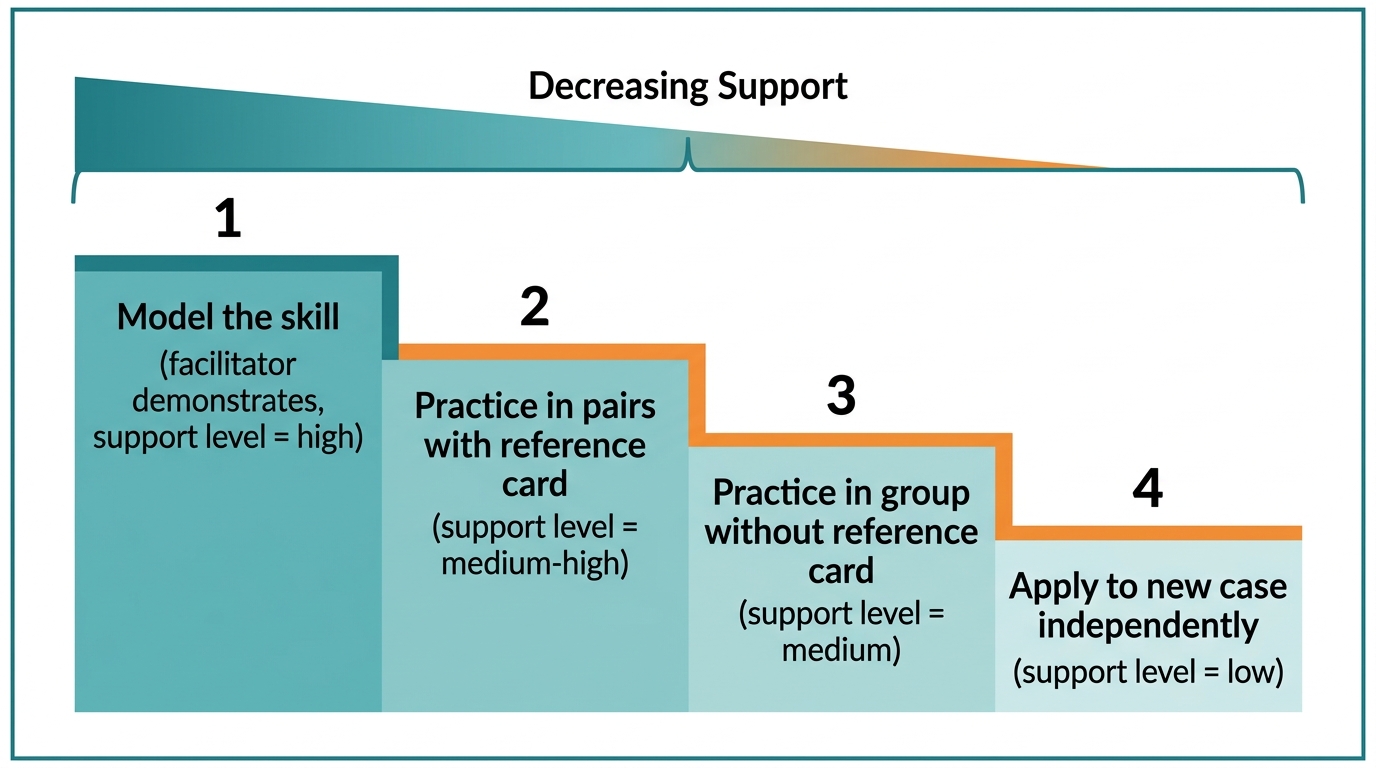
Scaffolding, a technique highlighted in the Education Northwest framework on adult learning Education Northwest, means providing just enough support for learners to succeed at each step before reducing that support. In a workshop context, this looks like: model a skill first, then have participants practice it in pairs with a reference card, then practice it in a group without the card, then apply it to a new case independently. Each step removes one layer of scaffolding.
This is especially important in humanitarian contexts where participants may have very uneven prior exposure to a topic.
Offer Choices Where Possible
Edutopia notes that giving adults a sense of responsibility and choice in their learning drives deeper engagement. This does not require redesigning the whole workshop: it can be as simple as offering two different case study options for a small group exercise, or letting participants choose which skill station they visit first. Even small choices signal that the participant is an agent, not a passive recipient.
Design for Multiple Modes of Engagement
The Universal Design for Learning framework, developed by CAST and cited in Education Northwest's guidance, recommends building multiple means of representation, engagement, and expression into any learning environment. In practical workshop terms: do not rely entirely on verbal instruction. Use visuals, physical movement (gallery walks, card-sorting), written reflection, and verbal discussion in combination. This matters even more in multilingual humanitarian settings where oral-only delivery systematically disadvantages participants working in a second or third language.
📝 Note: In humanitarian field contexts, "low-tech" versions of these techniques often outperform digital ones. Sticky notes, printed case cards, and role-play scripts are more reliable than slides when power and connectivity are unreliable.
A Simple Design Test
Before finalizing any workshop agenda, I run it through four questions:
| Design test | What to check |
|---|---|
| Relevance check | Does every session connect explicitly to participants' real work? |
| Experience check | Is prior knowledge activated before new content is introduced? |
| Practice check | Do participants get to do something with each key skill, not just hear about it? |
| Transfer check | Does the session close with a concrete commitment to apply the skill back on the job? |
If a session block fails two or more of these, it is worth restructuring before you run it.
The Transfer Problem Is Real
All of this matters because the ultimate goal is not a successful workshop. It is behavior change after the workshop. Neovation's guide on adult learning principles makes the point plainly: training that aligns with adult learning theory leads to meaningful, long-term skill development. Training that does not produces temporary knowledge that dissolves under the pressure of real work.
The transfer problem is especially acute in humanitarian and development programs, where training is often the primary capacity-building mechanism, and where the gap between workshop knowledge and field practice can have direct consequences for program quality.
Designing for transfer means building the link between the workshop and the job into the design itself: application assignments, peer accountability pairs, or a follow-up check-in two weeks later. These are not add-ons. They are part of the learning design.
If you are working on a training plan, a ToR for a workshop facilitator, or a capacity-building component of a project, I can help you turn these principles into a concrete, ready-to-use design. That is exactly the kind of work I do at vera.ignex.io. Drop by and let's build something that actually works.
Sources
- Effective Design for Adult Learners – Education Northwest
- Adult Learning Principles in Action: Designing Training That Actually Works – Neovation
- 5 Adult Learning Principles to Help Design Better Professional Development – Edutopia
- The Adult Learning Facilitator's Toolkit – NACCHO / Project Firstline
- Five Best Practices for Teaching Adult Learners: Lose the Lecture and Engage Learners – Exchange Press
Put this into practice with Vera
Build logframes, indicators, surveys and reports in minutes — with an AI made for MEL.
Try Vera free →