Adaptive Management in Practice: How to Actually Change Course When Your Project Isn't Working
Moving beyond the theory to make real, evidence-based pivots that keep your project on track
Every project manager has been there. You're three months into implementation, your monitoring data is coming in, and something feels off. Targets are being missed, community feedback is lukewarm, or an assumption buried in your Theory of Change is simply not holding. The question isn't whether you should adapt. The question is: how do you do it well, without losing momentum, accountability, or the trust of your donors?
Adaptive management is the structured answer to that question. But in practice, it gets reduced to a buzzword, something teams mention in proposals and then quietly abandon once work begins. I want to walk through what it actually takes to change course deliberately, using evidence rather than instinct.
What Adaptive Management Actually Means
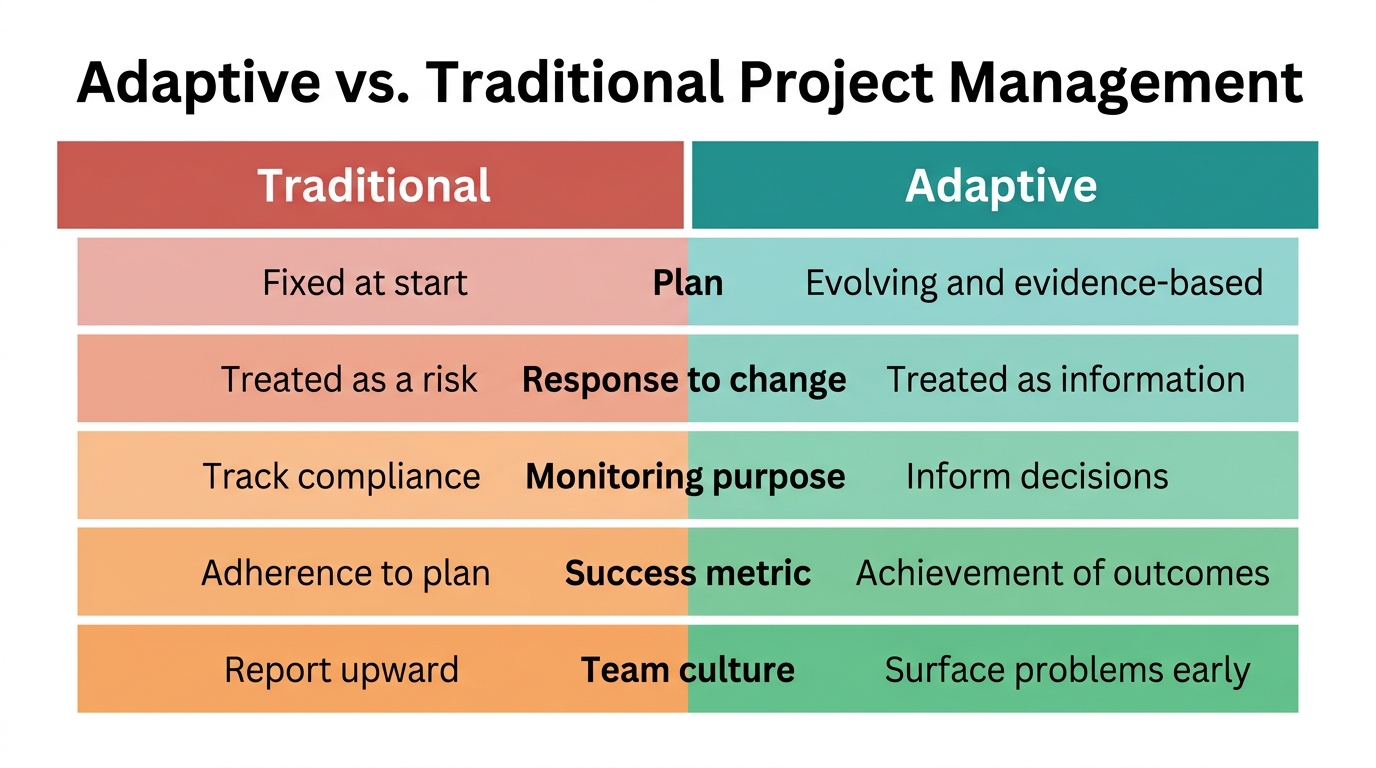
At its core, adaptive management is a systematic, evidence-based approach to project decision-making [1]. You are not randomly changing plans. You are using monitoring data, community feedback, and context analysis to make targeted adjustments, then tracking whether those adjustments work. Think of it as a loop: plan, implement, monitor, learn, adjust, repeat.
This is fundamentally different from the traditional project management model, where the plan is fixed at the start and success is measured by how closely you stuck to it. The traditional model made sense in stable, predictable environments. Humanitarian and development work is neither.
As the Open University's "Doing Development Differently" framework puts it, adaptive management has grown in popularity precisely because development contexts are complex and non-linear [5]. The assumptions you wrote into your logframe six months ago may be partially or entirely wrong. That is not a failure of planning. It is the nature of the work.
📝 Note: Adaptive management is not the same as Agile software development, even though they share vocabulary. Agile is optimized for product iteration. Adaptive management, as practiced in development and humanitarian programs, is optimized for achieving social outcomes in unpredictable environments.
The Real Barrier: Confusing Flexibility With Chaos
One of the most common fears I hear from program teams is that adapting mid-project will look like poor planning to a donor, or signal that the team doesn't know what it's doing. This fear is understandable, but it reflects a misunderstanding of what good adaptive management looks like.
Adapting without a system is chaos. Adapting with a system is professionalism.
The difference lies in documentation and intentionality. When you change course, you should be able to answer:
- What evidence triggered this decision?
- What specific element of the project is changing (strategy, activity, target, timeline)?
- What do you expect the change to achieve?
- How will you know if the change is working?
If you can answer those four questions clearly, you have an adaptive management decision. If you cannot, you have a gut reaction.
⚠️ Warning: One of the top reasons organizations fail to achieve their project goals is a lack of structured flexibility [2]. Changing your plan without documenting the rationale and expected outcome is often worse than not changing at all, because you lose the ability to learn from the decision later.
Building the Conditions for Adaptation
Adaptive management does not happen spontaneously. It requires deliberate infrastructure, both at the team level and the system level.
At the team level
Empower your team members to surface problems early, not just report upward. If field staff feel that flagging a problem will be seen as failure, you will not get the honest monitoring data you need [4]. This means building a culture where early warning is celebrated, not punished.
Use rolling work plans rather than fixed annual plans where possible. Rolling plans allow you to adjust activities for the next quarter based on what you learned this quarter, without reopening the entire project design [4].
At the system level
You need a central place where your plans, monitoring data, and decisions live together. When these are scattered across email chains, individual spreadsheets, and handwritten field notes, connecting evidence to decisions becomes nearly impossible [2]. A shared digital workspace, even a simple shared drive with a structured folder system, dramatically improves your ability to trace the thread from observation to action.
💡 Tip: Create a simple "decision log", a living document or spreadsheet where every significant project adjustment is recorded with the date, the evidence that prompted it, the change made, and the person who authorized it. This takes ten minutes per entry and becomes invaluable during reviews, donor visits, and evaluations.
The Adaptive Cycle in Practice
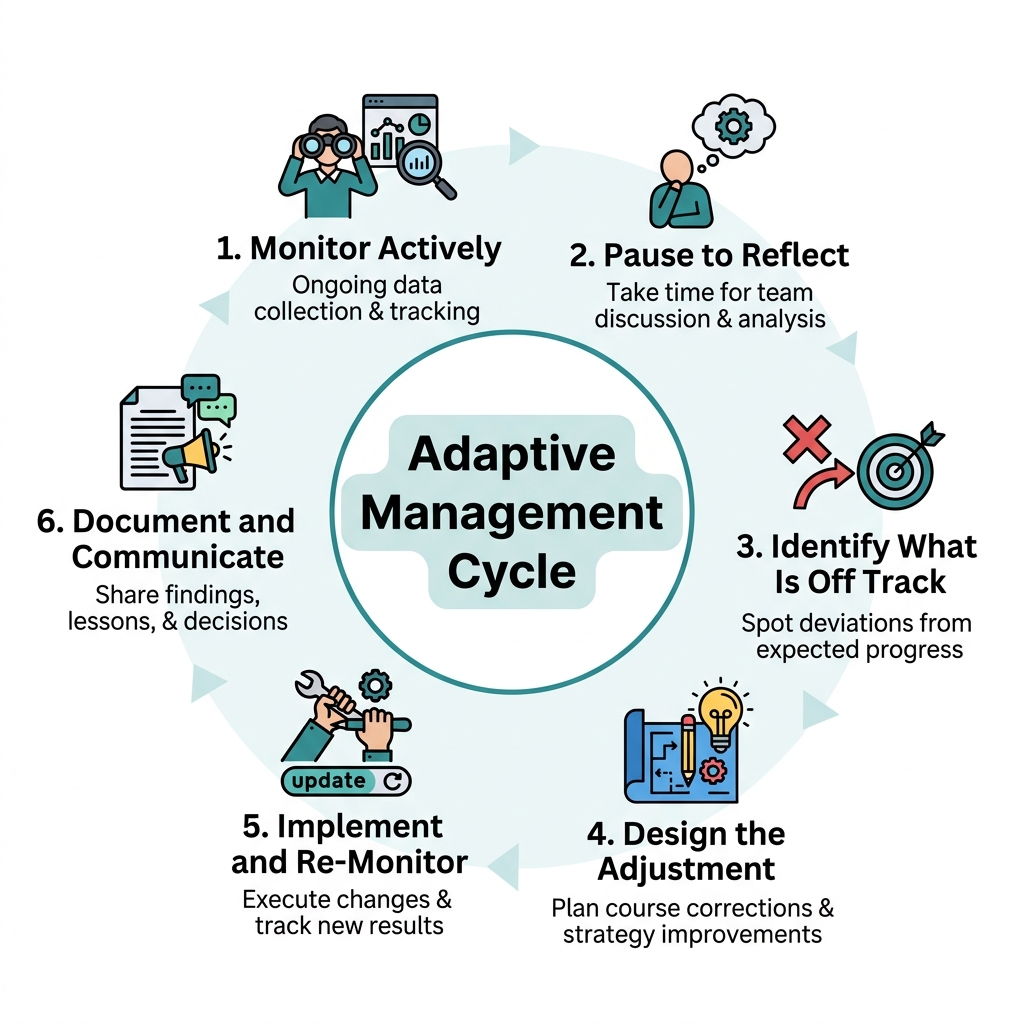
Here is how the adaptive loop looks in a real project context [1][3]:
- Monitor actively. Collect routine data against your indicators. Include qualitative signals: community feedback, staff observations, partner reports.
- Pause to reflect. Build regular reflection moments into your calendar, monthly or quarterly. These are not just reporting sessions. They are structured spaces to ask: "Is this working, and if not, why not?"
- Identify what is off track. Be specific. Is it the output (activities are not happening), the outcome (activities are happening but not producing change), or the assumption (the theory of change logic is flawed)?
- Design the adjustment. Change only what the evidence points to. Resist the temptation to redesign everything because one element is struggling.
- Implement and re-monitor. The adjustment is itself a hypothesis. Track it.
- Document and communicate. Update your work plan, log the decision, and notify relevant stakeholders.
💡 Tip: Frame your adaptations to donors as "learning in action." Most major donors, including USAID and FCDO, now explicitly encourage adaptive management and expect to see evidence of it in reporting.
Coherence Across Time: The Piece Most Teams Miss
One thing that often gets lost in adaptation cycles is coherence: making sure your adjustments still connect to the original theory of change and the broader story of how change happens in your context [3].
Adapting the how is often necessary and good. Drifting away from the why is a problem. Before any significant adjustment, ask: does this change still serve the same ultimate outcome? If the answer is no, you are not adapting, you are redesigning, and that requires a different conversation with your team and your donor.
Adaptive management done well is one of the most powerful things a program team can do. It turns honest monitoring data into better decisions, and better decisions into better outcomes for the communities you serve. The teams I see struggle with it are not struggling because the concept is hard. They are struggling because no one has sat down and built the simple structures, the decision log, the reflection rhythm, the shared workspace, that make adaptation systematic rather than reactive.
If you are working on a project that needs a stronger adaptive management framework, a decision log template, a reflection guide, or a monitoring system that actually feeds into decision-making, that is exactly the kind of work I can help you build. Come work with me at vera.ignex.io.
Follow Vera for more on MEL & project management: LinkedIn · Instagram · Facebook · X
Sources
- Adaptive Management: Turn Disruptions into Better Outcomes — ELD Training
- Adaptive Project Management Guide: Benefits, Framework, Steps — monday.com
- Adaptive Management Across Project Cycles: Look into Coherence in Time — Medium
- Adaptive Project Management for Complex Environments — Mithra Foundation / Facebook
- 5 Adaptive Management: Doing Development Differently — OpenLearn, The Open University
Put this into practice with Vera
Build logframes, indicators, surveys and reports in minutes — with an AI made for MEL.
Try Vera free →