How to Build a Results Chain That Actually Works
A practical, step-by-step guide to developing results chains that clarify program logic, sharpen your theory of change, and set you up to monitor what matters
If there is one tool I come back to again and again when helping teams design programs, it is the results chain. Not because it is fashionable, and not because donors require it. But because it forces a discipline that most program design skips: making your logic explicit before you spend a single dollar.
A results chain is, at its core, a visual representation of how a program's activities are expected to lead to outcomes and ultimately to impact. As Better Evaluation describes it, results chains "represent a program theory as a linear process with inputs and activities at the front and long-term outcomes at the end." Simple enough in theory. Harder to do well in practice.
Let me walk through what I have learned about building results chains that are genuinely useful, not just boxes and arrows that sit in a project document and gather dust.
Why Results Chains Matter More Than People Think
Most teams treat the results chain as a formality: something you produce during design, present to a donor, and then rarely revisit. That is a missed opportunity.
When done properly, a results chain does three things at once. First, it clarifies the logic of your program. The DCED Standard Guidelines put it well: "The results chain is a visual tool to show what the programme is doing, and why. They clarify the 'logic' of the programme, by showing how activities will lead" to results. Second, it surfaces your assumptions, which is where most interventions actually fail. Third, it gives your MEL team a roadmap for what to measure and when.
💡 Tip: A results chain is not just a design artifact. It is a living MEL instrument. Revisit it at every major review cycle and ask: "Are the links still holding?"
As ResearchGate's analysis of results chains in conservation notes, results chains "help teams make their assumptions behind an action explicit and positions the team to develop relevant objectives and indicators to monitor." If your results chain is not feeding directly into your indicator matrix, you are leaving value on the table.
The Building Blocks: What Goes in a Results Chain
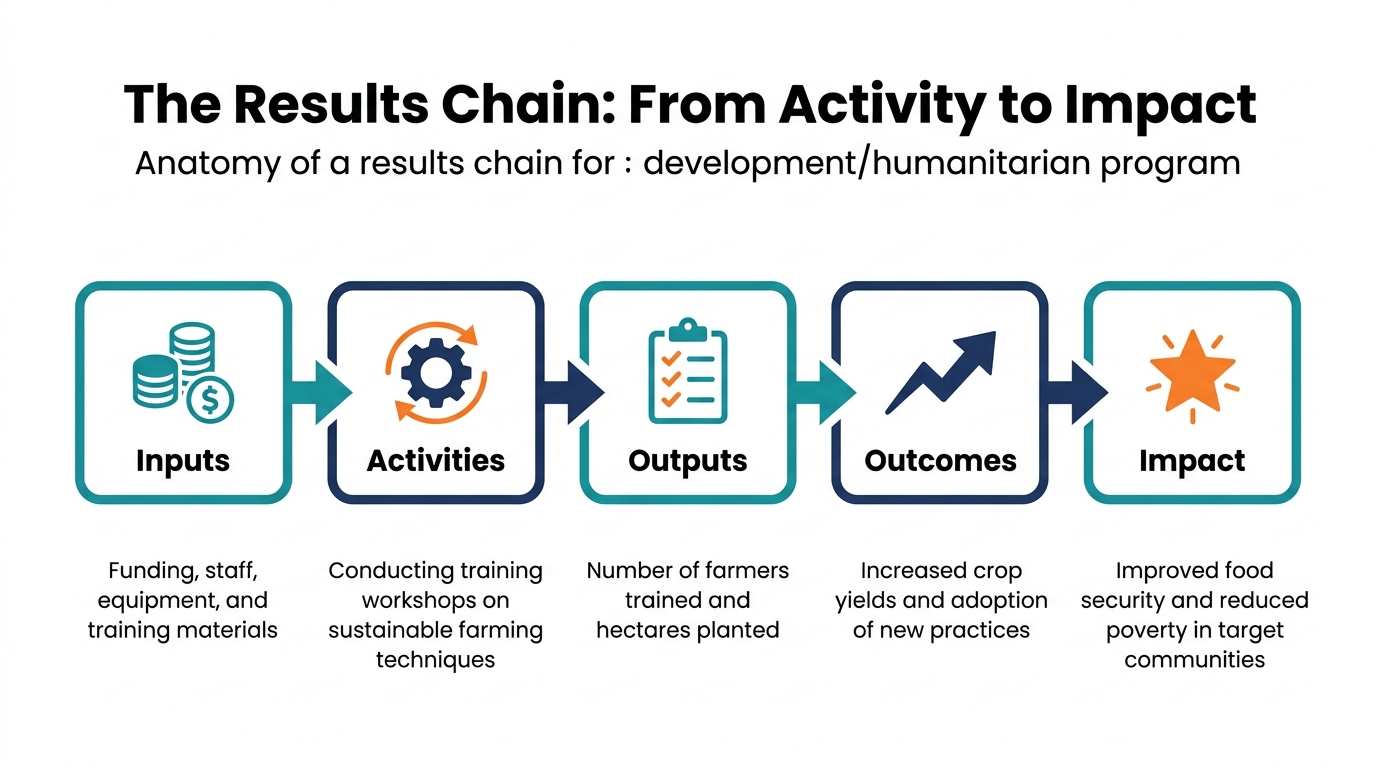
Before jumping into steps, it helps to understand the anatomy. A well-formed results chain moves from left to right (or top to bottom, depending on your layout) across these levels:
| Level | What it represents | Example |
|---|---|---|
| Inputs | Resources invested | Staff, funding, equipment |
| Activities | What the program does | Training sessions, policy advocacy |
| Outputs | Direct products of activities | Number of people trained, policies drafted |
| Outcomes (short-term) | Changes in knowledge, attitude, behavior | Farmers adopt improved practices |
| Outcomes (medium-term) | Changes in systems or conditions | Increased household food security |
| Impact (long-term) | The ultimate change you seek | Reduced rural poverty |
The IOM Development Results Note makes an important point here: "Results are generated throughout the results chain and data should be collected during the various stages of implementation and at various levels." This means your M&E plan should not just measure the end state. It needs to track movement at each level.
A Step-by-Step Approach to Building One
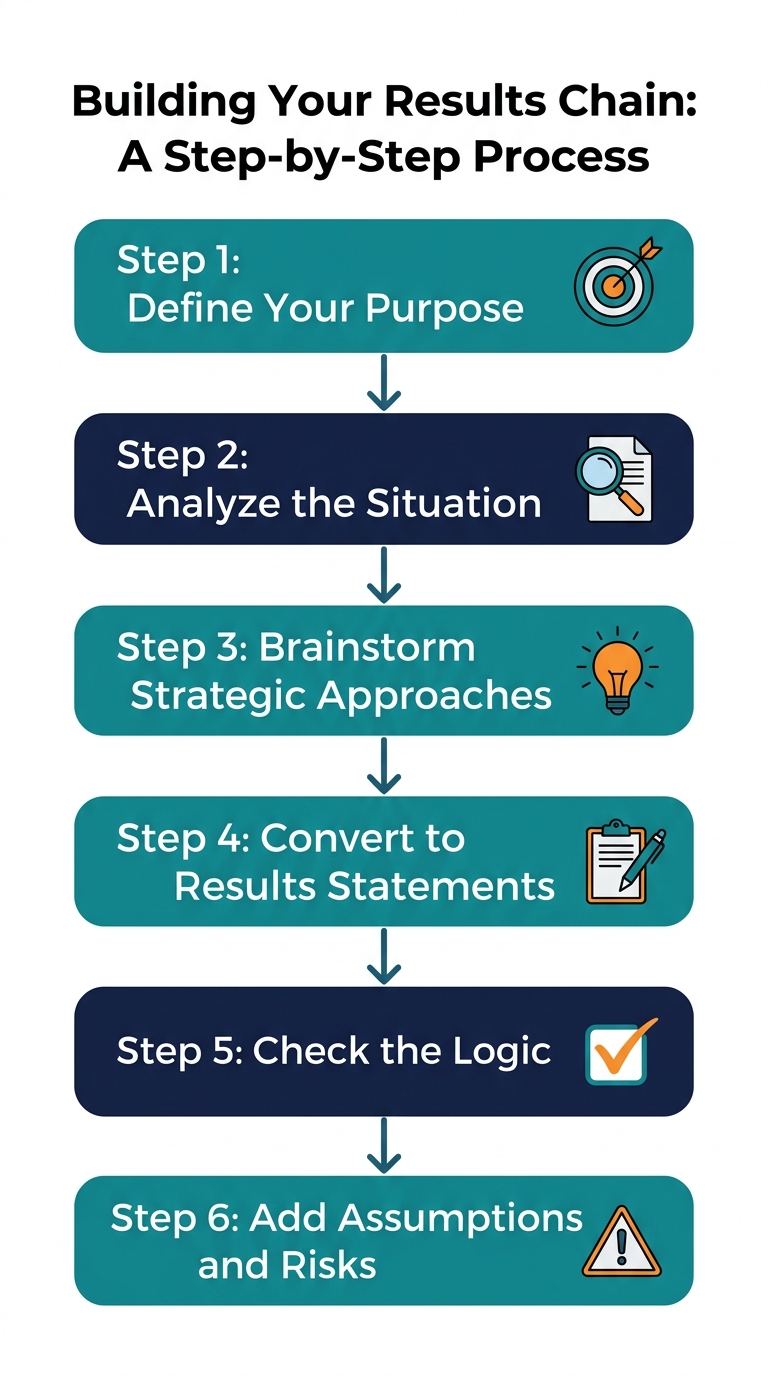
The USAID Biodiversity How-To Guide breaks the development process into 13 structured steps. I find that a simplified version of this framework works well for most humanitarian and development contexts. Here is how I would sequence it:
Step 1: Start with your purpose
Define what you are ultimately trying to achieve. Be specific. "Improve livelihoods" is not a purpose. "Reduce chronic food insecurity among smallholder households in Region X" is. Your entire chain will flow from this anchor point.
Step 2: Understand the situation
Before you design your strategy, analyze the drivers of the problem you are trying to solve. What causes the situation? Which of those causes are addressable by your program? USAID's guidance recommends selecting and separating relevant components from a situation model before adding any strategic layer. Skip this step and your results chain will be logical but wrong.
Step 3: Brainstorm and prioritize strategic approaches
Practical Action's PMSD Toolkit recommends starting simply: "list the activities and changes in boxes, and add additional detail until the full set of linked" steps emerges. Do not aim for perfection in the first draft. Get the logic out of your team's heads and onto paper.
Then prioritize. Not every strategic approach will be feasible, cost-effective, or within your mandate. Select the approaches that best address the key drivers you identified.
⚠️ Warning: Teams often try to cram too many strategic approaches into a single results chain. This makes it unreadable and unmanageable. If you have three distinct pathways to impact, build three separate chains and link them at the outcome level.
Step 4: Convert approaches into results statements
This is the step most teams get wrong. Activities are not results. "Conduct training" is an activity. "Farmers demonstrate improved post-harvest handling techniques" is a result. Every box in your chain, from outputs onward, should describe a state of change, not an action.
Step 5: Check the logic
Read the chain from left to right and ask: "If we do this, will that really happen?" Then read it right to left and ask: "For this to happen, what needs to be true first?" If any link feels weak or jumps too many steps, you need to add intermediate results or revisit your assumptions.
Step 6: Add assumptions and risks
This is listed as optional in the USAID guide, but I would argue it is essential. Every arrow in your results chain represents an assumption. Make the critical ones explicit. What needs to be true in the enabling environment for your logic to hold? What could derail it? This feeds directly into your risk register and your adaptive management process.
📝 Note: Assumptions are not the same as risks. An assumption is something you believe to be true for the chain to work. A risk is the possibility that an assumption turns out to be false. Both are worth documenting.
Linking Your Results Chain to Monitoring
Once your chain is solid, building your indicator matrix becomes much more straightforward. Each level of the chain suggests a category of indicators:
- Outputs: count-based, short-term, easy to verify
- Short-term outcomes: knowledge or behavior change, often measured by survey
- Medium-term outcomes: systems or condition changes, often harder to attribute
- Impact: long-term, measured at evaluation rather than routine monitoring
The discipline of the results chain is that it forces you to decide, up front, what change you expect to see and when. That clarity is what separates a results-oriented M&E system from one that simply collects data for reporting's sake.
If you want help turning your results chain into a full indicator matrix or performance tracking table, that is exactly the kind of work I do. Come try it at vera.ignex.io.
Common Mistakes to Avoid
- Starting with activities, not outcomes. Design backwards from impact, then work forward to activities.
- Conflating outputs and outcomes. Outputs are what you produce. Outcomes are what changes as a result.
- Ignoring the enabling environment. Your program does not operate in a vacuum. Build in assumptions about what the context needs to look like for your logic to hold.
- Building the chain once and never revisiting it. A results chain that does not evolve with your program is a theoretical exercise, not a management tool.
Final Thoughts
A results chain is not a bureaucratic requirement. It is a thinking tool. When built carefully, with real engagement from the program team, it becomes the backbone of everything else: your logframe, your indicators, your evaluation design, your learning agenda.
The 13-step process outlined in the USAID Biodiversity How-To Guide is one of the most rigorous frameworks I have seen for doing this well. But even a simpler version, done with honesty and rigor, will serve your program better than the most elaborate chain built in a hurry to satisfy a donor deadline.
Take the time. Make the logic visible. And then use it.
Sources
- Using Results Chains to Depict Theories of Change in USAID Biodiversity Programs (How-To Guide 2)
- Results Chains - Practical Action PMSD Toolkit
- Guidelines to the DCED Standard for Results Measurement
- Results Chain - Better Evaluation
- IOM Development Results Note
- Results Chains: a Tool for Conservation Action Design, Management and Evaluation (ResearchGate)
Put this into practice with Vera
Build logframes, indicators, surveys and reports in minutes — with an AI made for MEL.
Try Vera free →