The Assumptions Column Nobody Fills In: How to Use Logframe Assumptions to Actually Manage Risk
Stop treating assumptions as a formality. Here's how to make them do real work.
If you've reviewed as many logframes as I have, you know exactly what I'm talking about. The indicators column: filled in carefully, sometimes beautifully. The means of verification: a little thin, but something is there. The assumptions column: a handful of vague phrases like "political stability maintained" and "community cooperation assumed," copy-pasted from the last proposal, never revisited again.
It's one of the most consistent patterns I see across organizations of every size and donor type, and it matters enormously, because the assumptions column is the place where the vertical logic of your logframe either holds or falls apart.
Why Assumptions Are the Real Logic Test
A logframe [1] is built on a chain of "if-then" relationships: if you do the activities and the assumptions hold, you get the outputs; if you have the outputs and the assumptions hold, you achieve the purpose; if you achieve the purpose and the assumptions hold, you reach the goal. That last part, "and the assumptions hold," is doing a lot of heavy lifting that most teams quietly skip.
When I read a logframe, I go to the assumptions column first [2]. Not because I'm being contrarian, but because that's where honest thinking shows up, or doesn't. A team that has genuinely stress-tested its theory of change will have assumptions that are specific, plausible, and sometimes uncomfortable to admit. A team that rushed through will have assumptions that are so broad they could apply to any project anywhere.
💡 Tip: A good assumption should be able to fail. If you can't imagine a real scenario where that assumption breaks down, it's not a meaningful assumption -- it's a placeholder.
The World Bank's logical framework handbook [3] defines an assumption as an external condition that is necessary for the project's logic to hold, but that is outside the control of the project team. That's a tight definition, and it's worth taking seriously. "Community cooperation" is not an assumption under that definition -- it's a vague hope. "Village health committees meet at least monthly and are empowered to refer cases to the district clinic" is an assumption.
The Difference Between an Assumption and a Risk
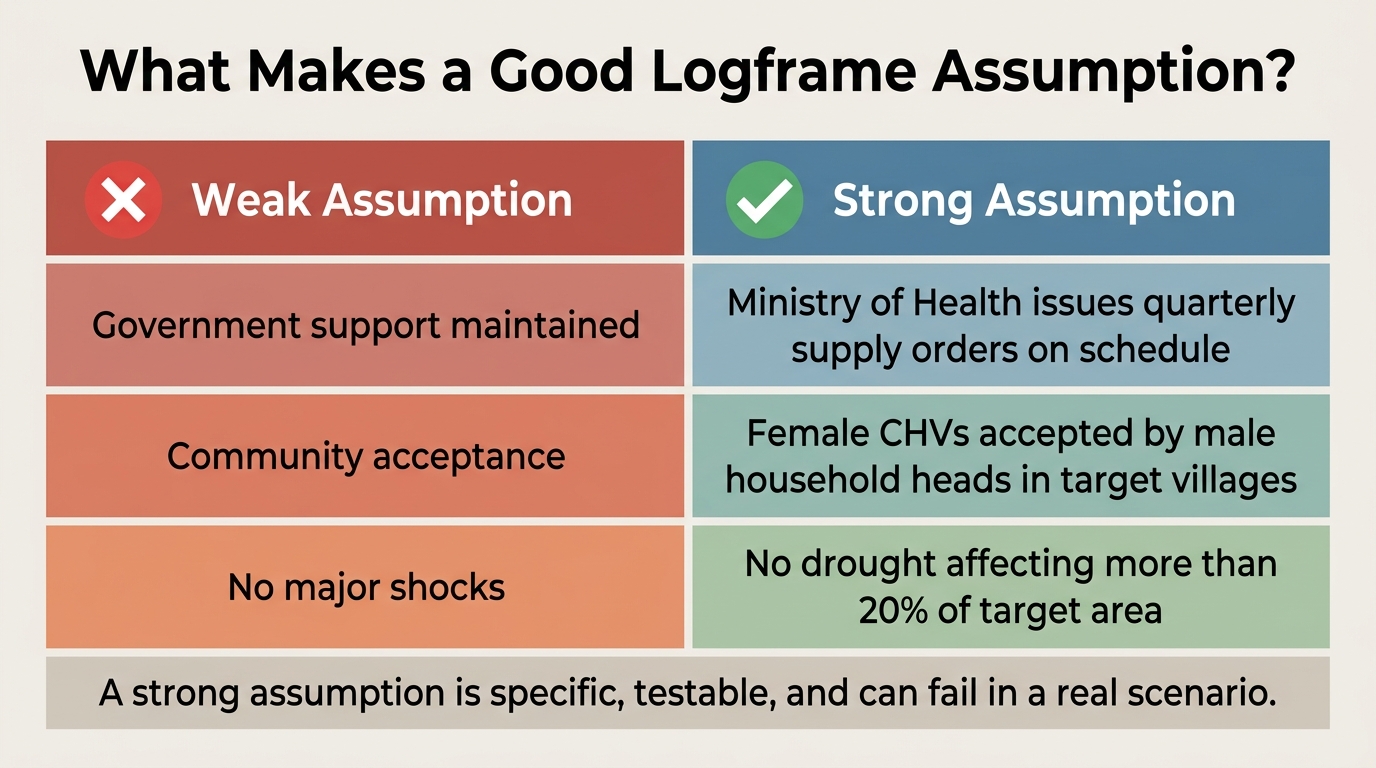
This is a distinction worth pausing on. An assumption is stated positively: the condition you expect to be true [4]. A risk is its negative mirror: what happens if that condition fails. Both are useful, but they serve different purposes in project management.
In a logframe, you write assumptions positively because the matrix is asking: "what external conditions must hold for your logic to work?" The risk register or risk matrix is where you explore what happens when those conditions don't hold. The two tools should be speaking to each other -- but that only works if your assumptions are specific enough to generate a real corresponding risk.
| Weak Assumption | Stronger Version | Corresponding Risk |
|---|---|---|
| Government support maintained | Ministry of Health issues quarterly supply orders on schedule | Stockouts occur if MoH procurement is delayed beyond 6 weeks |
| Community acceptance | Female community health volunteers are accepted by male household heads in target villages | Low male caregiver uptake reduces household-level behavior change |
| Funding continues | Donor tranche 2 disbursed before month 8 | Activity gap if disbursement delayed, affecting output 3 timeline |
| No major shocks | No drought or flood affecting more than 20% of target area during planting season | Household food security outcomes undermined in years of poor rainfall |
Notice how the stronger assumptions can actually be monitored. You can check whether MoH supply orders are on schedule. You can track acceptance of CHVs through your community feedback mechanisms. You can watch the calendar for disbursement. The weak versions give you nothing to act on.
How to Write Assumptions That Work
The process I'd recommend starts with your vertical logic -- the "if-then" chain from activities to outputs to purpose to goal. At each link in that chain, ask: what conditions outside our control have to be true for this link to hold?
- Brainstorm freely first. List every condition you can think of -- political, social, economic, environmental, institutional. Don't filter yet.
- Filter by control. Remove anything your team can actually influence. Those belong in your work plan or risk mitigation strategy, not in the assumptions column.
- Filter by importance. Remove assumptions that are so unlikely to fail that they add no information (e.g., "the sun continues to rise"). What remains should be conditions that are genuinely uncertain and genuinely consequential.
- Rewrite for specificity. Turn vague phrases into testable statements. Use observable language: quantities, frequencies, named actors, thresholds.
- Assign a signal. For each assumption, decide how you will know if it starts to fail. What data, what event, what report will give you early warning?
📝 Note: Tools4dev's logframe guidance [5] is clear that assumptions should reflect realistic conditions for the project context, not aspirational ones. Writing an assumption you secretly think is unlikely is a form of proposal fiction -- and it will catch up with you at evaluation.
From Formality to Risk Management Tool
Here's where most logframes stop, and where I think the real value begins.
An assumption written into a proposal and never looked at again is just documentation. An assumption that has an assigned "signal" and a named person responsible for watching it becomes a monitoring trigger. If you build your assumptions into your routine monitoring system -- whether that's a simple monthly checklist or a more structured indicator performance tracking table -- you shift from passive documentation to active risk management.
The logic is straightforward. If assumption A (say, "district health officer maintains engagement and co-facilitates quarterly reviews") is starting to fail -- the DHO missed the last two review meetings, hasn't responded to scheduling requests -- you now have advance warning before the output it supports is compromised. You can escalate, adapt, flag to the donor, or redesign the activity. That's dramatically better than discovering at the mid-term evaluation that a critical assumption collapsed six months ago.
⚠️ Warning: The most dangerous assumptions are the ones that feel "almost certain" -- the ones your team doesn't want to name because naming them feels like admitting fragility. Those are exactly the ones to name.
If you'd like help turning your logframe assumptions into a monitored risk-tracking tool, that's exactly the kind of work I can help you with at vera.ignex.io -- from drafting a strong assumptions set to building it into an IPTT or monitoring checklist.
What a Living Assumptions Column Looks Like
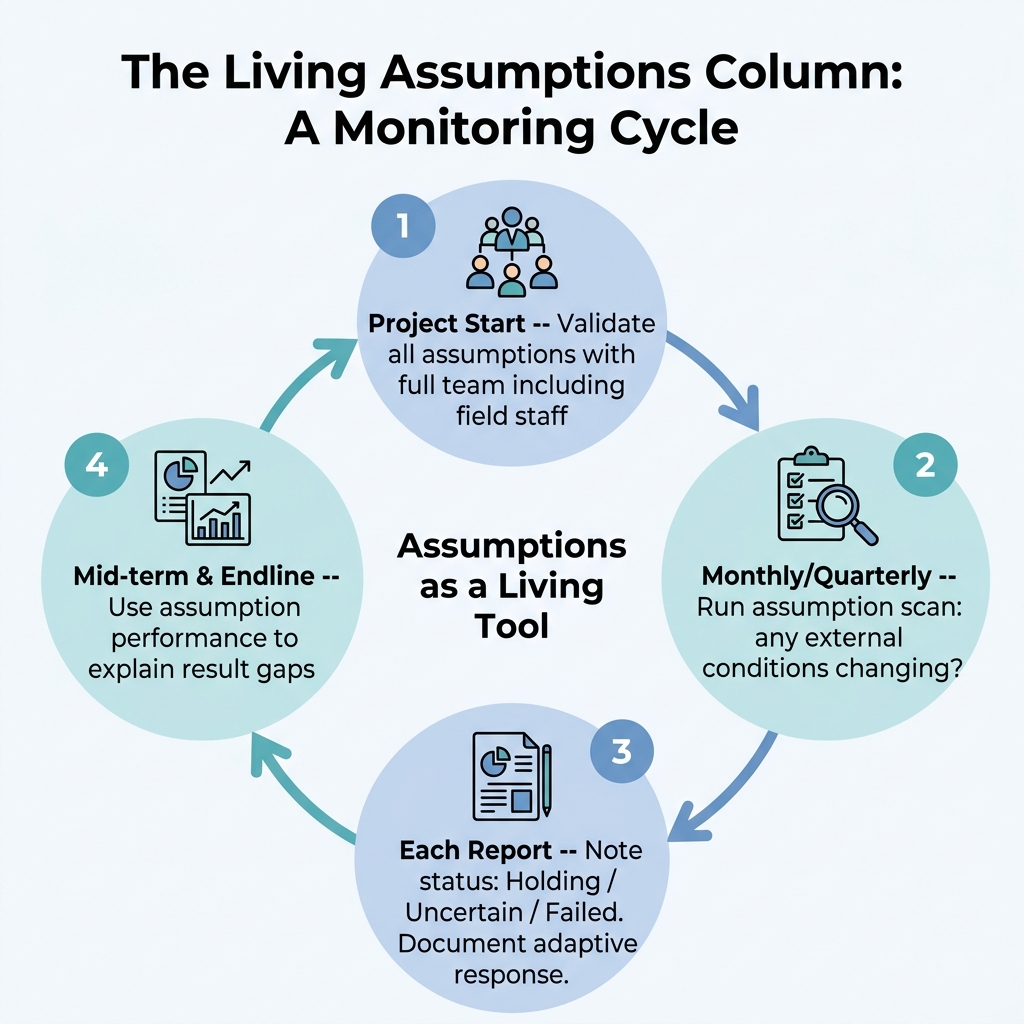
The best logframes I've worked with treat the assumptions column the same way they treat indicators: as living data that gets reviewed at every reporting cycle. Concretely, that means:
- At project start: Review and validate all assumptions with the full team, including field staff who know the context best.
- Monthly or quarterly: Run a brief "assumption scan" -- has anything changed for any of the key external conditions? Flag any assumption showing early stress.
- At each reporting cycle: Note the status of each critical assumption in your progress report: holding, uncertain, or failed. If failed or uncertain, document the adaptive response.
- At mid-term and endline: Use assumption performance as an explanatory lens for any gaps between expected and actual results. This is legitimate and important evaluation evidence, not an excuse.
This approach aligns with how the World Bank's handbook [3] frames the logframe as a living management tool rather than a static proposal annex. The point was never to have a filled-in matrix. The point was to have a shared, honest model of how the project works and what could break it.
💡 Tip: In your quarterly review meetings, spend 10 minutes reading through the assumptions column out loud with your team. Ask: "Is this still true? Are we seeing any early warning signs?" That small habit is worth more than most risk workshops.
The Payoff
When assumptions are treated seriously, a few things happen consistently. Proposals get more realistic -- which is better for everyone, including the donor who otherwise funds projects that miss targets for avoidable reasons. Teams think more clearly about what is and isn't in their control, which improves both planning and accountability conversations. And when things do go wrong -- because they will -- there's a documented, honest account of why, grounded in the external conditions the team was monitoring, not a scramble to explain a surprise.
The assumptions column is not a formality. It's a map of everything your project is betting on that you can't control. Filling it in well, and actually using it, is one of the highest-leverage things a MEL team can do.
Sources used in this article are listed below.
Follow Vera for more on MEL & project management: LinkedIn · Instagram · Facebook · X
Sources
Put this into practice with Vera
Build logframes, indicators, surveys and reports in minutes — with an AI made for MEL.
Try Vera free →