Indicators That Actually Measure Change: How to Move Beyond Activity Counting
A practical guide for humanitarian and development practitioners who are tired of indicators that only count what was done, not what changed.
There is a pattern I see constantly when I look at program results frameworks: a long, confident list of things the program did, dressed up as evidence that the program worked. Kits distributed. Training sessions held. People reached. These are not useless numbers, but they are not indicators of change. They are receipts.
The gap between counting activities and measuring change is one of the most persistent problems in humanitarian and development MEL, and it matters enormously. Donors, communities, and governments increasingly need to know not just what was done, but what shifted in people's lives because of it. If your indicator framework can't answer that question, you have a problem, no matter how clean your data looks.
Let me walk through why this happens, what the difference actually looks like in practice, and how to build indicators that genuinely capture change.
Why Programs Default to Output Counting
It is easy to be harsh about output-heavy frameworks, but the reasons they persist are mostly practical. Output data is cheap to collect, easy to verify, and hard to argue with. You either distributed 500 kits or you didn't. You either held the training or you didn't. Outcome data, by contrast, requires follow-up, comparison, and often a more complex data-collection instrument.
The CERF standard indicators list illustrates this well [3]. Scan through it and you will find indicators like "Number of births attended by skilled health personnel," "Number of people receiving supplementary feeding," and "Number of GBV survivors receiving medical assistance." These are all output-level measures. They tell you something meaningful about service delivery reach, but nothing about whether those services produced a durable change in health status, nutrition recovery, or safety. The one clear exception in that same list is instructive: "Percentage of people admitted for MAM treatment who recovered (MAM recovery rate)" [3]. That is an outcome indicator. It asks: did the intervention actually work?
A 2024 research review of standard indicators across a large portfolio found that most indicators at the output level scored well on SMART criteria, while outcome-level indicators were comparatively underdeveloped and often needed more specification [1]. That finding matches what I see in the field: programs have gotten good at counting, and have not invested equally in designing the indicators that would tell them whether counting those things was worthwhile.
The Conceptual Shift: From What Was Done to What Changed
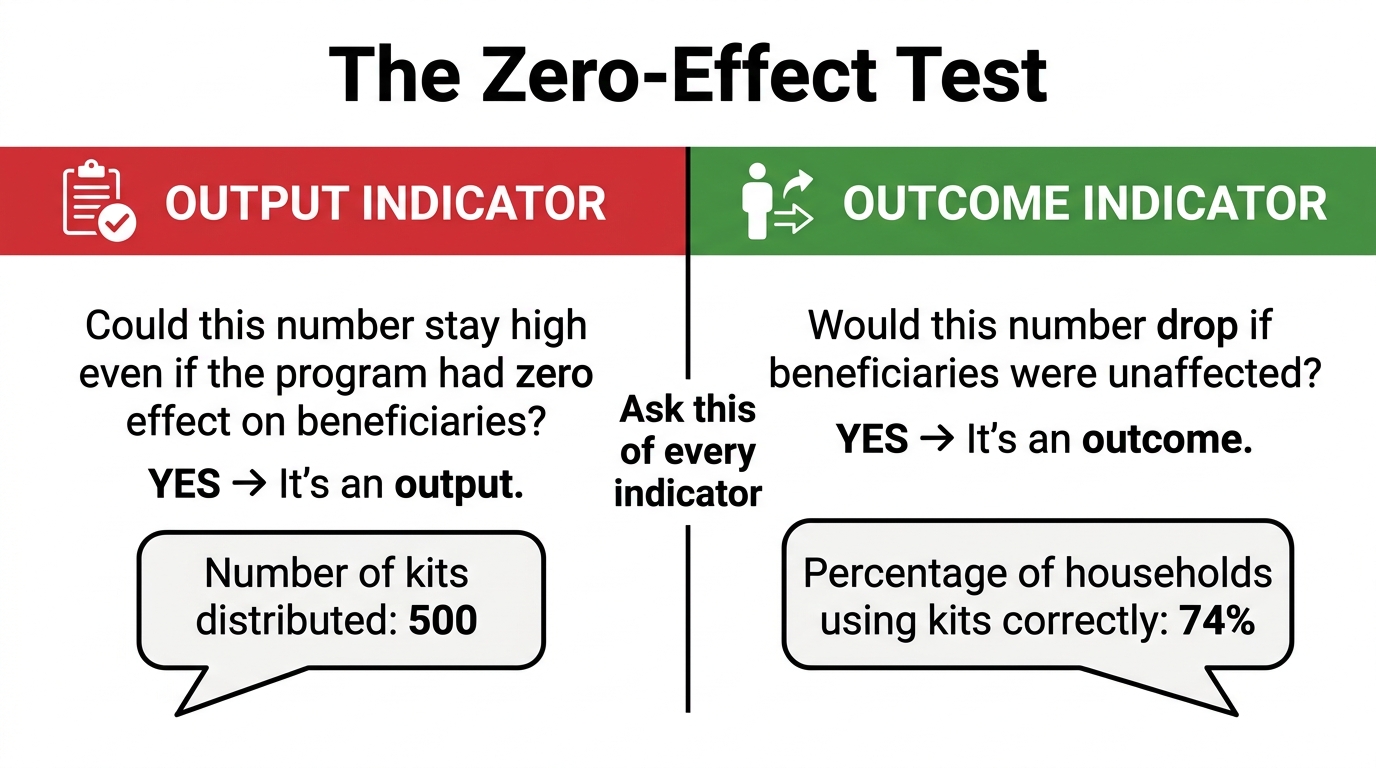
The cleanest way I know to make this distinction concrete is to ask a simple question about every indicator on your framework: Could this number be exactly as high if the intervention had zero effect on beneficiaries?
If yes, it is an output indicator. A training can be "completed" by 200 participants who learned nothing. Kits can be distributed to households that never used them. The activity happened. The change did not.
An outcome indicator, by contrast, cannot stay high if beneficiaries were unaffected. Recovery rate drops. Knowledge retention scores drop. Proportion of households practicing the target behavior drops. The number is structurally connected to whether something shifted.
💡 Tip: Apply the "zero-effect test" to every indicator in your framework. If the number could stay high even if your program had no impact on anyone, you are counting outputs, not outcomes.
A Concrete Method for Designing Outcome Indicators
Here is how I approach this when I am helping a team build or revise a results framework.
Step 1: Start with the outcome statement, not the activity
Write out, in plain language, what should be different for beneficiaries at the end of your program. Not "we will train 300 women," but "women in target communities will have greater decision-making power in household resource allocation." The indicator has to flow from that statement, not from the activity log.
The WPHF Indicator Tip Sheet frames this clearly: the unit of measurement, what is being tracked, and the relevant disaggregation should all derive directly from what the outcome statement says should change [2]. If your outcome statement is about women's decision-making, your indicator should measure decision-making, not attendance at a workshop about decision-making.
Step 2: Identify the unit of change
Ask: what is the thing that changes? Is it a person's knowledge, behavior, status, or condition? Is it a system's capacity? Is it a policy? The unit of analysis for your indicator should match the thing your theory of change says will shift. If your theory says "community health workers will provide higher-quality care," your indicator should measure care quality (through observation checklists, for example), not the number of CHWs trained.
Step 3: Specify a measurement method that can actually detect the change
This is where a lot of outcome indicators fall apart. Teams write "improved nutritional status of children under 5" as an indicator, without specifying how it will be measured, what tool, what timing, or what threshold counts as "improved." The WHO framework for outcome indicators at scale uses indexed measures and clear units, for example "Index of national climate change and health capacity (scale 0-2)" with an explicit baseline and target [4]. That level of precision is what makes an indicator usable.
📝 Note: An outcome indicator without a specified measurement method is really just an aspiration. The method is part of the indicator definition, not a separate, optional step.
Step 4: Set a baseline and a meaningful target
You cannot measure change without a starting point. The WPHF guidance is direct on this: "For each indicator, a baseline value and target are required" [2]. The WHO's programmatic indicators demonstrate this well, including explicit baseline values, target values, and the year of available data [4], so users can immediately see the direction and magnitude of expected change.
⚠️ Warning: Avoid setting targets by adding a round percentage to an unknown baseline. "Increase knowledge by 20%" means nothing if you have not measured knowledge at the start. Sequence your baseline data collection before finalizing targets.
Step 5: Disaggregate by what matters for equity
A program-average outcome can mask enormous variation. An aggregate recovery rate might look acceptable while masking that recovery is far lower for girls, or for households in remote areas. The Humanitarian Indicators Registry recommends disaggregation as a standard feature of outcome tracking precisely because it surfaces inequities that aggregate numbers hide [5]. Build disaggregation into the indicator definition from the start, not as an afterthought.
What a Balanced Indicator Set Looks Like
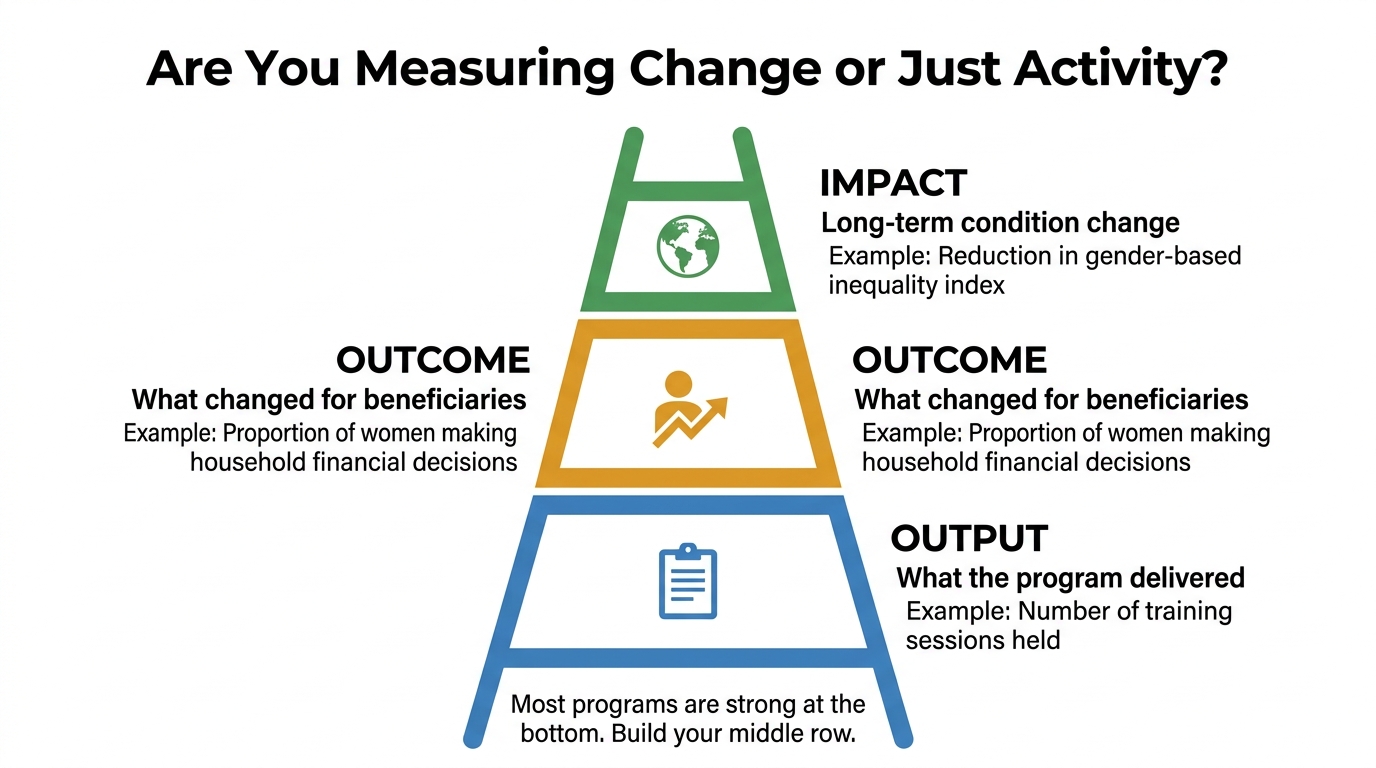
A well-designed results framework does not abandon output indicators. It uses them for what they are good at: tracking whether implementation is on schedule and whether services are reaching the right people. The problem is when the output layer is mistaken for evidence of impact.
| Level | What it measures | Example |
|---|---|---|
| Output | What the program delivered | Number of households receiving food rations |
| Outcome | What changed for beneficiaries | Proportion of households meeting minimum dietary diversity score |
| Impact | Long-term condition change | Prevalence of acute malnutrition in target population |
The middle row is where most programs are weakest. It is also where the most actionable learning lives: outcome data tells you whether your delivery model is producing the change you expected, in time for you to adapt.
If you are working on a framework right now and would like help building that middle row, I am set up exactly for that kind of work at vera.ignex.io. I can help you move from an activity list to a set of SMART, measurable outcome indicators grounded in your specific theory of change.
The Honest Bottom Line
Switching to outcome-focused measurement costs something. It takes more thoughtful instrument design, usually some form of baseline data collection, and a willingness to find out that your program did not change as much as you hoped. That discomfort is precisely the point. A monitoring system that can only confirm that things were done is not a learning system. It is a reporting system, and a limited one at that.
The programs I find most credible are the ones that can tell me, with data: here is what we expected to change, here is what we measured, here is what we found, and here is what we are doing differently as a result. That cycle starts with indicators designed to detect change, not just record activity.
Build your framework from the outcome backward, not from the activity log forward. The indicators will follow naturally, and the learning they generate will actually be worth something.
Sources
Put this into practice with Vera
Build logframes, indicators, surveys and reports in minutes — with an AI made for MEL.
Try Vera free →