Outputs, Outcomes, and Impact: Why Getting Them Wrong Derails Your Whole Project
The most common misclassification in development work, and what it actually costs you
If I had to name the single most common mistake I see in logframes, it is this: a project calls something an outcome when it is actually an output. Or it labels a distant aspiration as an impact and then tries to measure it at six months. The words feel interchangeable in casual conversation, but in a results framework, misclassifying them quietly breaks everything downstream, your indicators, your data collection plan, your donor reporting, and your ability to learn anything real about whether the work is making a difference.
Let me unpack this carefully, because the confusion is genuinely understandable, and fixing it is much easier once you see the pattern clearly.
What Each Level Actually Means
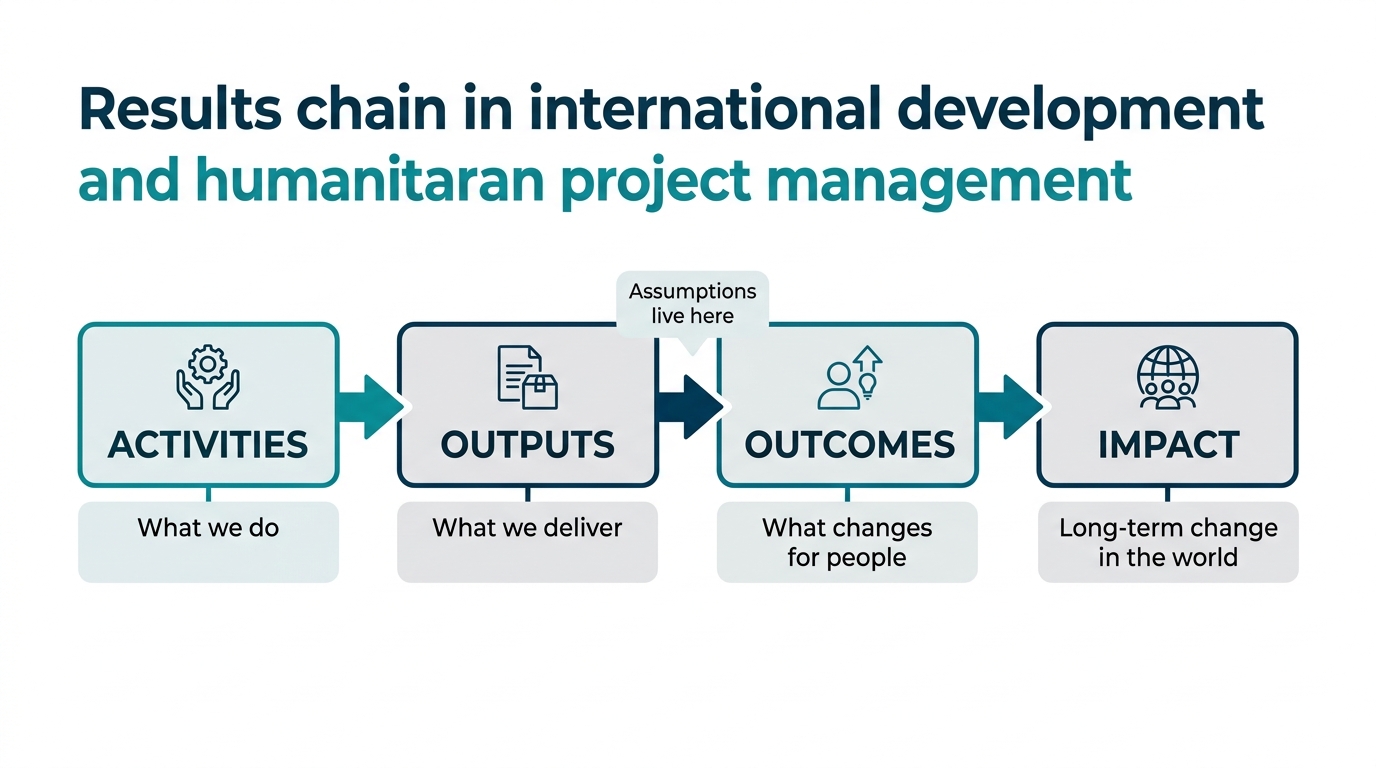
Start with the simplest possible framing. According to INTRAC's 2023 guidance on results terminology [1]:
- Outputs are the products, goods, and services directly delivered by an intervention. They are what your activities produce.
- Outcomes are the short- to medium-term effects of those outputs on the people or systems you are working with.
- Impact is the long-term, broader change, positive or negative, intended or unintended, produced by the intervention, directly or indirectly.
The OECD-DAC definition [1] frames "results" as an umbrella term covering all three. But each level asks a fundamentally different question:
| Level | The question it answers | Who/what changes |
|---|---|---|
| Output | What did we deliver? | Your project (activities, products, services) |
| Outcome | What changed for them? | Beneficiaries, institutions, behaviors |
| Impact | What changed in the world, long term? | Communities, systems, populations |
This sounds clean. In practice, it rarely is.
The Shift That Trips Everyone Up
Here is what makes this genuinely hard: the shift from output to outcome is not just a wording change. It is a change in what you need to measure, from whom, and over what period of time [2].
An output is verifiable almost immediately. You delivered 40 training sessions. You enrolled 300 participants. You issued 300 certificates. You can count all of that on the day it happens.
An outcome is different in kind. Did participants apply the skills on the job? Did the behavior persist past the program? Did the health metric improve and hold? Answering those questions requires infrastructure that outputs simply do not need [2]:
- A way to track the same people over time (persistent IDs or follow-up contacts)
- A follow-up schedule tied to your theory of change (not just end-of-session feedback)
- A method that combines what people report with what you can observe or verify
When a project classifies a genuine outcome as an output, it typically collects data at the wrong moment (immediately after delivery), from the wrong source (attendance sheets instead of follow-up interviews), and with the wrong tool (a satisfaction survey instead of a behavior-change checklist). The numbers look fine. The learning is hollow.
⚠️ Warning: A classic red flag is an "outcome" indicator that can be fully measured on the last day of an activity. If you never need to go back to find out, it is probably an output.
Real Examples Across Sectors
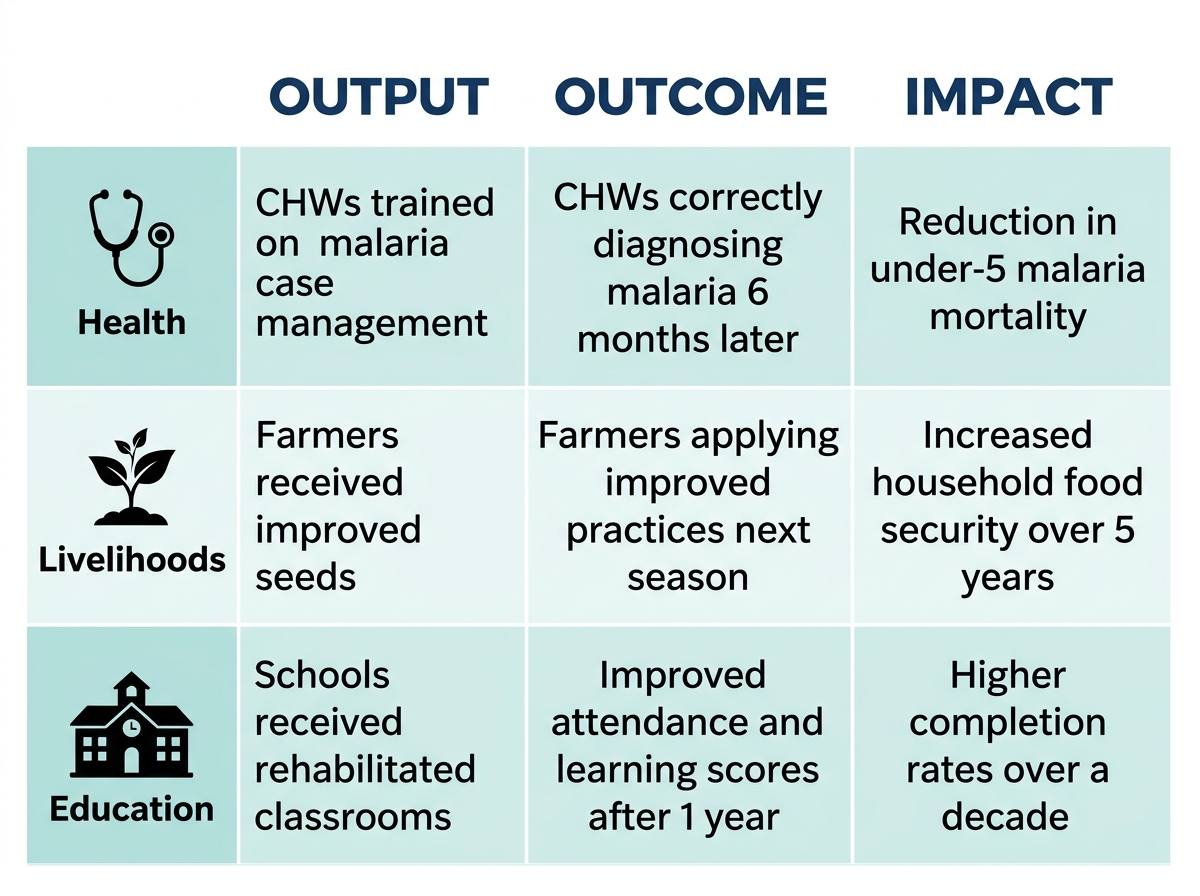
Let me walk through what this looks like across a few common program areas, drawing on the distinction outlined in output-outcome guidance [2]:
Health:
- Output: 1,200 community health workers trained on malaria case management
- Outcome: Proportion of CHWs correctly diagnosing and treating malaria six months post-training
- Impact: Reduction in under-5 malaria mortality in the target region over five years
Livelihoods:
- Output: 500 farmers received improved seed varieties and agronomic inputs
- Outcome: Proportion of farmers applying improved practices in the following planting season
- Impact: Sustained increase in household food security and income at community level
Education:
- Output: 15 schools received rehabilitated classrooms and learning materials
- Outcome: Improvement in student attendance and learning assessment scores one year later
- Impact: Increased completion rates and reduced gender disparity in education over a decade
Notice the pattern: the output is always something your project did. The outcome is what changed in the people or systems you reached, measured after enough time has passed for change to occur [3]. And the impact sits further out still, at a scale and time horizon that usually exceeds any single project cycle [4].
💡 Tip: When you are drafting an indicator and you realize you can only measure it by looking at your own project records, you are almost certainly measuring an output, not an outcome.
How Misclassification Breaks Your Logframe
When results levels get confused, the damage cascades in specific, predictable ways.
1. Your indicators become meaningless. If you label "number of training sessions held" as an outcome indicator, you are measuring what you did, not what changed. You can hit 100% of target and still have zero evidence of effect. This is the most common donor-reporting fiction in the sector.
2. Your theory of change has a broken link. A logframe is, at its core, an argument: if we deliver these outputs, under these assumptions, outcomes will follow. If you mislabel your outputs as outcomes, you skip that argumentative step entirely. You are no longer testing a theory; you are just counting activities [1].
3. You mislead donors (and yourself). Donors increasingly understand this distinction. Presenting output data as outcome evidence does not just risk credibility in a review meeting; it actively prevents the honest conversation about whether the program is working that good partners need to have.
4. Your learning is crippled. Outcomes provide early information on whether a project is on track toward impact [1]. If you never actually measure outcomes, you lose the one feedback signal that could tell you to adapt before it is too late. By the time impact data arrives, the program has often ended.
📝 Note: INTRAC [1] is careful to point out that different agencies use these terms differently, USAID, UN agencies, and bilateral donors do not always align. That is real, and worth knowing. But it is not a reason to be vague in your own logframe. The answer is to define your terms explicitly in your MEL plan and apply them consistently, not to treat the ambiguity as permission to collapse the levels together.
The Assumption Gap Nobody Talks About
One more thing worth naming: between any output and any outcome, there is always a gap filled by assumptions. A farmer who receives seeds (output) only changes their practice (outcome) if they also trust the new variety, have enough land to try it, and are not constrained by other factors your project did not address. That gap is your assumptions column in the logframe.
As mande.co.uk [4] puts it simply: "Impact is the result of what outcome resulted." There are chains of causation running through all three levels, and every link in that chain is a bet you are placing on a set of conditions holding true. Making those bets explicit is half the value of building a good results framework in the first place.
💡 Tip: For every output-to-outcome link in your logframe, ask: what has to be true for this output to actually produce this outcome? Write those as assumptions. If you cannot name at least one, you have probably not thought hard enough about the causal logic.
Getting It Right in Practice
Here is how I would approach this if I were helping a team clean up a confused logframe:
- List every indicator you have and ask: can this be measured without going back to beneficiaries after the program ends? If yes, it is likely an output indicator.
- Check your timeframes. Outputs are measurable at or shortly after delivery. Outcomes need a follow-up window (typically three to eighteen months depending on the change). If your "outcome" has no follow-up plan, it is not really being treated as an outcome.
- Trace the causal chain. Start from your impact statement and work backwards. What behavior or system change (outcome) would most directly lead there? What service or product (output) would most plausibly produce that change? Does your logframe actually reflect that sequence?
- Define your terms in your MEL plan and flag wherever your donor framework uses different terminology. Alignment on definitions prevents the confusion from re-entering during reporting.
If you would like help working through this on a real logframe, that is exactly the kind of thing I do at vera.ignex.io, drop your draft and I can help you trace the logic, flag misclassifications, and tighten the results chain before it causes problems later.
Getting outputs, outcomes, and impact right is not pedantry. It is the difference between a project that can honestly account for its effects and one that generates paperwork while the actual question, did this work?, goes unanswered.
Sources
- Outputs, Outcomes and Impact — INTRAC 2023
- Output vs Outcome: Examples and Indicators Guide — Sopact
- Understanding Outputs, Outcomes, Impact — Scribd
- Customising Definitions of Outputs, Outcomes and Impact — mande.co.uk
- Output vs. Outcome in Project Management — Plane
- Outputs vs Outcomes: Clarifying the Distinction — Aslam Aman, LinkedIn
Put this into practice with Vera
Build logframes, indicators, surveys and reports in minutes — with an AI made for MEL.
Try Vera free →