The KII Is Not Just a Conversation: How to Design Key Informant Interviews That Generate Real Evidence
Sampling, guide structure, probing techniques, and analysis, the full process for qualitative findings that actually hold up
I've worked through a lot of evaluation designs, and one pattern I keep seeing is this: organizations invest real time scheduling Key Informant Interviews, travel to meet community leaders and program staff, sit through an hour-long conversation, and then write up a two-page summary that no one can interrogate or verify. The KII becomes a quote mine rather than a genuine evidence source.
The problem usually isn't effort. It's that the KII was treated as a conversation rather than a method. There's a meaningful difference. Here's how I think about designing the full KII process so that your findings actually hold up.
What a KII Is (and Isn't)
A Key Informant Interview is a qualitative, in-depth interview conducted with individuals selected specifically for their first-hand knowledge about a topic of interest [1]. The CDC guidance puts the typical sample range at 15 to 35 people [4], not because that's a magic number, but because somewhere in that range, well-selected informants tend to reach thematic saturation: you stop hearing genuinely new perspectives.
What a KII is not is a structured survey read aloud, or a courtesy meeting with a program manager. The difference matters enormously for how you design the guide, conduct the session, and analyze the output. KIIs "delve deeply into individual perspectives, offering a granular understanding of complex issues" in ways that surveys cannot, and they do this precisely because they're flexible and semi-structured, not because they're casual [5].
📝 Note: KIIs differ from focus groups in a key way: you are accessing individual expert knowledge, not group dynamics or social consensus. If you need both, use both methods deliberately, not interchangeably.
Step 1: Purposive Sampling (This Is Where Evidence Is Won or Lost)
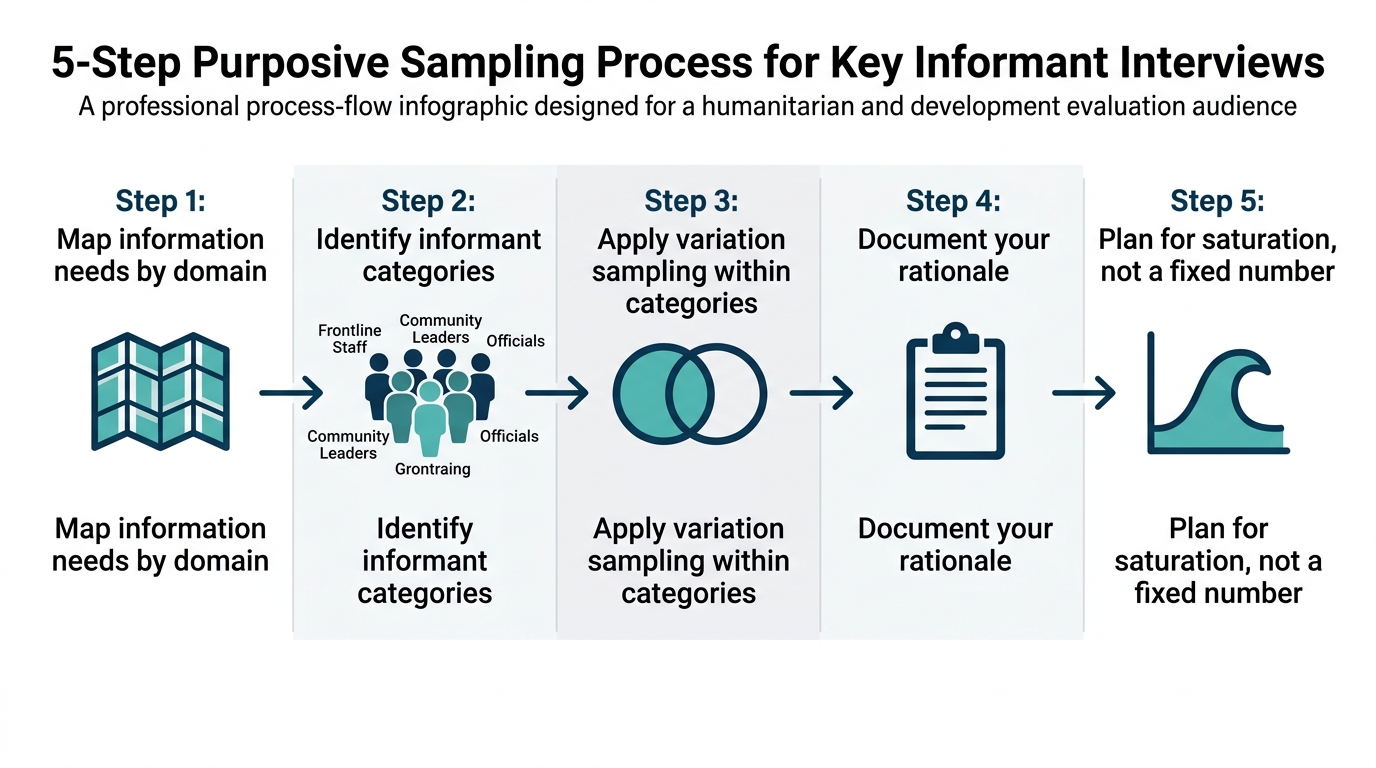
Most KII processes go wrong before the first question is asked, because the informant selection wasn't rigorous. Purposive sampling means choosing people because of what they know, not because they were available or easy to reach.
A published synthesis on key informant methodology notes that many applied researchers describe using "key informants" without explaining how they defined this role, how they conceptualized the value of information provided, or how they made decisions about identifying, sampling, and judging the sufficiency of data [6]. That absence of transparency is exactly what makes findings hard to defend.
Here's how I'd approach sampling deliberately:
- Map your information needs by domain. What aspects of the topic require insider knowledge? Service delivery gaps, community norms, policy context, implementation barriers, each may need different informant types.
- Identify informant categories, not just individuals. Think in terms of roles: frontline workers, community leaders, beneficiaries, government officials, implementing partners. Diversity across categories strengthens credibility.
- Apply variation sampling within categories. Within each category, seek variation in geography, gender, tenure, or experience level. This guards against capturing one faction's view.
- Document your rationale. For each informant, record why they were selected. This is what allows you to defend representativeness later.
- Plan for saturation, not a fixed number. Continue until new interviews stop introducing new themes. The 15-to-35 range [4] is a planning heuristic, not a stopping rule.
⚠️ Warning: Convenience sampling, interviewing whoever agreed to be interviewed, is the single most common threat to KII credibility. It introduces systematic bias toward accessible, articulate, often pro-program voices.
Step 2: Designing the Interview Guide (Not a Question List)
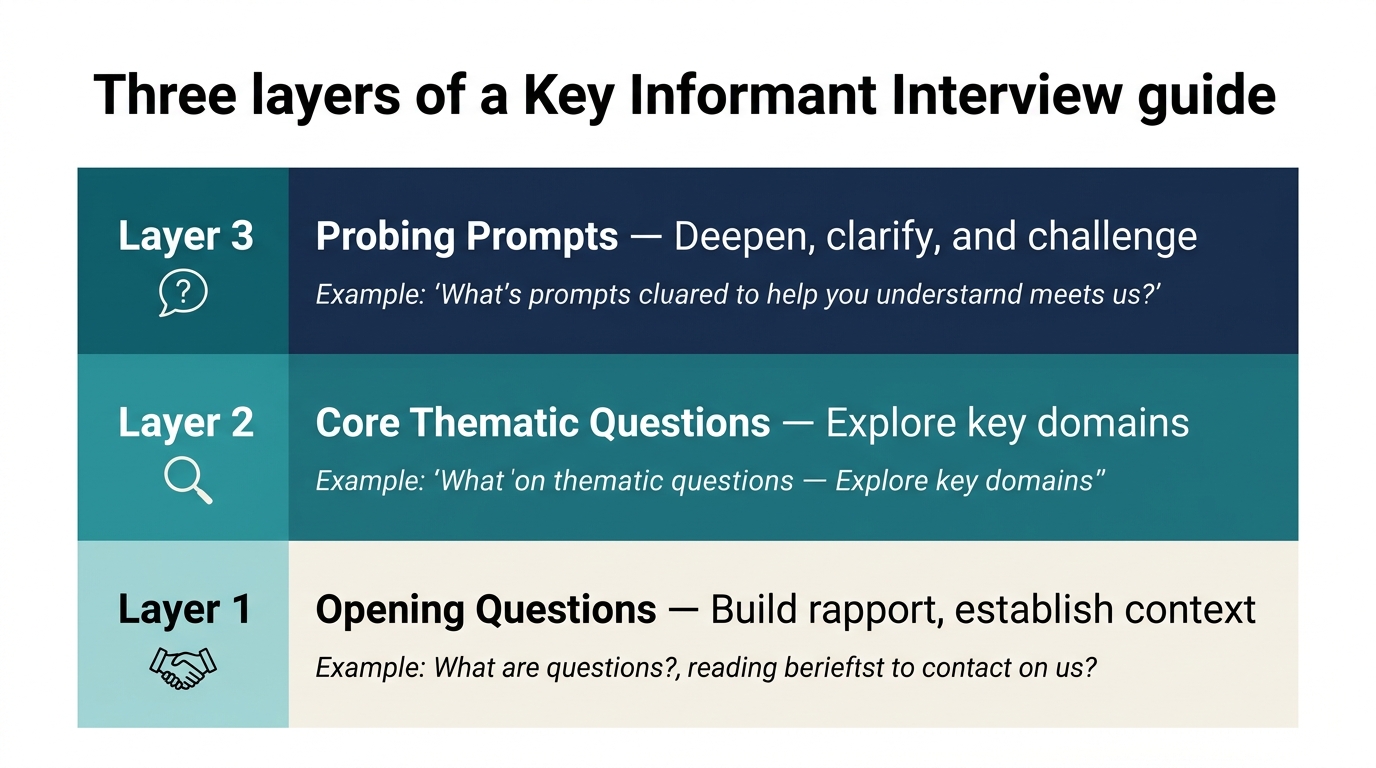
A KII guide is not a questionnaire. It is a framework for exploration that gives the interviewer enough structure to cover the topic and enough flexibility to follow what emerges.
The PTTC Network guidance describes KIIs as "structured conversations" [2], that phrase captures the balance well. Too structured, and you lose the depth that makes KIIs valuable. Too loose, and you can't compare findings across informants.
A well-designed guide typically has three layers:
| Layer | Purpose | Example |
|---|---|---|
| Opening questions | Build rapport, establish context | "Can you tell me a bit about your role and how long you've been working in this area?" |
| Core thematic questions | Explore the key domains | "What do you see as the main barriers communities face in accessing this service?" |
| Probing prompts | Deepen, clarify, and challenge | "Can you give me a specific example?" / "What do you mean by...?" / "What makes you say that?" |
The probing prompts are the most important and most neglected layer. Probes are what convert a polite answer into actual evidence. Good probes include:
- Elaboration probes: "Tell me more about that."
- Clarification probes: "When you say X, what do you mean specifically?"
- Example probes: "Can you walk me through a situation where that happened?"
- Challenge probes (used carefully): "Some people have said the opposite, that access has actually improved. What's your reaction to that?"
💡 Tip: Write your probing prompts into the guide itself, under each core question. Interviewers who have to invent probes on the spot tend to ask leading follow-ups or drop the probe entirely when they feel awkward.
Limit your core questions to 6 to 8. You will not get through 20 questions in depth in a 60-minute session. Trying to do so produces shallow answers across the board.
Step 3: Ethical Preparation and Data Security
If your KII touches sensitive topics or vulnerable populations, an IRB review or equivalent ethical clearance may be required before you start. The PTTC guidance is clear that this means submitting your interview protocol, consent script, recruitment plan, and data security procedures before data collection begins [2].
Even when formal IRB review isn't required, informed consent is non-negotiable. Informants should understand:
- What the data will be used for
- Whether they will be identified or anonymized
- That participation is voluntary and they can stop at any time
Data security matters too. Audio recordings, transcripts, and notes should be stored with access controls and, where appropriate, de-identified before analysis.
Step 4: Conducting the Interview
A few principles that I think make a real difference in interview quality:
- Open with relationship, not the guide. Spend the first few minutes letting the informant talk freely. People give richer answers once they trust you aren't going to misquote them.
- Follow the informant's logic, then steer back. If an informant takes an unexpected direction, follow it briefly, it may be the most important finding of the session. Then use a transition to return to your themes.
- Record with permission, and take backup notes. Relying on memory introduces distortion. Transcription, even partial, is far more analytically useful than notes alone.
- Close with a "meta" question. Something like: "Is there anything I didn't ask about that you think I should understand?" This consistently surfaces overlooked perspectives.
💡 Tip: For sensitive topics or contexts where recording isn't appropriate, consider a two-person team, one interviewer, one note-taker, so the interviewer can focus entirely on listening.
Step 5: Analysis That Produces Defensible Findings
This is where most KII processes are weakest. GeoPoll's guidance on KII methodology emphasizes that the goal is a "granular understanding of complex issues" [5], but granularity requires systematic analysis, not impressionistic summarizing.
A basic thematic analysis process for KII data:
- Transcribe or clean your notes promptly after each session, while context is fresh.
- Read across all transcripts before coding anything. Get a feel for the full corpus.
- Apply open coding, tag passages with descriptive labels (what is being said, not what you think it means).
- Group codes into themes, patterns that recur across multiple informants.
- Note disconfirming cases, informants whose views don't fit the dominant pattern. These are analytically important, not inconvenient.
- Triangulate, wherever possible, check themes against other data sources (program records, survey data, observation notes).
⚠️ Warning: A finding that comes from a single informant, however compelling, is not a finding, it is a lead worth investigating. Be disciplined about distinguishing the two in your report.
Document your analytic process. Who coded? Was there a second coder to check consistency? What was done when coders disagreed? These questions will be asked by any rigorous reviewer.
Putting It Together
The difference between a KII that produces real evidence and one that produces a collection of quotes is almost entirely in the process design: who you select and why, how your guide is structured, how your interviewers probe, and how systematically you analyze. The conversation itself is just the middle part.
If you're designing a KII component for an evaluation or needs assessment and want help building a guide, sampling matrix, or analysis framework, that's exactly the kind of work I do. Come find me at vera.ignex.io.
Sources: [1] Better Evaluation | [2] PTTC Network | [3] Washington University Evaluation Center | [4] CDC Performance Monitoring Tips | [5] GeoPoll | [6] PMC / Applied Qualitative Health Research
Sources
- Key Informant Interviews | Better Evaluation
- Conducting Effective Key Informant Interviews | PTTC Network
- Focus Groups and Key Informant Interviews: Best Practices | Washington University Evaluation Center
- Performance Monitoring & Evaluation Tips: Key Informant Interviews | CDC
- Key Informant Interviews: An In-Depth Guide for Researchers | GeoPoll
- Key Informants in Applied Qualitative Health Research | PMC
Put this into practice with Vera
Build logframes, indicators, surveys and reports in minutes — with an AI made for MEL.
Try Vera free →