The Theory of Change Trap: Why Most ToCs Look Good on Paper But Fall Apart in Practice
A practical guide to diagnosing and stress-testing the recurring failures that undermine theories of change before implementation begins
I've worked through enough logframes, program designs, and results frameworks to recognize a pattern: the theory of change that sounded airtight in a proposal workshop starts to unravel about three months into implementation. Not because the team wasn't thoughtful. Not because the context was unknowable. But because certain structural weaknesses were there from the start, quietly waiting.
This post is about those weaknesses. I want to name them specifically, show why they matter, and give you a way to stress-test your ToC before you're standing in the middle of a program year wondering why the causal chain isn't holding.
What a Theory of Change Is Actually Supposed to Do
Before diagnosing failure, it helps to be clear on the standard. A theory of change is not a diagram. It is not a summary of your activities. It is, as the CRS Practical Guidance puts it, the "logical flow between a key problem and its immediate and root causes, the long-term change it seeks to bring about... and what needs to happen in order for this change to come about" [1].
The UNDAF Companion Guidance adds a key dimension: a good ToC should articulate the causes of a development challenge, make assumptions explicit about how the proposed strategy will yield results, and test those assumptions against evidence, including what has and has not worked in the past [2].
That last part is where most ToCs quietly skip a step. They articulate causes. They describe the desired change. But they treat assumptions as background decoration rather than load-bearing structure.
📝 Note: A theory of change and a results framework are related but distinct. The RF shows what will be measured; the ToC explains why those results should occur. Confusing the two is one of the most common entry points for the failures described below [1].
The Five Recurring Failure Modes
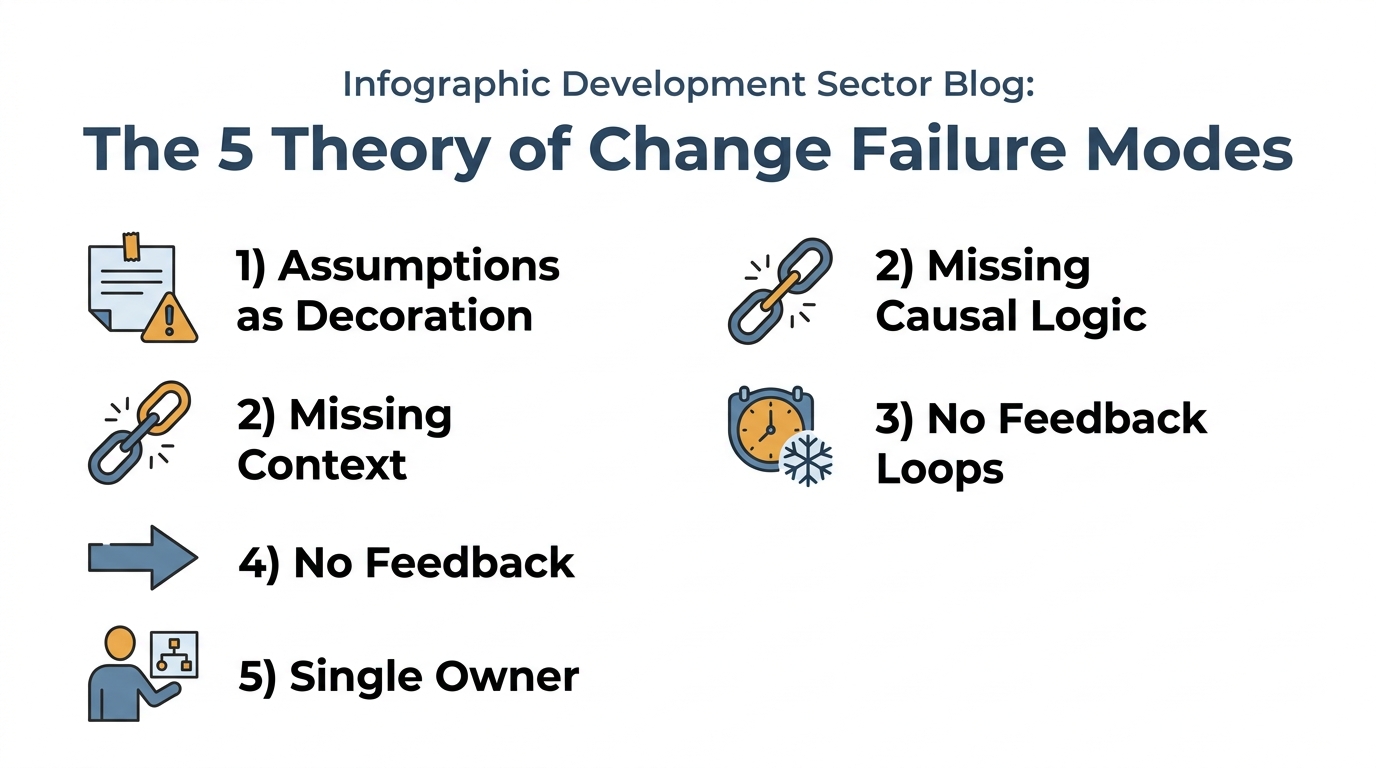
1. Assumptions Written as Decoration, Not as Risk
Every ToC includes an assumptions column or box. In practice, it almost always reads something like "community members are willing to participate" or "government counterparts remain committed." These are real considerations, but listing them as one-line afterthoughts treats them as fine print rather than as the structural joints that hold the whole causal chain together.
The DFID review of theory of change practice in international development found that assumptions are frequently under-specified and rarely revisited once the program begins [3]. The Annie E. Casey Foundation notes that for complex environments, where the operating context is "fluid and unpredictable," making assumptions genuinely explicit is especially critical, because the environment itself may influence strategy or implementation in ways that were not anticipated [4].
What good assumption documentation looks like is different from what teams usually produce. Each assumption should be:
- Stated as a testable condition, not a hope
- Assigned a likelihood assessment (high/medium/low probability of holding)
- Linked to a specific causal step it supports
- Tied to a monitoring trigger that tells you if it starts to break down
⚠️ Warning: If your assumptions list could be copy-pasted onto a different project in a different country without changing a word, your assumptions are probably not specific enough to be useful.
2. Missing Causal Logic Between Outputs and Outcomes
This is the gap I encounter most often. A ToC will describe a set of activities, jump to outputs (number of people trained, materials distributed, health workers certified), and then leap to an outcome like "improved household food security" or "increased civic participation." The mechanism that connects the output to the outcome is simply absent.
The CRS guidance is explicit that the ToC must map out not just desired changes but "what needs to happen in order for this change to come about" [1]. That "what needs to happen" is causal logic, and it requires naming the intermediate steps and the behavioral or systemic changes they depend on.
💡 Tip: For each output-to-outcome link in your ToC, write one sentence completing this prompt: "This output will lead to this outcome because..." If you cannot complete that sentence with specificity, the causal link is missing.
3. Context Treated as Static
A ToC developed during a proposal process reflects the context as it was understood at that moment. But programs run for three, four, or five years. Conflict dynamics shift. Political will changes. A neighboring intervention succeeds or fails and changes community expectations.
The CDA Collaborative guidance on theories of change in conflict and security contexts specifically flags this: programs frequently carry an "overall theory of change" that encodes fundamental assumptions about how change will come about, but those assumptions are rarely revisited as the operating environment evolves [5]. When context shifts, a ToC that was never designed to flex becomes a liability.
A well-built ToC should include contextual monitoring: a short list of environmental factors that, if they change, would require you to revisit the causal logic. This is different from your outcome indicators. These are signals about the world around your program, not the program itself.
4. No Feedback Loops
Most theories of change are linear. Activities produce outputs. Outputs produce outcomes. Outcomes contribute to impact. The arrow points one direction.
Real social change is not linear. Beneficiaries respond to your program and change their behavior, which changes what is possible in your next program cycle. Community leaders who gain capacity become actors who shape the context in which you are working. A one-directional causal map cannot represent this, and more importantly, it cannot be monitored for it.
The UNDAF Companion Guidance describes this as a core principle: the ToC should reflect iterative learning, including feedback from implementation, rather than functioning as a fixed blueprint [2]. Without feedback loops built into the design, there is no structural invitation to adapt.
💡 Tip: At your next ToC review, ask: "Where in this diagram does learning from implementation come back in?" If the answer is nowhere, the feedback loop is missing.
5. The ToC Is Owned by One Person
This is a process failure that produces a technical failure. When the theory of change is built primarily by a consultant during proposal development, or lives mainly in the head of the MEL manager, it becomes fragile. Program staff implement activities without understanding how those activities are supposed to connect to outcomes. When assumptions break down, no one flags it because no one is tracking the logic.
The Annie E. Casey Foundation emphasizes that developing a theory of change involves making "explicit collective assumptions", the word "collective" is doing real work there [4]. A ToC that is not understood and owned across the team is not a theory of change. It is a diagram.
How to Stress-Test Your ToC Before Implementation
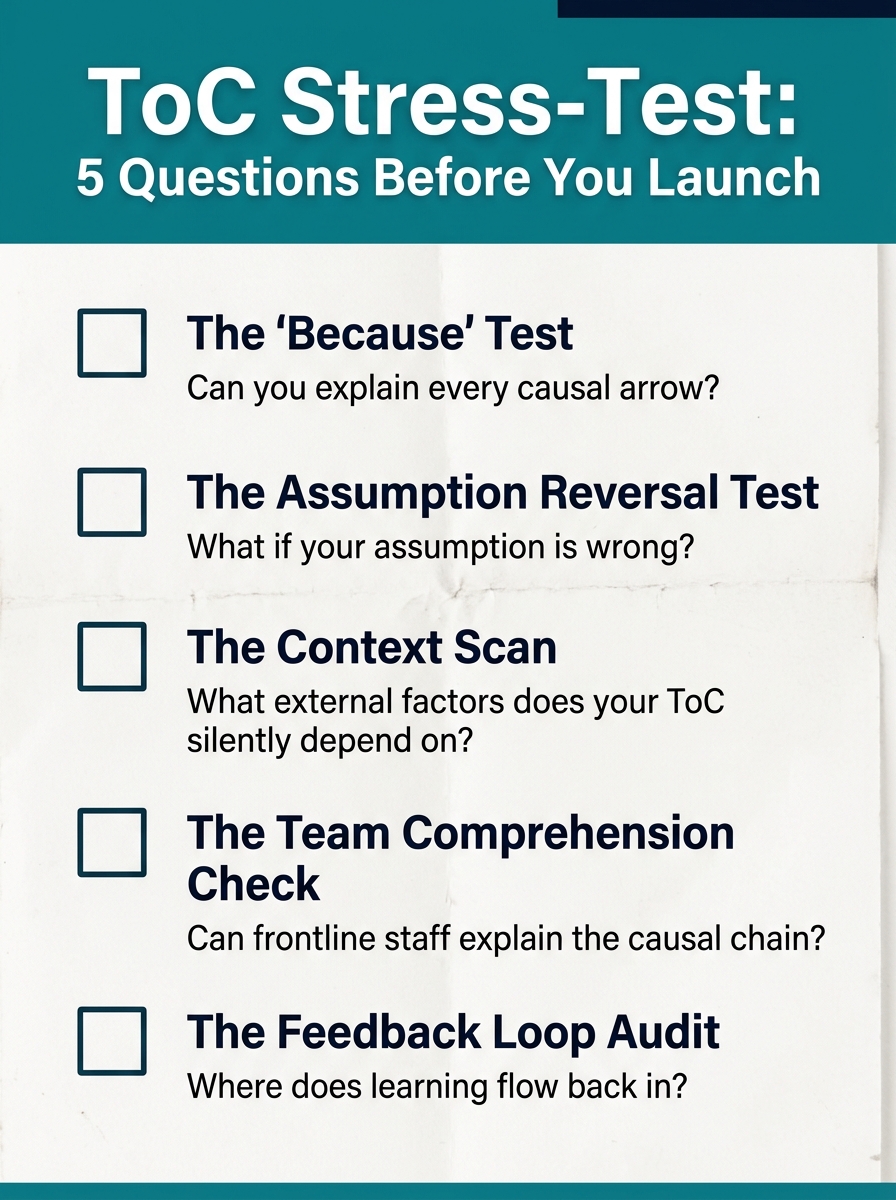
Here is the basic protocol I use when reviewing a theory of change for operational soundness:
- The "because" test: For every causal arrow, ask: "This leads to that because...?" Document the answer. Gaps in answers are gaps in logic.
- The assumption reversal test: Take each assumption and ask: "What happens to this causal chain if this assumption turns out to be wrong?" If the answer is "the whole chain collapses," that assumption needs either active monitoring or a contingency pathway.
- The context scan: List three to five external factors your ToC silently depends on. Assign a monitoring responsibility for each.
- The team comprehension check: Ask two frontline staff members to explain, in their own words, how their daily work connects to the program's longer-term outcomes. Their answers will tell you whether the ToC has been internalized or just filed.
- The feedback loop audit: Identify at least one point in the ToC where learning from implementation could flow back and modify the approach. If none exists, build one.
📝 Note: This stress-test works best as a facilitated team exercise, not a solo desk review. The conversation it generates is often more valuable than the revised diagram that results.
If you are heading into a design process, a mid-term review, or a program refresh and want a ToC that will actually hold up under implementation pressure, I am happy to work through it with you. You can find me at vera.ignex.io, bring your draft ToC, your logframe, or even just a problem statement, and we will build something that works in the field, not just in the proposal.
The goal, after all, is not a theory that looks good in a workshop. It is a theory that survives contact with reality.
Sources
- CRS Practical Guidance on Developing a Project's Theory of Change
- UNDAF Companion Guidance: Theory of Change (UNSDG)
- DFID Review of the Use of 'Theory of Change' in International Development
- How to Develop a Theory of Change — The Annie E. Casey Foundation
- Practical Approaches to Theories of Change in Conflict, Security and Justice (CDA Collaborative)
Put this into practice with Vera
Build logframes, indicators, surveys and reports in minutes — with an AI made for MEL.
Try Vera free →