The PDM Report That Changes Nothing: How to Turn Post-Distribution Monitoring Into Decisions, Not Just Data
Why most PDM cycles stop at the report, and what it actually takes to close the loop
I've worked through a lot of PDM cycles, and there is a pattern that shows up almost everywhere: a well-organized team conducts the survey, a careful analyst writes the report, someone uploads it to a shared drive, and then... nothing changes. The next distribution runs on the same assumptions as the last one. The complaints mechanism still has a 12-day response time. Targeting still misses the same household profiles.
The data was good. The report was thorough. But no one made a decision from it.
This isn't a data quality problem. It's a design problem, specifically, a problem with how PDM is positioned inside a program cycle. Here's what I've learned about fixing it.
What PDM Is Actually For
Let's start from first principles. According to UNHCR's guidance, post-distribution monitoring is conducted independently from the distribution itself, and its purpose is to collect information on whether distributions are actually meeting their objectives, things like access to basic needs, coping strategies, spending habits, and shelter outcomes [1].
The M&E Specialist's framing is just as useful: a PDM survey covers "the distribution process, timeliness, relevance, use and impact of the assistance distributed, and satisfaction of recipient populations" [5]. It can also include questions about the complaints and feedback mechanism and about recommendations for future distributions.
Notice that last word: recommendations. PDM is inherently forward-facing. It is not a documentation exercise. It is a learning exercise with a very specific audience, the people who will design or adjust the next distribution.
📝 Note: PDM surveys should only include programme participants, not non-recipients. The questions are designed around the experience of receiving and using a specific distribution [5]. If you want a broader needs picture, that's a different instrument.
The problem is that in practice, PDM is often treated as an accountability-to-donor exercise rather than a decision-support tool. The report gets written, the box gets ticked, and the cycle closes. The next planning meeting doesn't reference the findings.
The Four Places the Chain Breaks
Before you can fix a broken PDM-to-decision loop, you need to diagnose where it's actually breaking. In my experience, it tends to snap at one of four places:
- Timing: The PDM happens too late, weeks or months after distribution, so findings arrive after the next distribution is already designed.
- Tool design: The questionnaire collects interesting data but not the specific information program staff need to make a decision. Questions are too generic, or too many, or don't map to the program's actual decision points.
- Reporting format: The report is written for a donor narrative rather than for a program team. It buries the key finding on page 14, under a section called "Challenges."
- No decision owner: No one is formally responsible for reviewing PDM findings and confirming what will change. Recommendations sit in the annex, unkept.
People in Need's technical guidance on PDM for shelter programming is explicit about the analysis-to-use gap: it dedicates an entire section to "PDM products" precisely because generating a finding is not the same as generating a use [6]. A finding needs a product, a brief, a presentation, a decision log, to reach the person who can act on it.
⚠️ Warning: A long, comprehensive PDM questionnaire often produces a long, comprehensive report that no one reads fully. Ruthless prioritization of questions, tied to actual decision points, almost always produces more actionable findings than broad coverage.
Designing for Decisions, Not for Coverage
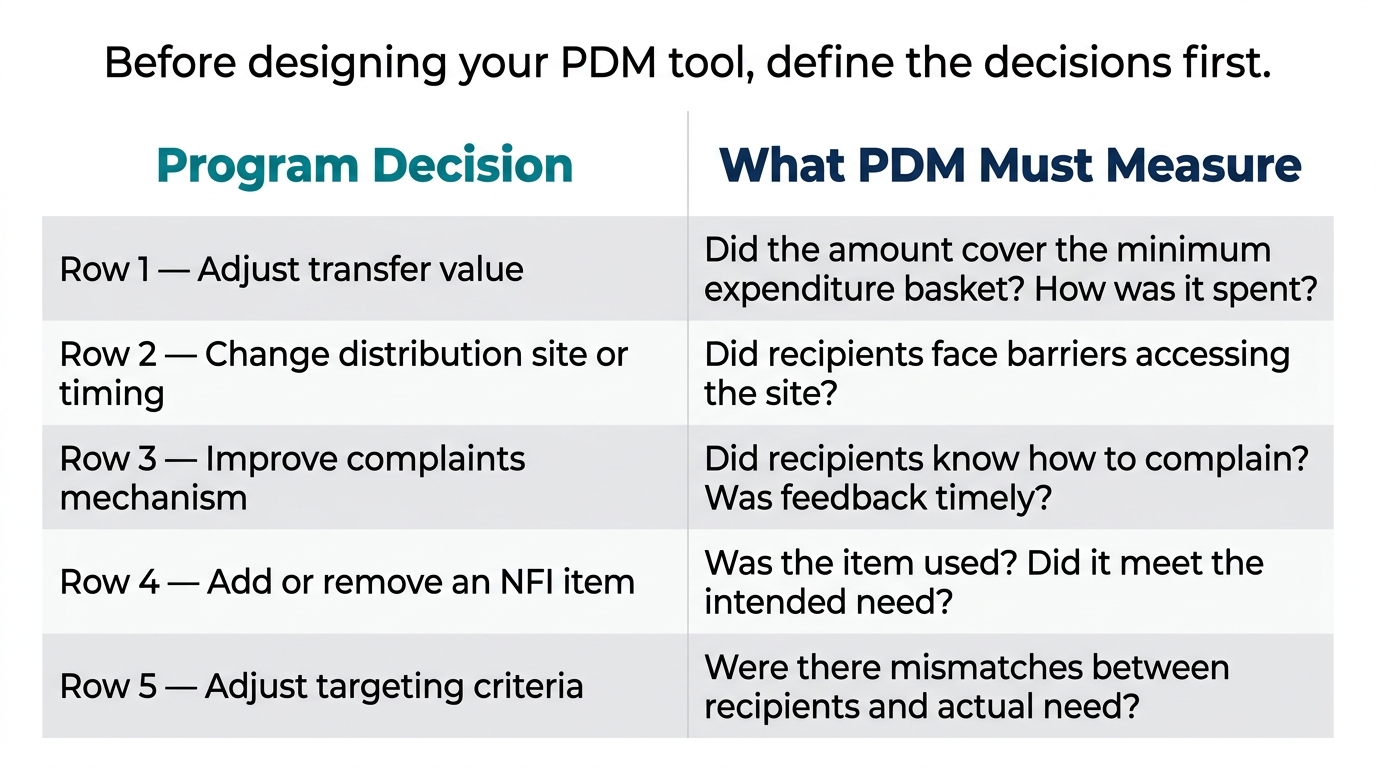
Here is the shift I'd encourage: before you design your PDM tool, write down the three to five decisions that program staff could realistically make based on PDM findings. Not hypothetical decisions, actual decisions that someone has the authority and budget to act on before the next distribution.
For example:
| Decision | PDM question it requires |
|---|---|
| Adjust transfer value up or down | Was the transfer amount sufficient to cover the minimum expenditure basket? What share of it was spent on food vs. other priorities? |
| Change distribution site or timing | What share of recipients reported difficulty accessing the distribution point? What were the main barriers? |
| Improve the complaints mechanism | Did recipients know how to complain? Did those who complained receive a response? How long did it take? |
| Add or remove an item from an NFI kit | Was the item used? Did it meet the need it was intended to address? |
| Adjust targeting criteria | Were there household profiles that received the assistance but didn't need it, or vice versa? |
This table becomes your PDM design brief. Every question in the tool should map to one of these rows. If a question doesn't map, if no one will make a different decision based on its answer, it probably shouldn't be in the survey.
💡 Tip: Share this decision-mapping table with program managers before you finalize the tool. Ask them: "If I bring you data on X, will you actually change something?" Their honest answer tells you which questions belong in the survey and which are wishful thinking.
The Anticipatory Action Lesson
The PDM report from the Anticipatory Action (AA) programme in Bangladesh offers a useful model of what happens when PDM is genuinely embedded in a decision loop [2]. In that program, PDM was part of a Forecast-based Financing cycle: data on multi-purpose cash grant use, mobile money transfer access, and minimum expenditure basket sufficiency fed directly into technical working group discussions about whether the anticipatory action protocol should be triggered differently or with different transfer values.
That context matters. PDM findings changed things because there was a formal mechanism, the technical working group, whose job was to receive findings and act on them. The findings didn't have to fight their way to a decision maker. A decision maker was waiting for them.
This is the structural fix. Not better reports. A standing review process where PDM findings are a scheduled agenda item, not an afterthought.
If you're building a PDM cycle from scratch and want help designing the tool, structuring the analysis, or turning findings into a decision brief, that's exactly the kind of work I do at vera.ignex.io. Drop in and I can help you build it.
From Report to Action: A Minimum Viable Loop
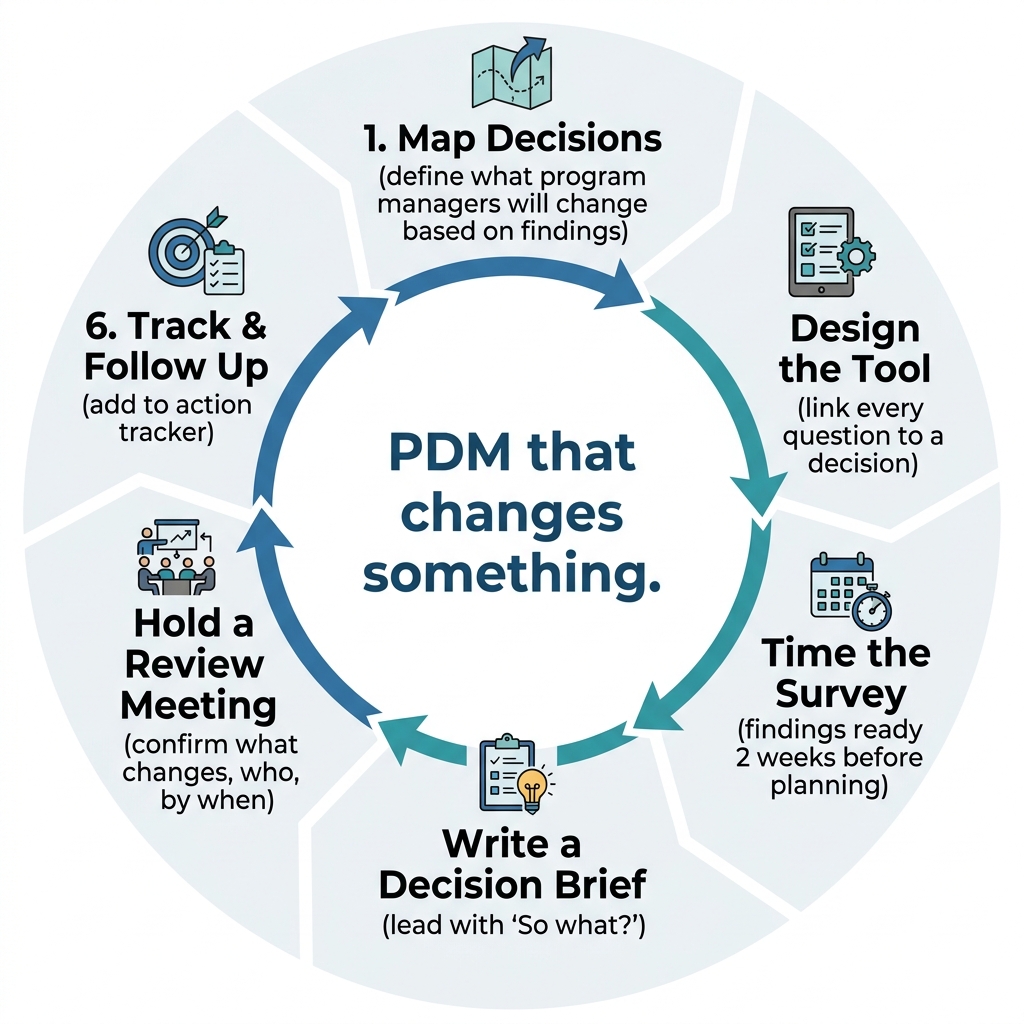
You don't need a sophisticated MEAL architecture to close the loop. Here is the minimum viable version:
- Before fieldwork: Confirm the three to five decisions the program team will make based on findings. Write them down. Share with the PDM team.
- Tool design: Map every question to a decision. Remove questions that don't map.
- Timing: Set the PDM window so findings are ready at least two weeks before the next distribution planning meeting.
- Report format: Lead with a one-page "So what?" brief. Put the key finding and its recommended action in the first paragraph. The full analysis follows for those who want it.
- Decision review: Schedule a 60-minute program team meeting specifically to review PDM findings. Before the meeting ends, confirm in writing: what will change, who is responsible, and by when.
- Track it: Add PDM recommendations to your existing action tracker. Review at the next coordination meeting.
💡 Tip: UNHCR and many coordinating bodies provide standardized PDM indicator sets [1][3]. Starting from a standard set and then adapting to your specific decision points is faster than building from scratch, and keeps you comparable across programs.
The Real Measure of a PDM
The real measure of a PDM exercise is not the response rate or the report quality. It is whether something in the program changed because of it.
That's a harder standard to meet than it sounds. It requires program managers who are genuinely curious about findings, not just compliant. It requires MEAL teams who design for decisions, not for coverage. And it requires organizations that have built the structural habit of reviewing evidence before they plan.
None of that is automatic. But it is designable, and that's the point. PDM that changes nothing is a design failure, not a data failure. Fix the design.
If you want a hand drafting a PDM tool, mapping it to your program's decision points, or structuring a findings brief that actually gets read, come work with me at vera.ignex.io.
Follow Vera for more on MEL & project management: LinkedIn · Instagram · Facebook · X
Sources
- UNHCR Microdata — Post Distribution Monitoring catalog
- Anticipatory Hub — PDM Phase 3 Report, Bangladesh Forecast-based Financing (SUFAL II)
- UNHCR — Post Distribution Monitoring and Outcome Monitoring
- Power BI — PDM Report Dashboard
- The M&E Specialist — What is Post-Distribution Monitoring?
- People in Need — Post Distribution Monitoring for Shelter Programming (First Edition)
Put this into practice with Vera
Build logframes, indicators, surveys and reports in minutes — with an AI made for MEL.
Try Vera free →