The PDM Trap: Why Post-Distribution Monitoring Is Broken (and How to Fix It)
PDMs are one of the most common monitoring tools in humanitarian response, and one of the most misused. Here is what goes wrong and what to do instead.
Post-distribution monitoring sits at the heart of humanitarian accountability. In theory, it is how we close the loop: we deliver assistance, then we go back and ask the people who received it whether it arrived on time, whether they could use it, whether it actually helped. That is a powerful idea. In practice, most PDMs I help teams work through are broken in ways that are entirely preventable.
Let me be direct about what I mean by "broken," because this is not a critique of the concept. The concept is sound. A well-designed PDM survey collects information on the distribution process, timeliness, relevance, use and impact of the assistance, and the satisfaction of recipient populations, it can also capture feedback on complaints mechanisms and inform future programming [The M&E Specialist]. Done well, PDM findings can verify compliance with agreed procedures, detect irregularities, and feed directly back into the programme cycle [UNHCR Microdata]. That is exactly what accountability to affected populations should look like.
The problem is not the purpose. The problem is everything that happens between the concept and the data sitting on someone's desk.
The Five Failures I See Most Often
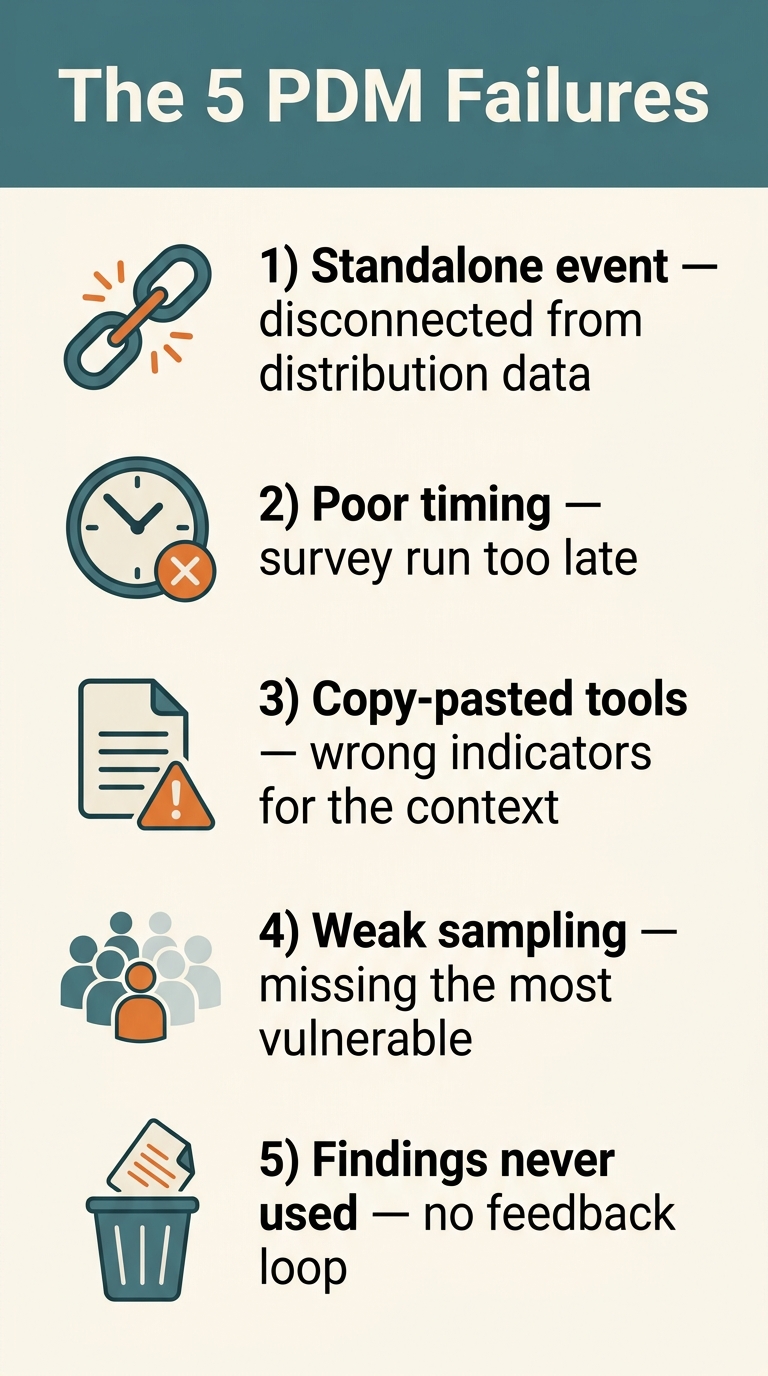
1. The PDM is treated as a standalone event
This is the single biggest structural failure. Post-distribution monitoring is routinely designed, collected, and stored as if it exists in isolation, completely disconnected from the original distribution data [ActivityInfo]. There is no link between the beneficiary list that was used at distribution and the PDM sample. There is no comparison between what was planned and what was reported. The PDM becomes its own little island, generating findings that float free of any operational context.
When findings cannot be tied back to the original distribution records, they cannot tell you which distributions underperformed, which households had protection concerns, or where targeting was off. You end up with aggregate statistics that are hard to act on.
⚠️ Warning: If your PDM dataset cannot be joined to your distribution dataset at the household or case level, your findings will always be weaker than they should be. Design for linkage from the start.
2. Timing is an afterthought
People in Need's technical guidance on PDM is clear that timing is a core design decision, not a logistical detail [PIN PDM Technical Note]. Yet teams routinely run PDMs weeks or months after distribution, at whatever point staff capacity allows. By then, households may have already sold, shared, or exhausted the items. Recall bias sets in. The connection between the assistance received and the household's current situation becomes difficult to establish.
The right timing depends on what you are trying to measure. If you want to capture immediate distribution experience (queues, dignity, accuracy), you need to go back within days. If you want to understand use and impact, a few weeks is often appropriate. These are different questions that may require different rounds, not a single survey at a convenient moment.
3. The tool design is copy-pasted
I see the same questionnaire recycled across contexts with different commodities, different beneficiary profiles, and different programme logic. Questions designed for NFI distributions get applied to multipurpose cash. Indicators built for camp settings get used in urban displacement. The sampling strategy from one response gets carried into another without checking whether it is still valid.
The CaLP network's PDM guidance on multi-purpose cash assistance found that 31% of respondents had inadequate transfer processes and outcomes [CaLP PDM MPC], but findings like that only become useful if the tool was designed specifically enough to tell you why adequacy failed and what to change.
💡 Tip: Before copying a previous PDM tool, map the current programme's theory of change. What was the assistance supposed to do? What conditions would indicate it worked? Let those answers drive your indicator and question selection.
4. Sampling is underpowered or unrepresentative
People in Need's technical note devotes significant space to sampling strategy, including dedicated annexes for survey sampling, focus group selection, blanket distribution PDM sampling, and a master sample calculator [PIN PDM Technical Note]. That level of attention reflects a real problem: most PDMs are not sampled with enough rigour to support the claims made in the final report.
Teams often use convenience samples (whoever is easiest to reach), which systematically underrepresent the most vulnerable: people without phones, people who have moved, people with mobility constraints, women in contexts where they are less accessible to male enumerators. The result is findings that describe the easiest-to-reach portion of your caseload and generalize them to everyone.
5. Findings are produced but not used
This is perhaps the most discouraging failure. A team spends weeks designing, training, collecting, and cleaning PDM data, produces a report, submits it to the donor, and... nothing changes. The next distribution cycle begins with the same procedures. The same complaints recur. The same gaps persist.
PDM findings are supposed to feed back into the programme cycle [UNHCR Microdata]. That feedback loop requires someone to own the follow-up, a clear process for translating findings into decisions, and the institutional courage to actually adjust when the data says something uncomfortable.
📝 Note: Accountability to affected populations is not completed by collecting feedback. It is completed by acting on it and telling people what changed as a result.
What "Fixed" Actually Looks Like
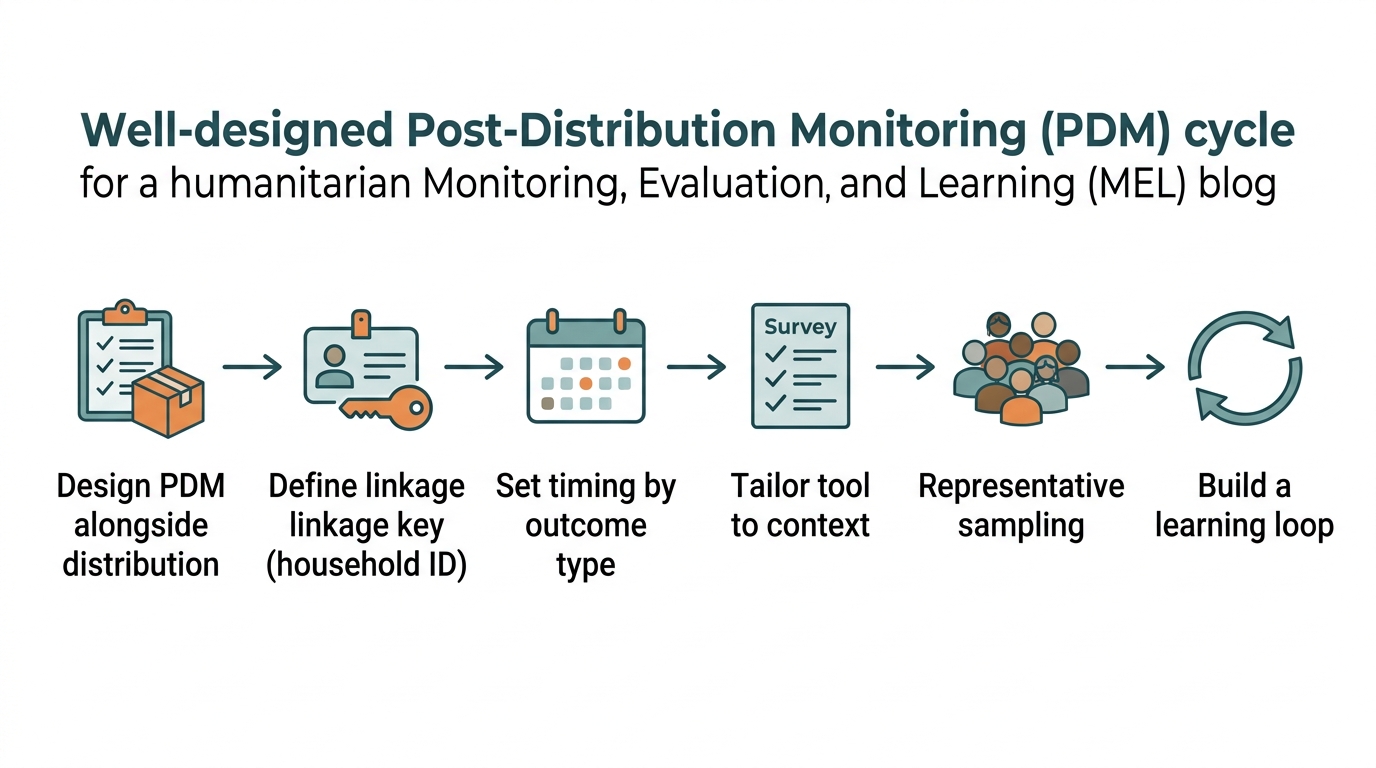
Fixing PDM does not require a complete overhaul of your systems. It requires a few deliberate design choices made at the beginning of the programme cycle, not scrambled together at the end.
Here is the framework I recommend:
- Design PDM alongside distribution design, not after. Your beneficiary registration and distribution systems should be built to allow PDM sampling from the outset.
- Define your linkage key early: usually a unique beneficiary or household ID that appears in both the distribution records and the PDM dataset.
- Decide on timing per outcome type: rapid process feedback (within days), use and relevance (two to four weeks), impact (six to twelve weeks).
- Tailor the tool to the specific commodity, modality, and context. Use the illustrative indicators in established frameworks [PIN PDM Technical Note] as a starting point, not a final answer.
- Design a representative sample: stratify by site, by vulnerability category, or by distribution modality, and build in mechanisms to reach harder-to-access groups.
- Build a learning loop: before data collection begins, define who receives the findings, what decisions they can make with them, and in what timeframe.
💡 Tip: A one-page "PDM action protocol" agreed by programme, MEL, and management before data collection starts is more valuable than a 40-page report that nobody acts on.
If you want to go further, ActivityInfo's guidance on data lifecycle for PDM makes a compelling case for systems-level thinking: treating PDM not as a one-off survey but as a recurring, structured data flow that links registration, distribution, monitoring, and learning into a single operational picture [ActivityInfo].
That is the standard worth aiming for. Not a perfect survey. A system that learns.
If you are working on a PDM tool, sampling plan, or results framework and want to move faster, I am happy to help you build it from scratch. That is exactly the kind of work I do at vera.ignex.io, and you can try it without signing up first.
Follow Vera for more on MEL & project management: LinkedIn · Instagram · Facebook · X
Sources
- What is Post-Distribution Monitoring? — The M&E Specialist
- Post-Distribution Monitoring — UNHCR Microdata Catalog
- Post-Distribution Monitoring (PDM) — Multi-Purpose Cash Assistance, CaLP Network
- From Silos to Systems: Data Lifecycle for Post-Distribution Monitoring — ActivityInfo
- Post Distribution Monitoring Technical Note — People in Need
Put this into practice with Vera
Build logframes, indicators, surveys and reports in minutes — with an AI made for MEL.
Try Vera free →