The PDM Trap: Why Post-Distribution Monitoring Is Broken (and How to Fix It)
Most PDMs collect data nobody uses. Here's what's actually going wrong, and a practical path forward.
Post-distribution monitoring is one of those ideas that makes complete sense on paper. You distribute food, cash, or non-food items to affected populations, then you go back a few weeks later, ask people how it went, and use what you learn to improve the programme. Simple. Logical. Accountable.
So why does it so rarely work that way?
After working with dozens of humanitarian programmes across contexts, I've seen the same pattern repeat itself: a PDM is conducted, a report is filed, and then... nothing changes. The data sits in a folder. The next distribution goes ahead on the same assumptions. The cycle repeats.
This is what I call the PDM trap, and it's more common than most MEL practitioners want to admit.
What PDM Is Actually Supposed to Do
Let me start with the basics, because I think some of the dysfunction starts here, with a fuzzy understanding of purpose.
A PDM aims at collecting affected populations' feedback and gauging their satisfaction with the distribution process and the assistance they received [The M&E Specialist]. That's the feedback dimension. But there's a second, equally important dimension: according to UNHCR's own framework, PDM findings may be used to verify compliance with agreed procedures and detect irregularities, with results fed back into the programme cycle [UNHCR Microdata Library].
Those are two different jobs: accountability upward (to donors and clusters) and learning downward (into programme adjustments). Most PDMs are designed as if they only need to do one. Usually the former.
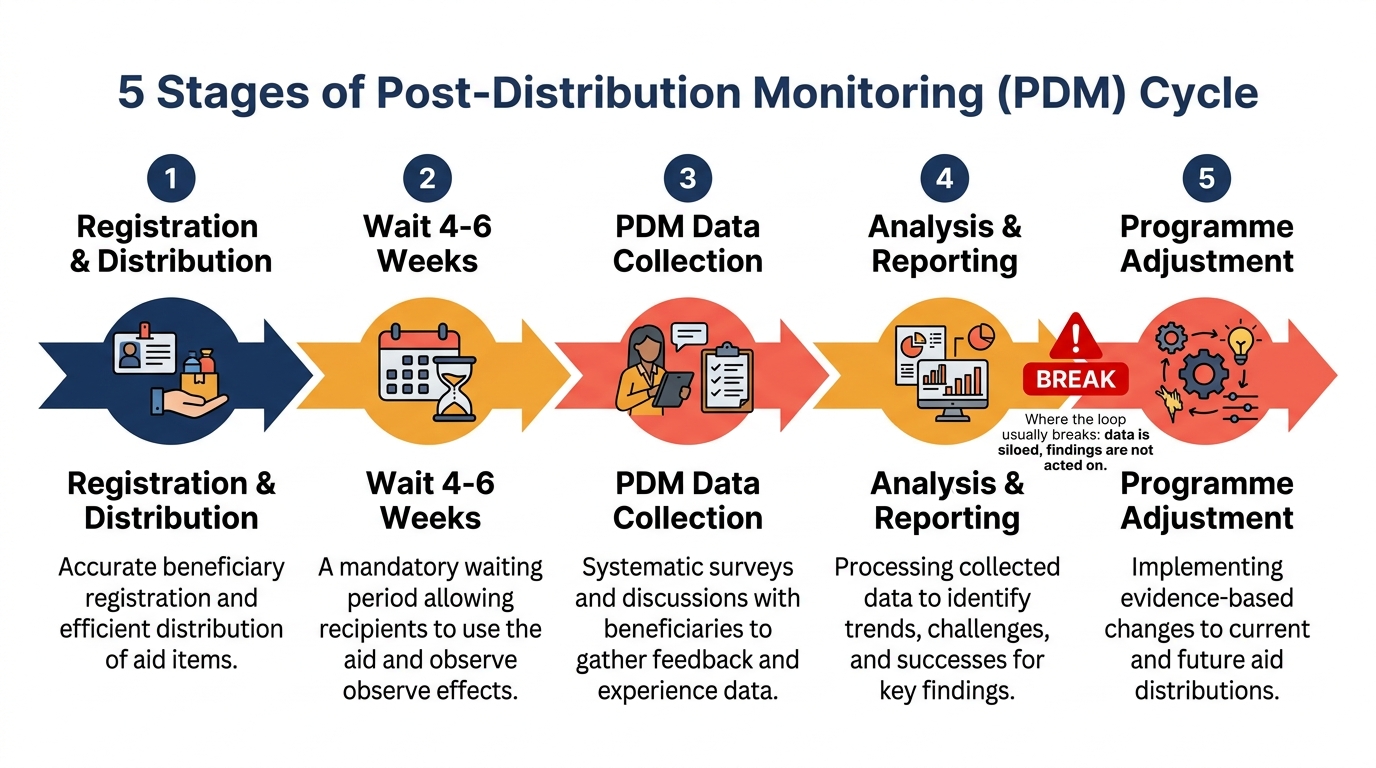
The Shelter Cluster guidance for Somalia, for instance, specifies that a PDM exercise is normally conducted 4 to 6 weeks after a distribution has ended [Shelter Cluster]. That timing guidance exists for good reason: it gives households time to actually use the items or cash they received, so their feedback reflects real experience rather than first impressions. But in practice, that 4 to 6 week window often slips, tools get designed at the last minute, and enumerators go to the field without adequate preparation.
⚠️ Warning: A PDM conducted too early captures first impressions, not actual use. A PDM conducted too late loses recall accuracy and may no longer be actionable for the current programme cycle. Timing is not a minor logistical detail.
The Three Core Failures
1. The Data Silo Problem
This is the one I see most consistently, and it has been documented clearly: post-distribution monitoring is often treated as a standalone survey that is completely disconnected from the original distribution data [ActivityInfo].
Think about what that means in practice. You have a registration list. You have a distribution record. Then you have a PDM dataset. Three separate files, often in three separate systems, sometimes owned by three separate teams. Nobody links them. So when a PDM shows that 30% of respondents say they did not receive the correct quantity, you cannot cross-reference that against who actually showed up on which distribution day, which team was operating that site, or whether there were known logistical problems at that location.
The finding becomes a percentage floating in a report, not a diagnostic tool.
2. The Satisfaction Score Trap
PDM questionnaires almost universally include satisfaction questions. "Are you satisfied with the quality of the items received?" "Was the distribution process respectful?" These are useful questions. But when satisfaction scores become the headline metric, everything else tends to get buried.
Humanitarian programmes operate under enormous pressure to demonstrate success to donors. A finding that says "87% of beneficiaries were satisfied" is clean, quotable, and reassuring. A finding that says "34% of female respondents reported they did not feel safe at the distribution site" is harder to put in an executive summary. So it often doesn't make it there.
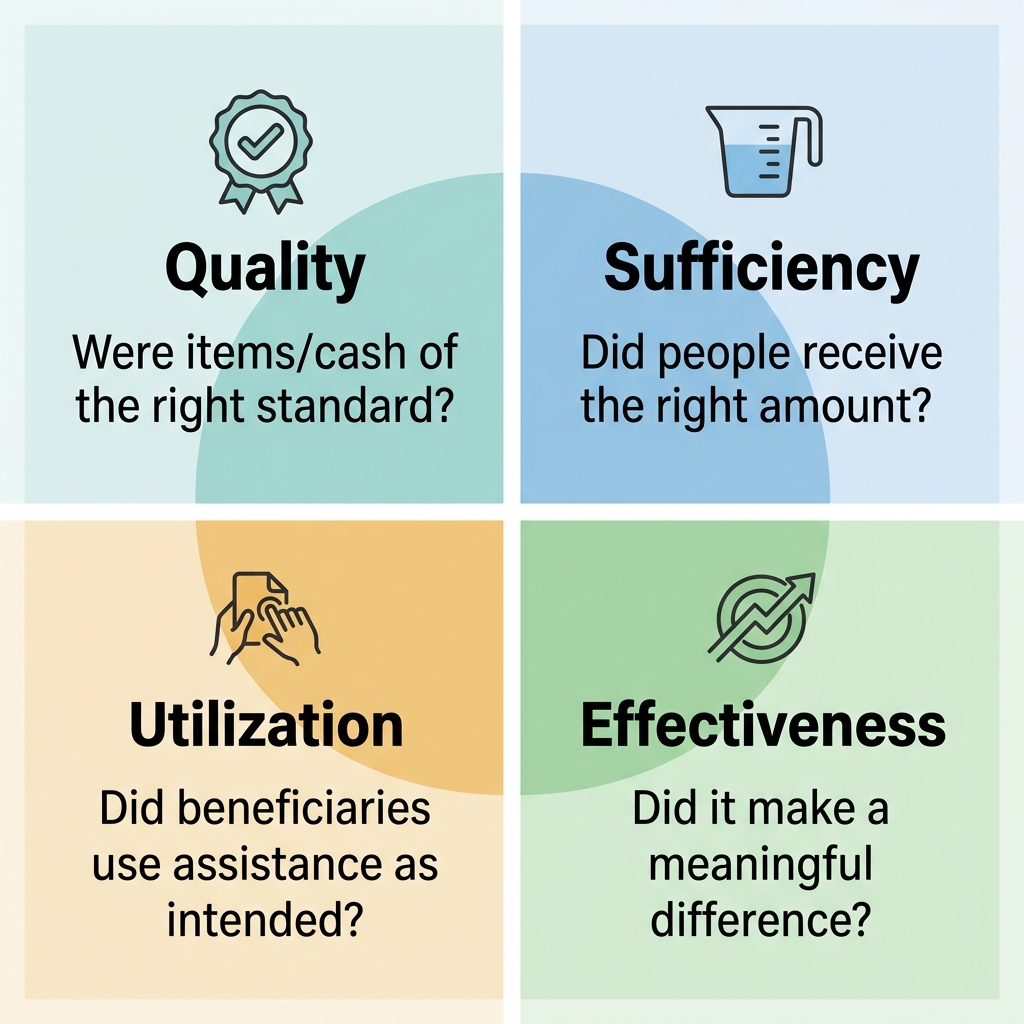
UNHCR's cash-based intervention PDM methodology is more rigorous than most, explicitly tracking quality, sufficiency, utilization, and effectiveness of assistance [World Bank / UNHCR 2023]. Those four dimensions together tell a genuinely useful story. Most field PDMs collapse them into a single satisfaction number.
3. The Tool Design Problem
People in Need's PDM technical note lays out a comprehensive process: methodology selection, tool design, sampling strategy (with separate guidance for surveys, FGDs, and KIIs), enumerator training, validation, and analysis [People in Need, 2021]. That's the standard. And it's a good one.
The reality is that many PDM tools are copy-pasted from a previous project, or downloaded from a cluster resource page and barely adapted. Questions about NFIs get asked in a cash programme. Likert scales get used with populations that have no experience with that format. Sampling is convenience-based rather than statistically representative.
💡 Tip: Before finalizing your PDM tool, ask one simple question for each item: "If this question gives us a concerning result, do we actually have the capacity and authority to act on it?" If the answer is no, rethink whether that question belongs in this tool.
What a Fixed PDM Actually Looks Like
Here's the honest version: fixing PDM is not primarily a technical problem. It's a design and culture problem. But there are concrete things you can do.
Link your data from the start. Build a unique household or beneficiary identifier into your registration, distribution, and PDM datasets from day one. This is not complicated, but it requires planning before the distribution, not after. When your PDM data can be joined to your distribution records, your findings become actionable rather than descriptive.
Design for learning, not reporting. Before you write a single question, decide what decisions this PDM is supposed to inform. If the answer is "the donor report," you'll build one kind of tool. If the answer is "whether we adjust targeting criteria, item composition, or distribution modality for the next round," you'll build a much better one.
Use mixed methods deliberately. The People in Need guidance distinguishes carefully between surveys (for quantitative reach and representative findings), FGDs (for understanding experience and context), and KIIs (for operational and compliance perspectives) [People in Need, 2021]. These aren't interchangeable. A survey tells you how many; an FGD tells you why.
Close the feedback loop visibly. This is the piece that gets skipped most often. If communities see that a PDM was conducted and nothing changed, they stop participating honestly in the next one. Build a short "here's what we heard and here's what we adjusted" communication into your programme cycle. It doesn't need to be elaborate.
📝 Note: Closing the feedback loop doesn't mean acting on every piece of feedback. It means communicating what you heard, what you're acting on, and why, including why some things you heard are outside your control to change.
The Bigger Picture
PDM was designed to be a mechanism for accountability and continuous improvement in humanitarian response. When it works, it does both: it catches irregularities before they become scandals, and it gives programme teams the evidence they need to make smarter decisions in the next cycle.
When it doesn't work, it's a compliance exercise that consumes field staff time, generates reports nobody reads, and gives affected populations the impression that their feedback disappears into a void.
The good news is that the fix is largely within reach of any MEL team willing to invest a bit more thought at the design stage, before the distribution happens, not after.
If you're working on a PDM right now and want help designing a tool that actually connects to your distribution data, builds in appropriate sampling, and produces findings you can act on, that's exactly the kind of work I do. Come try it at vera.ignex.io.
The data your communities give you is valuable. It deserves better than a folder.
Follow Vera for more on MEL & project management: LinkedIn · Instagram · Facebook · X
Sources
- Post-Distribution Monitoring — UNHCR Microdata Library
- Post Distribution Monitoring Tool — Shelter Cluster Somalia
- What is Post-Distribution Monitoring (PDM)? — The M&E Specialist
- From Silos to Systems: Data Lifecycle for Post-Distribution Monitoring — ActivityInfo
- Post-Distribution Monitoring of Cash-Based Intervention 2023 — UNHCR / World Bank Microdata
- Post Distribution Monitoring Technical Note — People in Need (2021)
Put this into practice with Vera
Build logframes, indicators, surveys and reports in minutes — with an AI made for MEL.
Try Vera free →